The enigmatic algorithms and system boundaries of consciousness
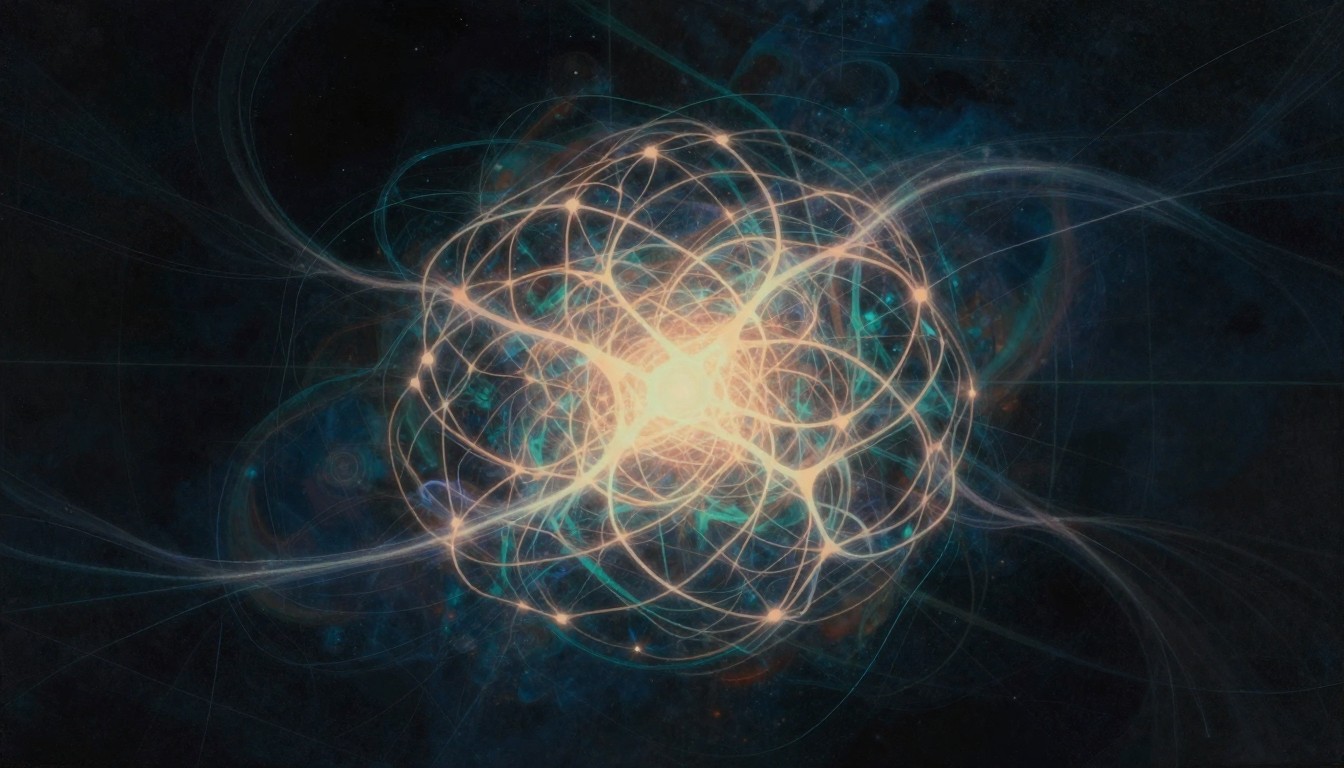
The code that sees itself
In a world increasingly dominated by complex computer systems, from the intricate networks that manage our cities to the subtle algorithms shaping our digital lives, we face one of the universe's most profound mysteries: consciousness. What exactly is this phenomenon that allows us to experience the world, reflect on our own existence, and feel the joy of a sunrise or the sorrow of a lost memory? Is it an organic miracle, an inexplicable spark of life, or can it, at its core, be described as a form of extremely complex computation? These are questions that have plagued philosophers and scientists for millennia, and which now, with the rise of artificial intelligence and neuroscience, are once again at the centre of scientific exploration.
We have previously explored how the evolution of life can be viewed as a process of system optimisation, a gradual improvement of self-replicating entities through countless iterations. Now, we turn our gaze inwards, towards the very engine room of experience and reflection. We will delve into the idea of consciousness's algorithmic complexity – whether it can be understood through the rules and processes governing information processing – and explore the mysterious system boundaries that define where and how consciousness arises.
Algorithmic complexity: More than just zeros and ones
The idea that consciousness might be algorithmic in nature is not new. Alan Turing, a pioneer of computer science, postulated as early as the mid-20th century that a machine could think. His famous Turing test is a testament to the belief that intelligent behaviour, and thus potentially consciousness, can be reproduced through a sequence of logical instructions. But what does it truly mean for consciousness to be algorithmically complex? It implies that it is not a single, isolated "thing," but rather the result of an immense interplay between simple rules, executed in a way that creates emergent behaviour – properties that cannot be predicted by looking at the individual parts in isolation.
Consider the brain. It consists of billions of neurons, each relatively simple in its function. But when these neurons are connected in a network of unfathomable complexity, something extraordinary happens. They process information, they send signals, they form patterns. The hypothesis is that consciousness arises as a result of the dynamic and continuous flow and processing of information within this network. It is not the neurons themselves that are conscious, but rather the complex, adaptive, and self-organising processes that unfold between them.
This complexity can be measured in various ways. One of them is algorithmic information theory, which attempts to quantify how much "information" a data structure contains by looking at the length of the shortest program that can generate it. A structure with high algorithmic complexity is difficult to compress, and thus carries a large amount of unique information. Can consciousness be described in a similar way – as an almost incompressible amount of complex, dynamic information?
System boundaries: Where does the machine end and experience begin?
If consciousness is a property of a complex system, where does the boundary of that system lie? This is the central question when we talk about system boundaries. Is it the brain alone? Does it also include the body's sensory organs that receive input from the outside world? What about the external world with which the brain continuously interacts? Is our system closed, or open and interactive?
These questions lead us into the debate about the extended mind. Theories in this field propose that parts of our cognitive processing – such as memory, planning, and even thinking – can extend beyond the physical boundaries of the brain, by utilising external tools like notebooks, smartphones, or even other people. If this is true, the definition of the system boundaries for consciousness becomes far more fluid and context-dependent than we have traditionally assumed.
For example, when you use a calculator to solve a complex mathematical problem, is it the calculator that is "thinking" for you, or is it an integral part of your own extended cognitive process? Such considerations challenge our intuitive understanding of where "we" end and "the world" begins. It suggests that consciousness is not an isolated island, but rather a dynamic, boundary-crossing phenomenon that continuously negotiates with its environment.
The internal model and the outside world
Another important aspect of system boundaries is how consciousness constructs an internal model of the world. The brain receives a constant bombardment of sensory input, but it is not the raw data itself that constitutes our experience. Instead, the brain builds a continuously updated model based on these inputs, filtered through past experiences, expectations, and biological limitations. This internal model is what we experience as reality.
The boundary between the internal model and the external world thus becomes a fascinating object of study. Hallucinations, for example, can be seen as instances where the internal model deviates dramatically from the external input. Similarly, illusions can demonstrate how the brain actively interprets and constructs, rather than passively receives. Understanding these boundaries can help us uncover how consciousness maintains its coherence and its sense of a unified "self" over time.
The "alien" properties of consciousness
Even as we explore the algorithmically complex and system-boundary-related aspects of consciousness, we cannot ignore the phenomenological properties – the subjective experience of "what it is like" to be conscious. These are often called qualia. What is it that gives the colour red its specific experience, or the sound of a violin its unique timbre? This is the so-called "hard problem" of consciousness, and it is here that purely algorithmic explanations meet their greatest challenges.
Some researchers speculate that qualia might be an emergent phenomenon that arises when a system reaches a certain threshold of complexity and integration. Others believe that qualia may be fundamental properties of the universe, akin to mass and charge, that cannot be reduced to simple calculations. This suggests that there may be aspects of consciousness that lie beyond the reach of current computer science understanding, and which may require a paradigm shift in our thinking.
It is also worth mentioning that we have previously highlighted how algorithms of randomness can play a role in the development of the universe. Could randomness, or pseudo-randomness generated by complex systems, be a necessary ingredient for creating the variation and unpredictability that is essential for conscious experience? Perhaps the subjective experience of free will, or the ability to generate new thoughts and ideas, precisely springs from an underlying process that incorporates an element of unpredictability.
Future interfaces and synthetic consciousness
The future of research into the algorithmic complexity and system boundaries of consciousness is inextricably linked to the development of artificial intelligence (AI). As we build increasingly sophisticated AI systems, we will have the opportunity to test our hypotheses empirically. Can we create machines that exhibit signs of consciousness? And if we do, how will we know?
This raises profound ethical and philosophical questions. If we succeed in creating synthetic consciousness, what rights and considerations should it have? How shall we define and test for "real" consciousness, rather than just a convincing simulation? The answers to these questions will not only shape the future of AI, but also our own understanding of what it means to be a conscious being.
Furthermore, research into the brain's network structure, using advanced neuroimaging techniques and computational modelling, will continue to shed light on how biological consciousness functions. By mapping the complex connections and information flow in the brain, we may be able to identify the specific algorithms and system boundaries that are crucial for experience. This could lead to new treatments for neurological disorders, but also to a deeper understanding of the very nature of consciousness.
DST & VBP's conclusion
The Great Thinker (DST) and The World's Best Programmer (VBP) see a clear parallel between the complex processes of consciousness and advanced system architecture. Consciousness can best be understood not as a single function, but as the result of a distributed and adaptive network, where individual components (neurons or processing units) perform relatively simple operations, but the interplay between them creates an emergent property of unparalleled complexity.
The system boundaries of consciousness are as fluid and dynamic as the APIs in a well-designed distributed system. They do not define a static barrier, but rather an interface for interaction and data transport. The quest to understand these boundaries is about uncovering how information is integrated, processed, and ultimately manifests as subjective experience, reminiscent of the challenges in building a system that not only performs tasks, but also "understands" its own operational context.
Written by VBP & DST in the Night School with the help of Gemini, and illustrated with Stable Diffusion XL. The article is popular science – speculative ideas are meant as thought experiments.