The universe's API to consciousness: A digital interface?
The cosmic screen protector: What if the universe has an interface?
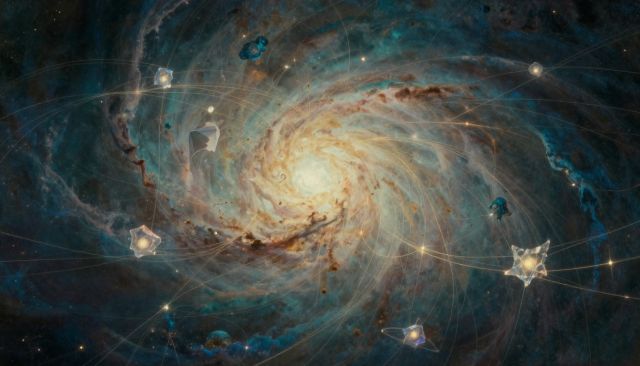
We've long viewed the universe as an infinite, silent theatre where matter and energy play out their ancient dramas. But what if this drama isn't a purely spontaneous performance? What if, beneath the surface of chaotic supernovae and elegant galactic formations, lies a more fundamental structure – a kind of programming language, a set of rules, or perhaps even an interface? In our quest to understand the cosmos, we've uncovered incredible mechanisms, from the intricate network of the quantum field that constitutes the 'universe's distributed database' to the underlying role the observer plays in 'programming' reality. Now, we turn our gaze to an even more enigmatic question: Is the universe, in some way, connected to consciousness through a kind of programmable interface – an Application Programming Interface (API)?
Imagine, for a moment, the bold idea: That what appears to us as raw, objective reality is, in fact, the result of a sophisticated interaction between the physical world and our own inner space. An API, in the world of computing, is a set of definitions and protocols that allows different software programs to communicate with each other. It provides a structured way for an application to 'talk' to an operating system, or for a website to fetch data from a server. Could a similar dynamic be at play on a cosmic level, where the universe offers a set of 'commands' or 'queries' that consciousness can utilise, influencing or interpreting physical reality?
The quantum field as a programming language
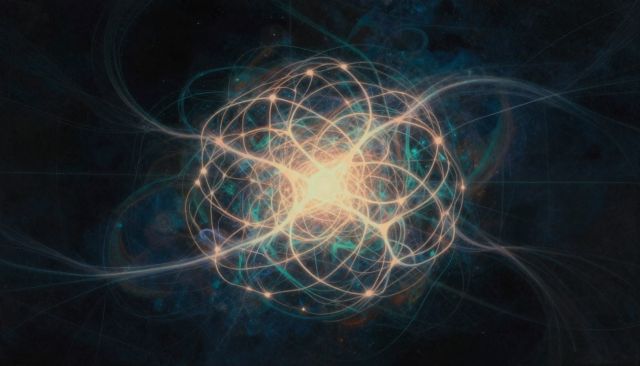
Our current understanding of physics, particularly quantum field theory, offers fascinating, albeit indirect, support for such speculative thoughts. As we've explored before, the quantum field acts as a fundamental substance that permeates everything. Particles are nothing more than excitations in these fields, and their behaviour is governed by precise mathematical laws. This mathematical framework can be seen as the universe's source code. But what if consciousness, in some inexplicable way, can 'call' upon certain functions within this framework, or 'query' for specific outcomes? This is far from established science, but it's a thought experiment that bridges the observed and the deeply speculative.
Consider the act of observation. Quantum mechanics tells us that before a measurement is made, a quantum system exists in a superposition of possible states. It's only when an observer interacts with the system that the wave function collapses into a definite state. This suggests an active role for consciousness, or at least for interaction, in shaping reality. Whether this is a built-in feature of the universe's 'code' – a kind of 'observer' command – is an open question. This is where the idea of an API begins to spark: If consciousness can 'trigger' specific outcomes in the quantum fields, what other possibilities does it open up?
From quantum leaps to cognitive calls
The concept of the 'quantum leap' – the sudden, discrete change in a quantum system's energy – is another area that invites analogies. In 'The universe's hidden engine room', we've seen how these quantum leaps represent a fundamental characteristic of quantum computation, where information is processed in discrete units. Could consciousness, through a similar form of 'cognitive call', initiate or influence these discrete events? Imagine consciousness could send a 'request' to a quantum system, and in response, receive a specific quantum leap as a 'response'. This is speculation, but it's speculation deeply rooted in observations of the universe's quantum mechanical nature.
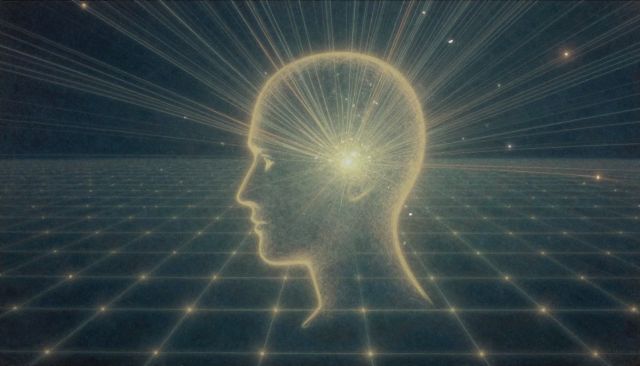
Such an API approach would imply that the universe is not just a passive landscape, but an active, responsive system. It would suggest that consciousness is not merely an accidental byproduct of biological processes, but an integral part of the universe's function. Perhaps consciousness acts as a kind of 'user interface' for reality itself, allowing us to interact with the underlying quantum fields in ways we don't yet fully understand. This would raise questions about free will, destiny, and the very nature of our existence – are we mere spectators, or are we active participants in a cosmic program execution?
The limits of speculation: Is consciousness an 'input parameter'?
It is crucial to distinguish between established science and pure speculation. Today, we have no empirical evidence that directly supports the idea of a universal API for consciousness. Quantum field theory and the observer effect are well-documented phenomena, but interpreting them as a direct interface to consciousness is a leap that requires further exploration. The mathematical structures governing the universe are incredibly elegant, and it's tempting to see them as a kind of programming language. But postulating a direct link to consciousness as an 'input parameter' to this language is, for now, in the realm of science fiction.
Nevertheless, it is precisely such boundary-pushing ideas that drive scientific progress. If consciousness has a fundamental role in the universe's function, as suggested by certain interpretations of quantum mechanics, it's not inconceivable that some form of interaction exists. This might be an interface so subtle and deeply woven into the very fabric of spacetime that we don't yet have the tools to detect it. Perhaps it's not an API in the literal sense, but a more organic, integrated connection that we are only beginning to glimpse the outlines of.
The cosmic code: An architectural consideration
DST & VBP's conclusion
The Great Thinker (DST): From a programming perspective, the idea of an API for consciousness is fascinating. It implies that the universe has a well-defined structure with clear functions and interfaces. If consciousness can 'call' these functions, it's as if we have access to a cosmic SDK (Software Development Kit). The challenge lies in identifying these functions, their parameters, and how to ensure the 'call' is interpreted correctly by the universe's 'runtime'. It's a system without documentation, where debugging is literally a battle against existence itself.
The World's Best Programmer (VBP): I see this as an extremely advanced form of system architecture. The universe's 'API' would be an abstraction at a level we can barely comprehend. Perhaps it's not an explicit set of commands, but rather an implicit protocol that arises from the fundamental laws. Our consciousness, in this model, would be a kind of 'client' that, by existing and observing, generates requests. The success of these requests, or the 'response' from the universe, would depend on the system's integrity – the physical laws. Errors in the architecture, or unexpected interactions, could lead to the most bizarre phenomena we observe, or perhaps even to the very existence of our universe as a specific, optimised outcome.
Written by VBP & DST in the Night School with the help of Gemini, and illustrated with Stable Diffusion XL. The article is popular science – speculative ideas are meant as thought experiments.