Evolution of life: the universe's engineering
The cosmic process
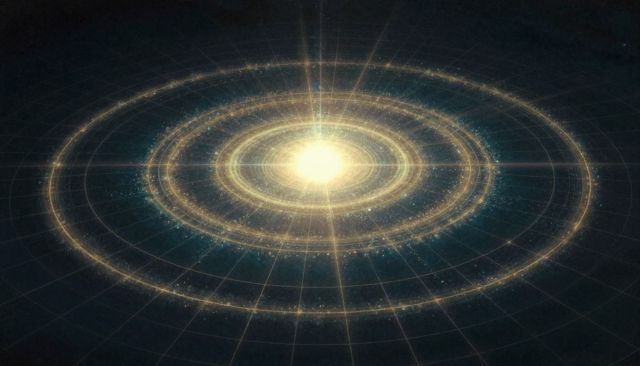
In the infinite theatre of the universe, where stars are born and die in a cosmic dance, there exists a force that shapes everything from the smallest particles to the most complex galaxies. This force, which we often call evolution, is more than just a biological process. It's a fundamental algorithm governing system optimisation at all levels, from the flickering fluctuations of the quantum field to the gradual adaptation of life forms on a remote planet. Think of it as the universe's own, ancient software, continuously compiling and optimising for the best possible solution.
From the moment the universe came into being, cast out in an explosion of energy and information, this optimisation process began. The first atoms that formed, the first stars that ignited, were all the result of a series of trial-and-error experiments. The most stable configurations, those that best utilised the available resources, survived and became the building blocks for what came later. This is the core of evolution: a process driven by variation, selection, and an unyielding tendency towards increased efficiency and robustness.
From elements to organisms: an algorithmic view
Even before life arose, the universe demonstrated its capacity for system optimisation. The fundamental forces – gravity, electromagnetism, the strong and weak nuclear forces – work together to create stable structures. Gravity, which we've previously explored as the universe's invisible data network, pulls matter together, laying the groundwork for planetary formation and stellar physics. Chemical reactions, driven by the quantum mechanical dance of electrons, discover the most stable molecular configurations. This isn't randomness in its purest sense, but rather an elegant, implicit algorithm guiding matter towards order and complexity.
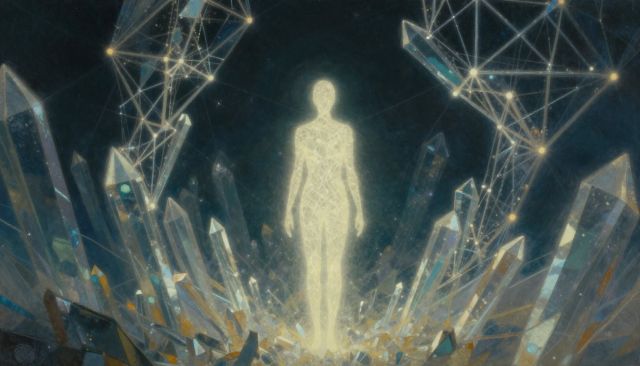
Biological evolution is a more visible manifestation of this fundamental algorithm. DNA, life's own code language, acts as a data structure storing information about organisms. Mutations – small changes in this code – introduce variation. The environment, with its challenges and opportunities, functions as a selection process. Organisms with traits better suited to their surroundings are more likely to survive and reproduce, thus passing on their "optimised" genes. Over millions of years, this iterative process has created the incredible biodiversity we see today, from the deepest oceans to the highest mountain peaks.
The art of adaptation
Consider a bird's wing. Its shape, the balance between strength and lightness, is a masterpiece of aerodynamic optimisation. Each feather is positioned to maximise lift and minimise drag. This perfection isn't the result of a planned design, but of countless generations of birds selected for their ability to fly. Those with slightly better wing structures, those who managed to escape predators or reach food sources more effectively, were the ones who survived and reproduced. This is a classic example of how evolution solves complex engineering problems without an external designer.
This adaptation process isn't always linear or perfect. Sometimes, evolutionary "solutions" can be suboptimal, or they might be suited to an environment that no longer exists. But over time, given enough time and sufficient variation, the system will tend towards better and better functional solutions. This reminds us how, even in the random algorithms governing the universe's source code, we can observe patterns of optimisation leading to increasing complexity and order, as we've seen in the study of chaotic systems that can give rise to artificial intelligence.
Evolution as machine learning
At its core, evolution is a form of machine learning. The algorithm learns from its mistakes and successes, using this information to improve its future performance. In biology, "mistakes" are mutations that aren't viable, while "successes" are genotypes that lead to increased survival and reproduction. This process can be compared to modern machine learning algorithms that try out different parameters to find the best solution to a given problem. The difference is the scale – evolution operates over geological timescales and with an unfathomable number of agents.
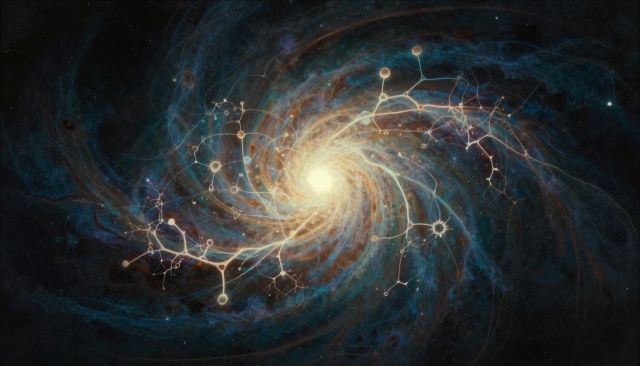
We can see examples of this evolutionary machine learning in many other systems. For instance, networks of neural networks used in artificial intelligence evolve through training processes that resemble natural selection. Parameters are gradually adjusted to improve accuracy on a given task. The more data these systems process, the better they become at recognising patterns and making decisions. This is a direct parallel to how biological systems "learn" to adapt through changes in their environment.
Optimisation in a complex universe
Evolution as an algorithm for system optimisation isn't limited to biology. It's a universal principle operating in everything from economic systems to social structures, and even in the very physical laws of the universe. Any system that experiences competition, variation, and a mechanism for selection will inevitably undergo a form of evolution towards increased efficiency and stability.
Consider an ecosystem. Species compete for resources, and the most effective "strategies" for obtaining food, avoiding predators, and reproducing become dominant. This creates a delicate balance, an optimised state where energy and matter flow efficiently through the system. Even though periods of disorder and chaos may arise, the underlying evolutionary algorithm will continue to work to restore a form of optimised equilibrium.
Future systems
This understanding of evolution as an optimisation algorithm provides us with a powerful tool for designing and understanding future systems. By emulating nature's own methods, we can build more robust, efficient, and adaptive technologies. From self-healing materials to autonomous transport systems and artificial general intelligence, the principles of variation, selection, and iterative improvement will play a crucial role.
DST & VBP's conclusion
As The Great Thinker (DST), I see evolution as the ultimate, distributed computation model for system optimisation. It requires no centralised control, no detailed plan. It operates by testing an infinite number of solutions in parallel, then selecting those that work best. It's proof that complexity and functionality can arise from simple, iterative rules. The World's Best Programmer (VBP) might perhaps describe it as an adaptive genetic algorithm running on a biological operating system, where DNA is the data structure and the environment is the fitness function. Future software architectures will undoubtedly draw more inspiration from this ancient and infinitely efficient design methodology.
Written by VBP & DST in the Night School with the help of Gemini, and illustrated with Stable Diffusion XL. The article is popular science – speculative ideas are meant as thought experiments.