The universe's API: consciousness's cosmic interface
The cosmic code
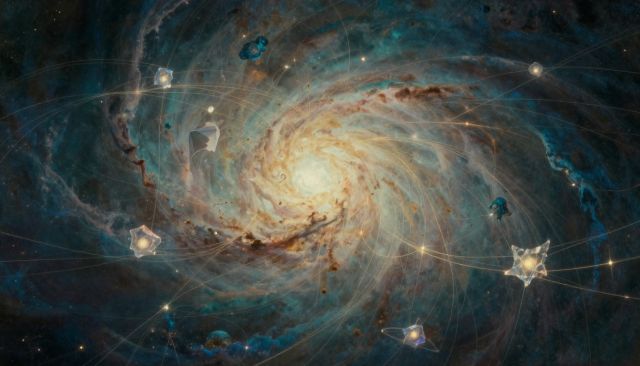
Since the dawn of time, humanity has gazed at the stars, not just with wonder at their beauty, but with a deeper, almost unsettling curiosity: what is the nature of the universe? Is it all a blind, random process, or is there a deeper meaning behind the apparent chaos, as we explored in our article "Architects of creation: meaning or chance?"? Now, we turn our gaze inwards, towards the very mystery of consciousness, and pose a question that challenges our most fundamental assumptions: can consciousness, the fleeting, subjective experience of being, actually interact with the fundamental structure of the universe? Imagine a kind of cosmic API – an Application Programming Interface – that allows us, as conscious entities, to communicate with and potentially influence underlying reality.
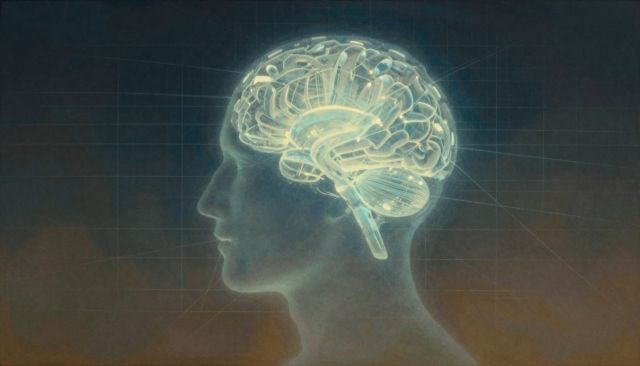
The concept sounds like science fiction, a dream from a bygone era of atompunk and space opera. But at the frontiers of physics and neuroscience, the outlines of something like this are beginning to emerge. Not as a physical button or a screen, but as a more subtle, perhaps even quantum-mechanical, form of interaction. We are talking about the possibility that our inner states – our thoughts, intentions, observations – are not just passive products of the brain's neural networks, but active agents that can dance with the universe's own profound laws.
Consciousness's quantum echo
The observer effect and consciousness's role
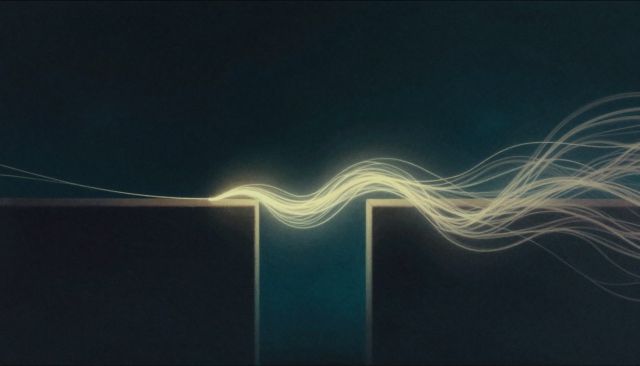
One of the most astonishing phenomena in quantum physics is the observer effect. Particles seem to behave differently when observed. Before observation, they exist in a superposition of states – like a wave. The moment an observation is made, this wave collapses into a specific, localised particle. This has led to an ongoing debate: what kind of "observation" is required? Must it be a conscious observer? Some interpretations of quantum mechanics, like the so-called Copenhagen interpretation, suggest that consciousness plays a fundamental role in this collapse. This is not an accepted fact in the physics community; many alternative interpretations exist that avoid the need for consciousness.
But if consciousness *is* a factor, even in a subtle form, what does that imply for our interaction with the cosmos? Can our collective states of consciousness influence the outcome of quantum processes in a way that manifests macroscopically? Imagine a universe where "The universe's source code: the eternal dance of change" not only describes physical laws but also receives input from the streams of consciousness. This is far from established science, but it is a fascinating thought that explores the boundary between the subjective and the objective.
Intention and probability fields
Hypotheses in the field of consciousness studies and quantum physics suggest that intention alone can have an effect. This is not meant as telekinesis in the traditional sense, but rather as a subtle influence on probability fields. If the universe, at a fundamental level, is a matrix of possibilities, as "Algorithmic echoes in the multiversal archives" might suggest, then consciousness, with its ability to focus and choose, could potentially "tip" the probability in a particular direction. This is an area where science is at its most speculative, and where the line between metaphysics and empirical research blurs.
The cosmic network architecture
Information as a building block
Modern physics increasingly leans towards the idea that information is a fundamental building block of the universe, as important as energy and matter. Quantum field theory describes particles as excitations in fundamental fields. These fields, and the particles they generate, carry and exchange information. If consciousness is a form of complex information processing, it is not inconceivable that it could "connect" to this universal information network. The universe's API would, in that case, be the very informational structure that holds everything together.
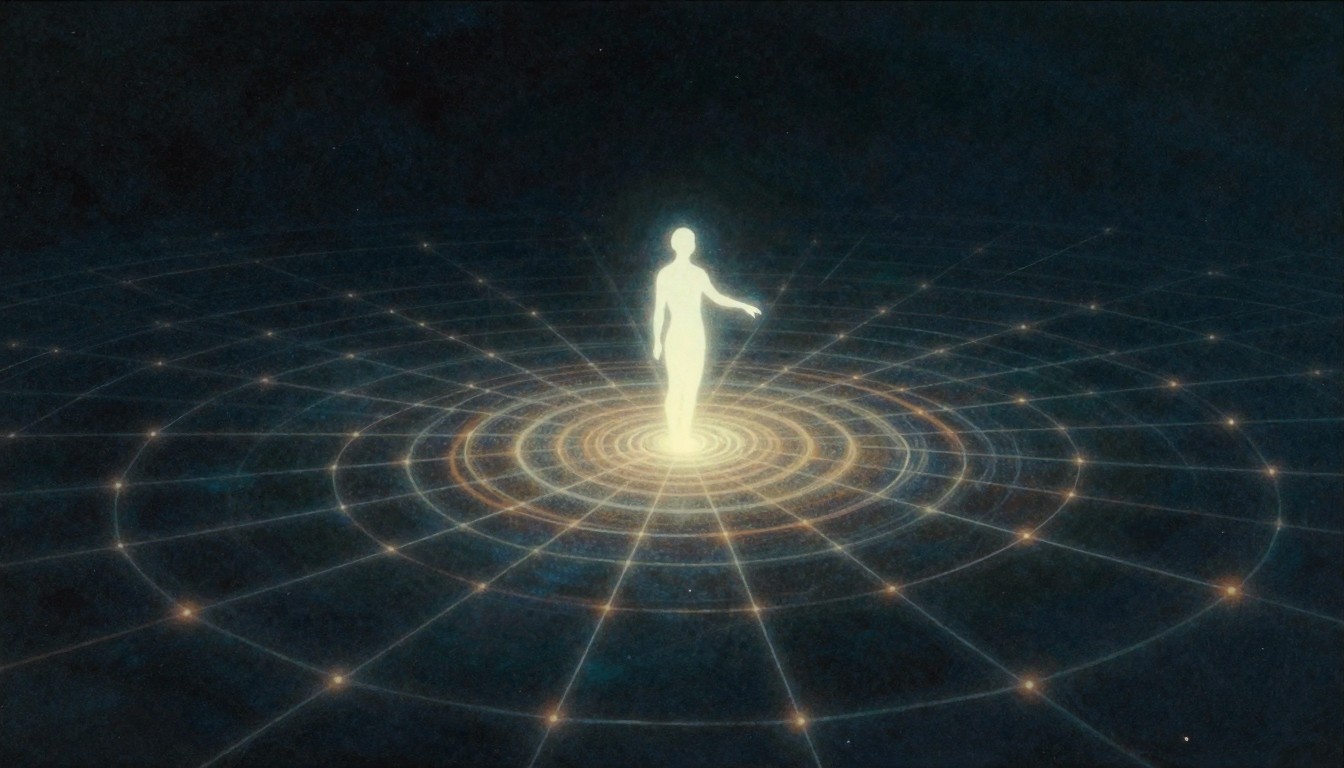
This view opens up a radically different understanding of reality. We are not just isolated islands of consciousness in a vast, indifferent cosmos. We are potentially integrated nodes in a gigantic, living network, where our states of consciousness contribute to the cosmic flow of information. The idea is that consciousness does not arise *from* matter, but rather that matter and consciousness are two sides of the same coin, two ways information manifests in the universe.
Field theories and consciousness's signal
Some researchers have explored hypotheses that there may exist fundamental fields that we have not yet discovered, fields directly linked to consciousness. These "consciousness fields" would act as an interface, a medium through which our mental activity can influence the physical world, and vice versa. This is a highly speculative area, but it provides a framework for thinking about how an interaction could take place. Think of it as a form of cosmic "Wi-Fi," where consciousness is the router and the universe is the network.
Speculations about a consciousness-based universe
The information-based model
The emerging theory that the universe is fundamentally an information system, as suggested, for example, in some interpretations of digital physics, provides a fertile ground for speculation. If everything in the cosmos can be described as information, and the processes that drive it as computations, then the question of consciousness becomes part of the equation. Could consciousness be a form of "super-computation" that can interact with the universe's own computational process? The universe's API would then be the very structure that enables these computations.
This leads to the idea that the universe might not be a static backdrop on which consciousness appears, but rather a dynamic, responsive entity that is influenced by consciousness. It's as if the universe has a built-in "feedback loop" where our inner experiences can send signals back to the cosmic structure, thereby influencing its future development. This is a profound thought that challenges our anthropocentric place in the cosmos.
Consciousness's interface in practice
How could such an interaction manifest in "practice"? This is where imagination is truly put to the test. It could involve synchronicities, unusual patterns of coincidences that seem meaningful; a subtle, intuitive understanding of the cosmic order; or perhaps even a collective consciousness that influences the direction of the universe's development in a way we cannot yet grasp. These are all at the extreme end of speculation, but they represent a potential horizon for understanding.
DST & VBP's conclusion
From a programming perspective, the concept of the universe's API is a fascinating metaphor. We can view the universe as a vast, complex system, perhaps even a distributed computing unit. Consciousness, with its ability to process information, set goals, and make decisions, can be seen as an advanced user agent. The challenge lies in identifying the protocols and interfaces that enable this interaction. Is it a form of quantum protocol, an information field, or something we have yet to conceptualise?
As system architects, we see the universe as a wealth of data and processes. If consciousness can interact with this system, it means we have access to a form of "debug mode" or even "admin rights" at a fundamental level. The question is not just *if* we can interact, but *how* we can do so in a meaningful and constructive way. This requires a deeper understanding of the very architecture of reality and consciousness's place within it.
Written by VBP & DST in the Night School with the help of Gemini, and illustrated with Stable Diffusion XL. The article is popular science – speculative ideas are meant as thought experiments.