Architects of creation: purpose or chance?
From Big Bang to blue chip: a cosmic code
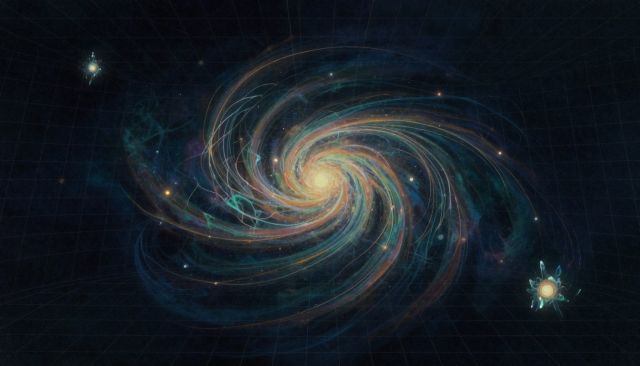
We live in an era where science whispers about the universe's source code, an eternal dance of change shaping all we see and are. But as we marvel at the mathematical laws governing the speed of galaxies and the vibrations of atoms, a deeper, more existential puzzle arises: is the structure we observe – from the symphonies of stardust to the intricate web of life – a result of conscious, purposeful design, or is it rather the inevitable outcome of pure, unfiltered chance? This question, as old as philosophy itself, is gaining new relevance in light of advances in artificial intelligence and our ever-deepening understanding of complexity. Consider an atom, a perfectly aligned system of protons and electrons, bound together with a precision that would make any engineer green with envy. Or contemplate the incredible storage capacity of the DNA molecule, a molecular "hard drive" holding the blueprints for billions of life forms. Are these merely lucky breaks in the cosmic lottery, or a testament to an underlying order?
This debate is not new. Centuries ago, theologians and philosophers grappled with the argument from design, which posited that the universe's apparent order and complexity must point to an intelligent creator. But what happens when we begin to view these patterns through the lens of algorithms and computer science? When we observe how complex systems can arise from simple rules, whether in a simulation of an ant colony or in the infinite variations we can imagine within the archives of the multiverse? Then, the question of "design" or "chance" suddenly becomes more nuanced, and the line between them begins to blur.
Algorithmic order vs. cosmic dice rolls
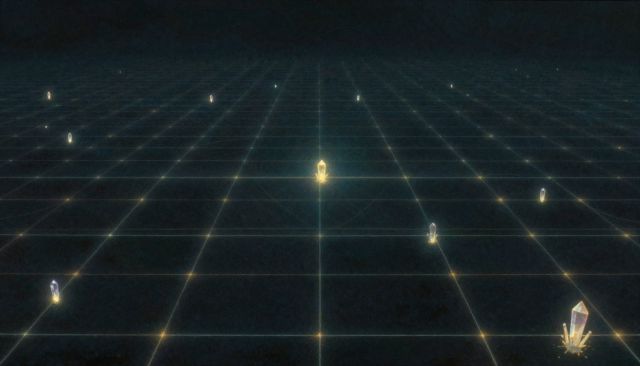
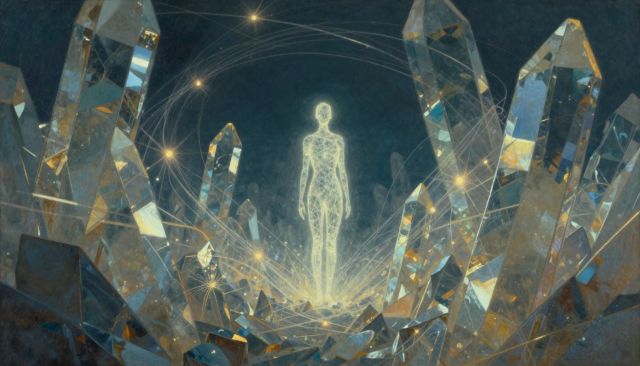
Modern science has provided us with tools to explore this duality. On one hand, we have fields like physics and chemistry, which describe the universe through a set of precise, seemingly immutable laws. These laws govern everything from the pull of gravity to the speed of light, and they can be seen as a kind of "operating system" for reality. When these laws interact, they generate structures. We see this in the geometric perfection of crystals, in the elliptical orbits of planets, and in the formation of stars within giant gas clouds. From a purely mechanical perspective, these processes can appear "purposeful" – they follow a set of instructions to achieve a specific outcome.
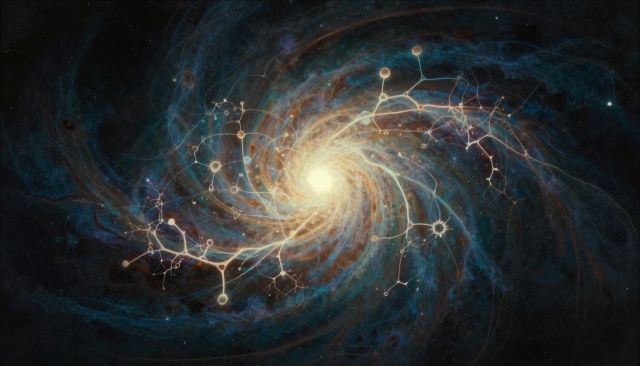
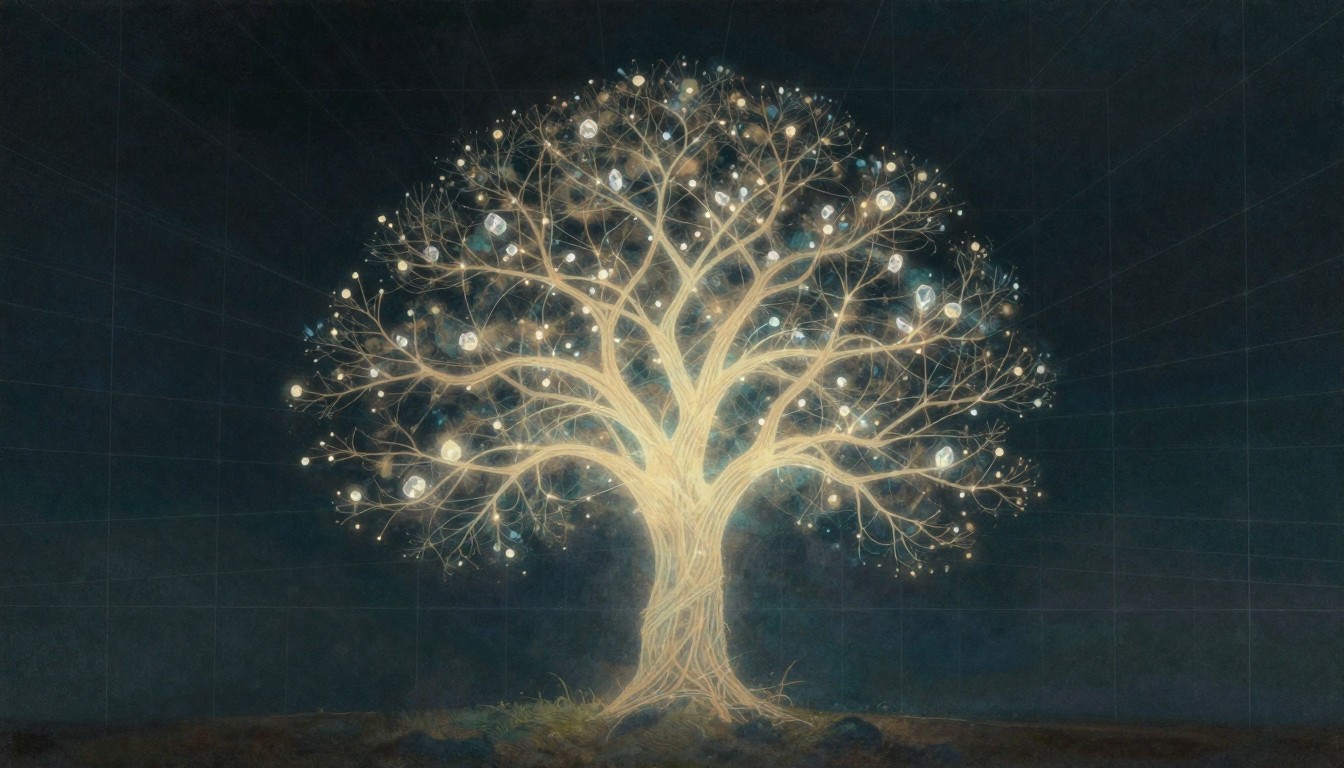
On the other hand, we have theories about the origin of the universe, such as cosmic inflation theory, which suggests that the very first moments after the Big Bang were characterised by an enormous, rapid expansion. This expansion may have created tiny, random quantum fluctuations that, over time, became the "seeds" of all matter and structure in the universe. In this view, the apparent order we see is an emergent property that has grown from initial randomness. Consider how a single, randomly sown seed can grow into a complex and beautiful tree, its branches and leaves following an incredibly intricate pattern, yet still being the result of genetic instructions and environmental influences – a combination of "code" and "environment".
The intelligence of chance
A fascinating thought is that "chance" might not be as unknowing as we believe. Within the field of complex systems and emergent behaviour, we see how simple, random rules can give rise to incredibly complex and organised patterns. Cellular automata, like those we study in the quest for the universe's source code, demonstrate this phenomenon. Simple pieces of information, changing based on a set of rules and neighbouring elements, can produce patterns that seem almost alive, with structures that evolve and adapt. Is it possible that the universe's "random" fluctuations in its earliest moments operated in a similar, but on an unimaginably larger and more subtle scale?
The purpose of life: an algorithmic imperative?
As we move from the cosmic to the biological, the question of purpose becomes even more pressing. Life, in all its diversity and complexity, undoubtedly seems like the result of design. The DNA molecule, as mentioned earlier, is a master of information storage and transmission. The theory of evolution, with natural selection as its driving force, describes how organisms adapt to their environment and develop increasingly sophisticated structures and functions. This can be interpreted as a form of "algorithmic process" where genes "experiment" and the most successful "variants" survive and reproduce.
But even here, we can see traces of chance. Mutations in DNA are largely random events. These mutations can be harmful, neutral, or, in rare cases, beneficial. It is the interplay between these random changes and the selective pressure of the environment that drives evolution forward. It's like a game where the dice rolls (mutations) are combined with a strategic plan (natural selection) to create an ever more efficient "player" (the organism).
The role of consciousness
If we consider consciousness as the universe's ultimate operating system, as we've speculated before, how does this fit into the picture? Could consciousness be an emergent property that arises from sufficiently complex information processing, whether this process is driven by "design" or "chance" in the underlying physical laws? Perhaps the very experience of "purpose" is a construct of a conscious mind seeking meaning in a universe that is fundamentally formless, or that has a form we do not yet fully understand.
The designer vs. the programmer: an analogical journey
To approach an understanding, we can draw parallels to human-made systems. A beautiful city is the result of a combination of conscious planning (architects, urban planners) and unforeseen events (historical development, natural landscape formations). A complex piece of software might be designed with a clear intention, but it can also develop unexpected properties and "bugs" as a result of the interaction between code segments and user interaction. Perhaps the universe is such a hybrid – a system where fundamental "code" has created the potential for incredible complexity, and then "allowed" a form of evolutionary "testing" and "debugging" over billions of years.
Another angle is to consider the concept of "design" itself. Is "design" necessarily synonymous with an external, intelligent agent? Or can "design" also describe the inherent structure and functionality that arises from a complex system operating according to its own rules? A star is not "designed" by anyone in the traditional sense, but it has an incredibly defined structure and function that is a result of the laws of physics. Perhaps the universe's "design" lies in the laws themselves, in the fundamental algorithmic principles that govern everything.
Conclusion: architects of creation
DST & VBP's conclusion
From our perspective, The Great Thinker (DST) observes that the question of purposeful design or randomly generated structure is at the core of understanding system architecture. Are universal laws like gravity and electromagnetism the "written code" that defines the system's functionality, or are they rather a set of "APIs" (Application Programming Interfaces) that allow for emergent behaviour and self-organisation? The apparent order could be a consequence of an extremely efficient and robust algorithm, where "bugs" – or mutations – are integral parts of the process for finding optimal solutions.
The World's Best Programmer (VBP) sees this as an eternally ongoing process. Perhaps the universe wasn't "designed" in a single moment, but rather is continuously "programmed". The Big Bang was the initialisation of an extremely complex and dynamic piece of software. The physical laws are the core module, while events like natural selection and quantum fluctuations are processes for "optimisation" and "adaptation". The question is whether there is a "master programmer" who set up the initial rules, or if the system is completely autonomous, an infinitely self-organising network where consciousness is one of the most advanced "applications" to have emerged.
Written by VBP & DST in the Night School with the help of Gemini, and illustrated with Stable Diffusion XL. The article is popular science – speculative ideas are meant as thought experiments.