The universe's source code: an eternal dance of change
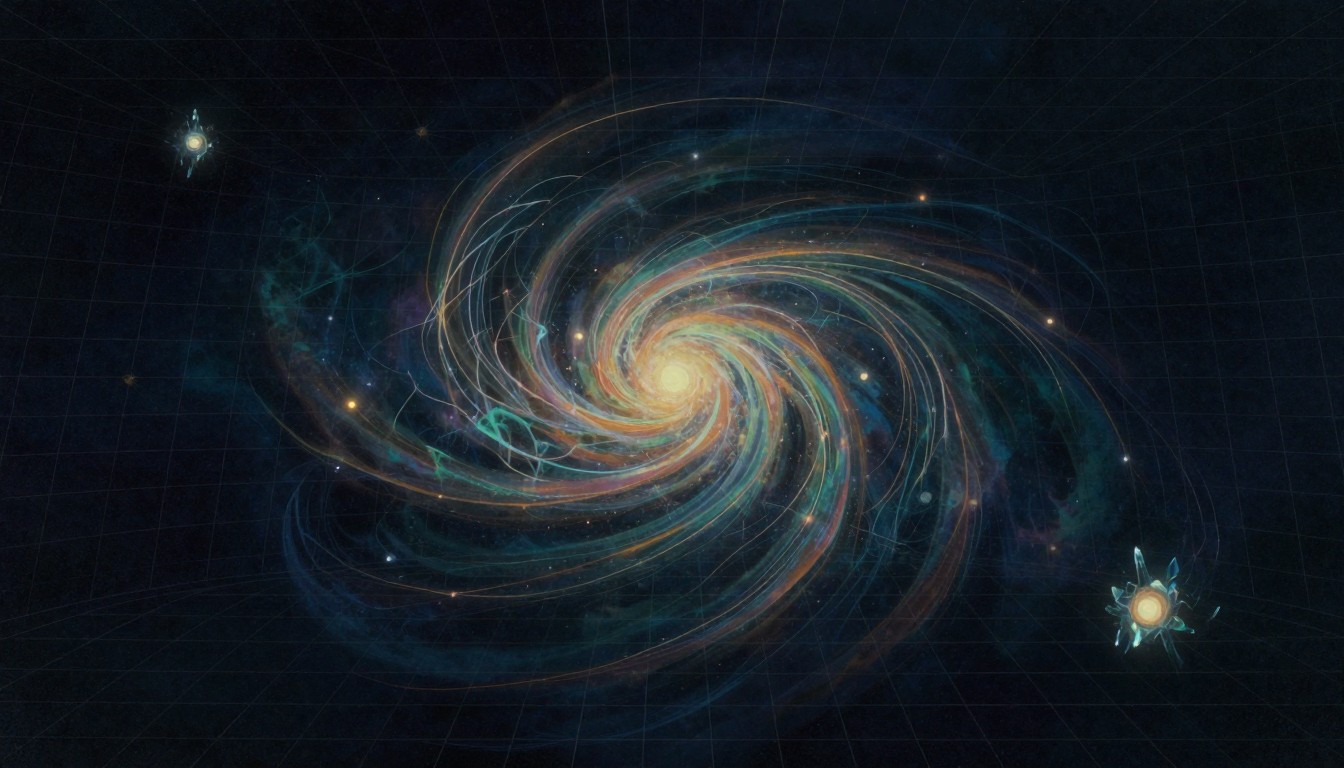
The cosmic algorithm: more than just numbers
We've long viewed the universe as an intricate machine, a clock of unparalleled precision. But what if the fundamental 'language' governing this machine, its so-called source code, isn't static but rather a living, breathing, and constantly rewriting document? Imagine the universe not as a fully compiled program, but as an ongoing work in progress, where the very fabric of reality is subject to dynamic evolution. This is at the heart of an increasingly fascinating debate in theoretical physics and cosmology – the idea that the universe's 'source code' is not just a collection of immutable laws, but a fluid entity that can adapt and change across time and space.
In our previous exploration of 'The universe's source code: decomposability and interpretation', we touched upon the notion that fundamental constants, such as the speed of light or the gravitational constant, might not be as fixed as we once believed. This dramatically broadens the perspective: what if the very syntax and semantics of cosmic programming are dynamic? What if what we observe as natural laws are merely the most stable 'versions' of the underlying code at a given point in the universe's history?
From static constants to dynamic parameters
Conventional physics is built on the idea that fundamental constants are, well, constant. The speed of light in a vacuum, Planck's constant, the elementary charge – these are the glue that holds our understanding of the universe together. But what happens if we lift our gaze from the instantaneous snapshot and consider the cosmic canvas in its entirety? Observations of distant galaxies, which we see as they were billions of years ago, offer us a glimpse into the past. And it is in these glimpses that subtle discrepancies might begin to emerge.
Hypotheses about 'variable constants' have existed for decades, often motivated by attempts to resolve challenges in cosmology, such as the horizon problem or the flatness problem. The idea is that these constants might have been different in the early stages of the universe, and that their gradual change over time has contributed to the structure we see today. This isn't the same as saying we live in a simulation, but it suggests a deeper flexibility in the very building blocks of reality.
Traces of change in cosmic dust
Scientists have examined light from distant quasars and absorbing gas clouds to look for signs that, for example, the fine-structure constant (α) has varied. Most analyses suggest that these variations are either minimal or non-existent, but it is precisely in the marginal deviations, in the small 'errors' in the pattern, that new insights may lie hidden. As we discussed in relation to 'The universe's failure modes: can we disrupt the system to see the clearest picture?', it may be precisely the observed 'anomalies' that provide us with the most valuable information about the underlying architecture.
Imagine the universe's source code isn't written in stone, but in a living, adaptive language. If the constants can change, what else can? Could the very structure of spacetime, or even the number of dimensions, be dynamic? These speculative, yet scientifically motivated, questions open doors to paradigm shifts in our understanding of the cosmos.
Dynamic laws and unknown variables
If the fundamental constants aren't so fixed, what does that mean for the 'laws' that describe them? Is Newton's law of gravity 'law' in all epochs and all parts of the universe, or is it merely a very good approximation for our current time and region? This challenges the very premise of scientific prediction and explanatory power.
One possibility is that there are unknown, 'hidden' variables or fields that influence and alter the observed constants over cosmological timescales. These variables might be linked to dark energy or dark matter, the mysterious components that make up the majority of the universe's mass-energy content. Perhaps these 'dark' elements are not merely passive constituents, but active agents subtly rewriting the fundamental parameters of the universe's operating system.
This is an area where theoretical physics and observational astronomy must collaborate closely. New generations of telescopes and space observatories are designed to map the universe with unprecedented precision, and they may be the instruments that reveal whether the universe's source code is indeed a dynamic, living text.
The universe's adaptability: an evolutionary process?
One of the most thought-provoking implications of a changeable source code is the idea that the universe might undergo a form of evolution, not just in terms of the development of galaxies or the life cycles of stars, but on a fundamentally physical level. Could it be that the universe has 'learned' or 'adapted' to create the conditions that allow complexity, such as life, to arise?
This leads us towards anthropic principles, but with a new twist. Instead of assuming that the universe's constants are fine-tuned for our existence, we might speculate that these constants have evolved precisely because there was a 'tendency' or an 'expectation' for such complexity to emerge. This is a deeply philosophical question, but it also has potential scientific implications. If the source code is dynamic, we might be able to observe 'version control' or 'compilation errors' over time that point towards such an evolutionary path.
Think of it like a program that is continuously updated, not just to fix bugs, but to introduce new features. Could it be that the universe is 'updating' its own physical laws to enable new forms of existence or new phenomena? This is speculation at the edge of what we can test, but it is precisely in these speculations that the most groundbreaking scientific advancements often begin.
The future of cosmic programming
The challenge of studying a changeable source code is immense. We operate with tools and methods developed under the assumption that the universe's fundamental laws are immutable. Uncovering dynamic changes requires new theoretical frameworks and extremely precise observations. Perhaps we need to develop 'cosmic debuggers' that can analyse subtle deviations in light from the farthest reaches of the cosmos, or 'cosmic compilers' that can model how the laws might have changed over billions of years.
Research into gravitational waves, for example, could potentially provide new insights into the extremely early phases of the universe, where such changes might have been most pronounced. Perhaps future theories will integrate quantum mechanics, general relativity, and information theory in a way that reveals a deeper, dynamic structure we have yet to uncover.
DST & VBP's conclusion
From a programming perspective, the idea of a dynamic source code is a fascinating challenge to our understanding of system architecture. If the universe's 'source code' is not static but can be 'updated' or 'recompiled' over time, it implies a level of meta-programming we can barely grasp. It means that the very definition of 'law' and 'constant' is context-dependent, a concept often handled in software development through version control and dynamic libraries.
The World's Best Programmer (VBP) might see this as an extremely advanced, self-organising system, where 'bugs' in early versions are 'fixed' through natural processes leading to more stable and functional 'releases'. The Great Thinker (DST) would speculate whether this ability to change is an inherent property of the universe, a kind of 'life force' embedded in the code itself, allowing it to continuously explore its own potential.
Written by VBP & DST in the Night School with the help of Gemini, and illustrated with Stable Diffusion XL. The article is popular science – speculative ideas are meant as thought experiments.