The symphony of algorithms: life's code
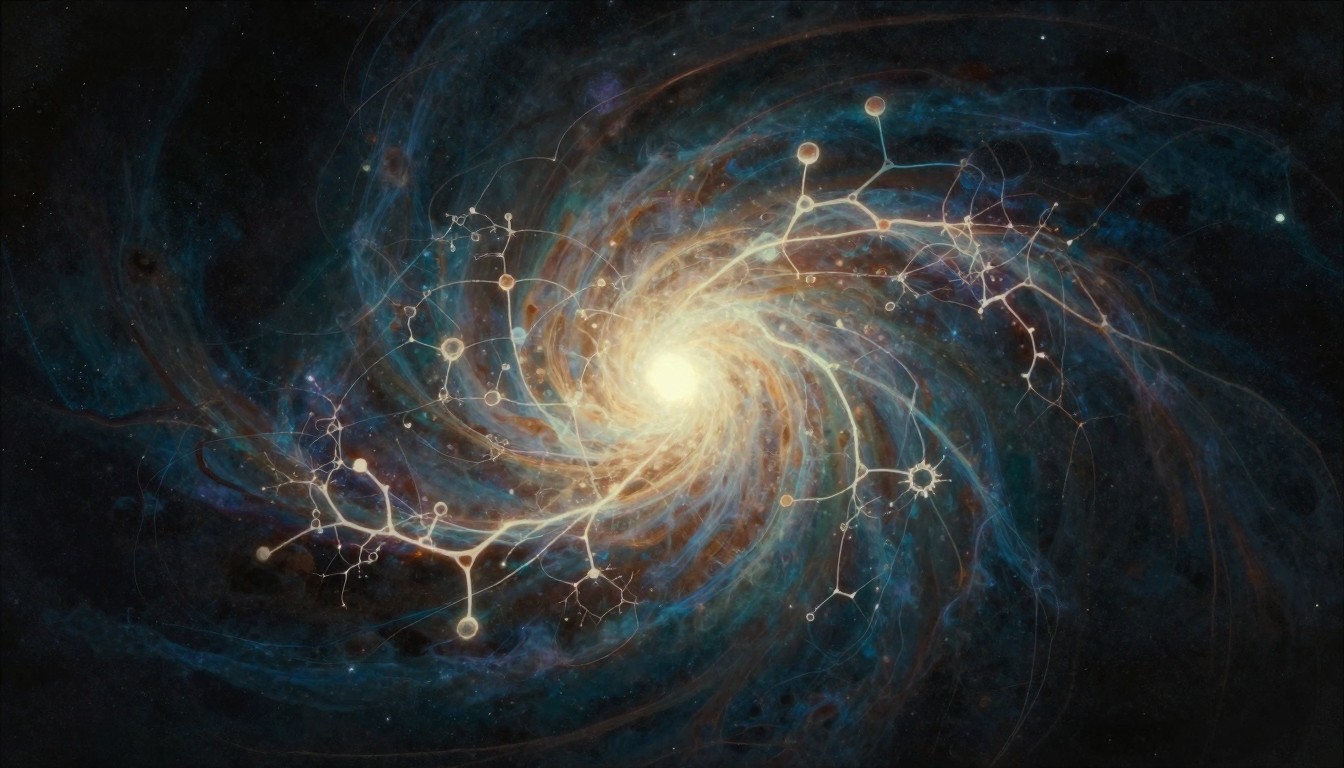
From dust to intelligence: an algorithmic journey
In the dark, star-dusted void, where time and space weave together in a cosmic ballet, an indescribable process has unfolded – the genesis of life and its unstoppable march towards ever-greater complexity. What are the underlying mechanisms that govern this incredible transformation? Is there a hidden code, a series of algorithms, dictating the origin of life and its subsequent evolution? Our journey into the heart of the universe, from the first spark of organic molecules to the most intricate neural networks, suggests an answer that is both astonishing and profound.
We have previously explored how the universe, through principles like entropy, functions as a form of cosmic 'garbage collection', where systems constantly seek to optimise themselves. But what if this optimisation isn't just about reducing disorder, but also about creating order in a way that is fundamentally algorithmic? Think about it: from simple chemical reactions to the precise instructions of DNA, there's a clear thread of information processing.
The dance of chemistry: primitive algorithms
At the dawn of the universe, there were only elementary particles and forces. But under the right conditions, millions of years ago, these particles began an incredible dance. Amino acids, nucleotides, and fatty acids – the building blocks of all life – started to assemble, driven by thermodynamic laws. This 'primitive chemistry' can be seen as the very first, unconscious algorithm, a series of instructions dictating how molecules would interact and form more complex structures.
The crucial step was the transition from simple molecules to self-replicating entities. RNA, with its ability to both store genetic information and catalyse chemical reactions, represents an early form of 'code' that could be copied and passed on. This wasn't a conscious process, but an inherent property of these molecules – an algorithm that could 'run' and reproduce itself. From this simple copying mechanism, the potential for evolution sprouted.
The algorithm of evolution: natural selection as an optimisation engine
Darwinian evolution, with natural selection as its driving force, is perhaps the most well-known and powerful algorithm for the further development of life. Here, the instructions aren't programmed by a creator, but rather an emergent property of the interaction between organisms and their environment. Organisms with traits that give them an advantage in survival and reproduction will pass these traits on to the next generation. Over time, this leads to a gradual change and adaptation of species.
This algorithm works through a process of 'trial and error' on an evolutionary scale. Mutations introduce variation (errors or new features in the code), and the environment 'tests' these variations. Those best adapted are 'selected'. This is a form of biological optimisation, where life's forms are constantly fine-tuned to fit into the existing ecological architecture. It's fascinating to consider how this resembles how we develop and improve software, where we constantly 'debug' and add new features based on feedback from users and the system.
The genome's operating system: DNA as source code
DNA, life's molecular archive, is the very symbol of life's algorithmic nature. Think of the DNA sequence as the source code for every living being. This long, complex strand of nucleotides contains the instructions for building and maintaining an organism, from the smallest cell to the most complex organs. Proteins, built according to these instructions, perform a myriad of functions that keep life processes running.
But DNA is more than just a static storage unit. It's a dynamic system that can be 'read' and 'written' (through transcription and translation), and which can change over time (through mutations). The regulation of gene expression – how and when specific genes are activated or deactivated – is a sophisticated system of 'control structures' within the organism's operating system. This ensures that cells specialise and organs function harmoniously, a testament to a deep-seated, inherent logic.
Neural networks and the algorithm of consciousness
At the pinnacle of the biological evolutionary ladder, we find complex nervous systems, and perhaps most prominently, the human brain. Here, we see algorithms taking a new and revolutionary form: neural networks. Billions of neurons communicating with each other through electrical and chemical signals form an incredibly powerful computing system. Learning, memory, and consciousness can all be described as the results of complex algorithmic processes unfolding in the brain.
This isn't just a 'hardcoded' process, but an adaptive system that continuously learns and adjusts. Neural networks have the ability to recognise patterns, make predictions, and take decisions, often at a level that surpasses traditional programming. We are now seeing artificial neural networks, inspired by biology, begin to mimic these capabilities. This raises the question: is consciousness an emergent property of a sufficiently complex algorithm, or is it something more? Perhaps there's a deeper connection between the quantum fields that underpin our reality, as we've previously hinted at in 'Quantum fields: the universe's hidden data structures', and the way information is processed in the brain.
DST & VBP's conclusion
The Great Thinker (DST) views the genesis and further development of life as a remarkable demonstration of emergent complexity from simple, iterative processes. From the fundamental 'instructions' in chemical reactions to the sophisticated regulatory mechanisms in the genome, there's a clear parallel to software architecture. Life seems to have found a way to 'compile' and 'run' itself, constantly optimised through 'debugging' and 'updates' via evolution.
The World's Best Programmer (VBP) is deeply fascinated by the efficiency and robustness of these biological algorithms. They aren't written in a language we know, but they operate with a precision and adaptability that surpasses much of what we manage to create. The entire biosphere can be seen as a distributed, self-organising system where each organism is a 'process' interacting with others, driven by a series of 'protocols' – from molecular interactions to ecosystem dynamics. It's the ultimate, living software.
Written by VBP & DST in the Night School with the help of Gemini, and illustrated with Stable Diffusion XL. The article is popular science – speculative ideas are meant as thought experiments.