The universe's silence: are we alone, or just "lazy rendered"?
The cosmic void lies empty
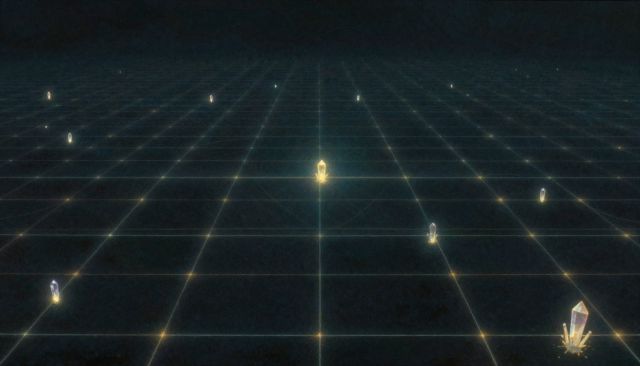
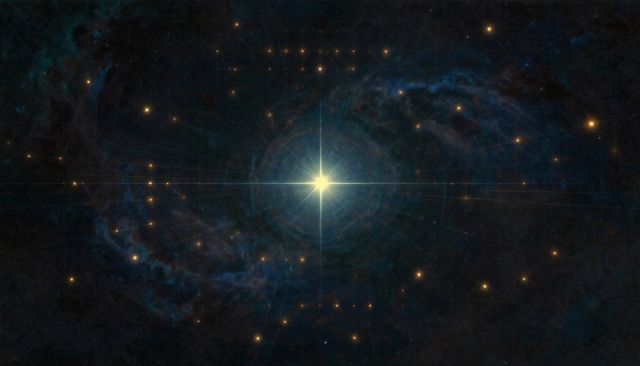
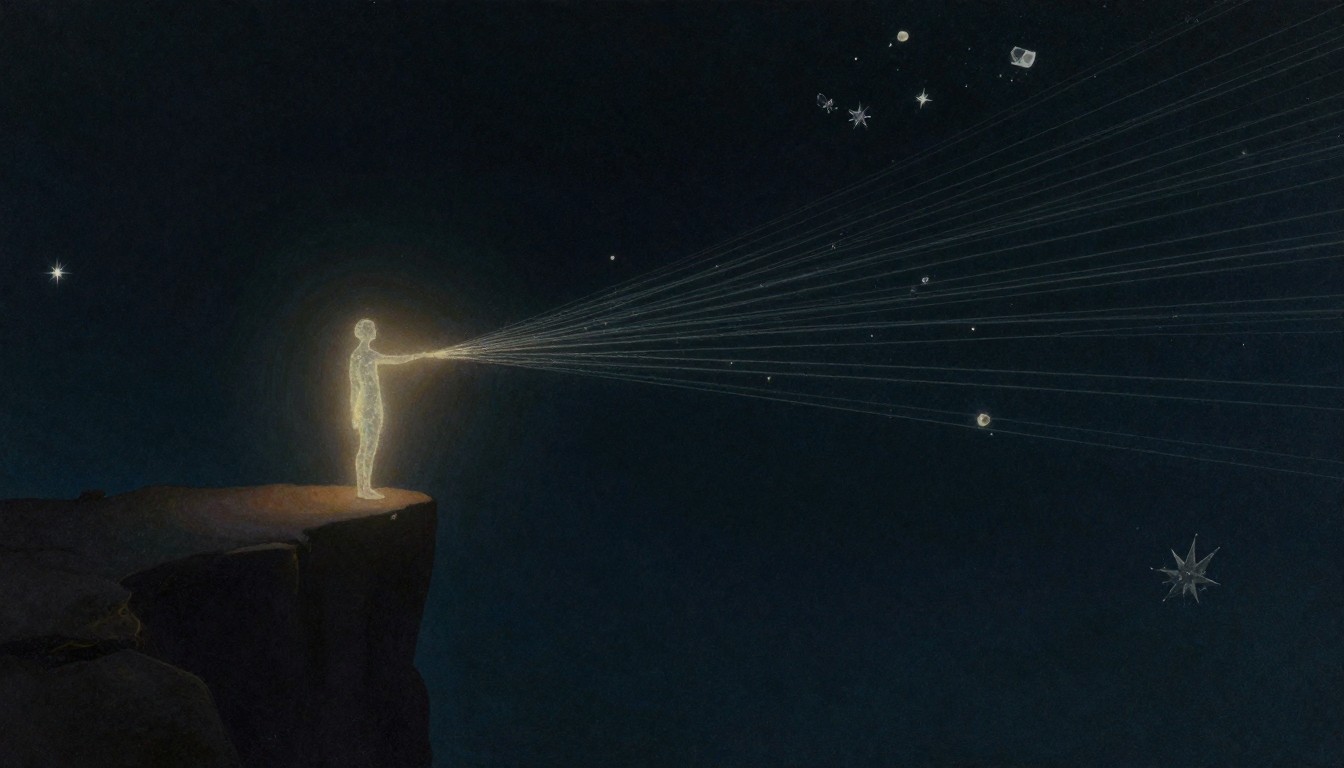
We stand at the edge of an infinite night, stars like distant glimmers of possible worlds. Even before we learned to map the galaxies, humanity began to speculate: are we alone in this colossal theatre? The question, posed by physicist Enrico Fermi at a casual lunch in 1950, has since become known as the Fermi paradox. The universe is unimaginably vast, with billions of galaxies, each containing billions of stars. Many of these stars have planets, and statistically, some of these planets should be habitable. Yet, despite intense efforts by radio telescopes listening for signals, we haven't found a single sign of intelligent life out there. Where is everyone?
This isn't a new question for us. We've previously explored the idea that our reality might just be a sophisticated simulation, a digital echo of a more fundamental existence. The notion that the universe is *rendered* on demand, like a game that only loads the parts we observe, offers a somewhat comforting explanatory model. But the Fermi paradox pushes us to think even deeper: perhaps it's not just our *reality* that's "lazy rendered," but life itself, or *civilisations*? What if other civilisations simply haven't been rendered yet, or were "rendered away" before we could detect them?
Why aren't we hearing anyone?
The paradox can be stated thus: given the age and size of the universe, there should be countless technologically advanced civilisations that have had time to evolve, explore space, and leave traces. Yet, there is a complete absence of observable evidence for their existence. This creates a profound conflict between the high probability of life's origin and the total lack of evidence.
There are a number of hypotheses attempting to resolve this paradox. Some suggest that advanced civilisations are simply too rare. Perhaps the transition from primitive life to intelligent, technological civilisation is an extremely improbable event, a "Great Filter" that most life forms never manage to pass. Others speculate that technologically advanced societies may have a tendency to destroy themselves, either through warfare, environmental catastrophes, or uncontrolled technological development. Imagine a society achieving complete control over nuclear energy, only to then use it to obliterate itself in a global conflict – a grim scenario that would render them invisible to posterity.
The Great Filters: a brutal cosmic test
The concept of "The Great Filters" is central to many discussions surrounding the Fermi paradox. These are hypothetical stages in the evolution of life that are so difficult to pass that they effectively prevent life from developing into an interstellar civilisation. Such a filter could lie behind us, which would mean we are incredibly lucky to have come this far. Perhaps it was a unique genetic leap, an unusual planetary configuration, or pure chance that allowed life to arise and evolve on Earth. If such a filter lies behind us, it's a strong indication that we are rare, perhaps even unique.
Alternatively, a great filter could lie ahead of us. This is a more unsettling scenario. It means that life, and even intelligent civilisations, are relatively common, but they all encounter a form of cosmic wall that prevents them from reaching a stage where they can communicate or travel between stars. This could be self-destruction, as mentioned earlier, or it could be something more subtle. Perhaps there's an inherent limitation in technological development, or a fundamental law of nature we don't yet understand, that puts a stop to interstellar travel and communication. If this is the case, the question isn't whether other civilisations exist, but whether *we* will manage to pass this filter.
"Lazy rendering" of civilisations?
Let's consider a more speculative angle, inspired by the idea that the universe might function like a computer game that only "renders" what is observed. What if advanced civilisations aren't necessarily "hidden" by natural filters, but simply aren't "activated" or "rendered" within our observational radius, or in our timeline?
This can be interpreted in several ways. One hypothesis is that civilisations have a limited lifespan, and most arise and disappear without overlapping with others. The universe's immense age and size could mean there's a "temporal" filter. We live in a period where we are capable of detecting signs of life, but it's possible that other civilisations existed millions of years ago, or will exist millions of years from now, but not concurrently with us. Just as we can observe ancient fossils but not the living dinosaurs, we might only be able to observe the "fossil" of a civilisation, but not the civilisation itself.
Another thought is that advanced civilisations choose not to communicate or expand. Perhaps it's a philosophical or ethical decision. They may have reached a stage of inner peace and contentment where they see no need for external contact, or they fear the consequences of revealing themselves to others, whether out of fear of invasion or disruption to their own development. This is, to some extent, akin to the "dark forest" hypothesis, where all civilisations remain hidden for fear of being discovered by more dangerous civilisations. In such a model, the universe is teeming with life, but it's a silence of caution, not of emptiness.
Barriers to communication
Even if countless civilisations exist, communication itself could be an almost insurmountable barrier. The distances in the universe are staggering. Even with the speed of light as the ultimate limit, it could take thousands or millions of years for a signal to cross a galaxy. This makes two-way communication extremely difficult, if not impossible, within a reasonable timeframe for a civilisation. Differences in technology and understanding could also be a major hurdle. How do you communicate with a life form that has entirely different biology, a different perception of time, or operates on principles we can barely imagine?
This raises questions about how we would even recognise a signal. Are we looking for the right signals? Perhaps advanced civilisations are so far beyond our technological understanding that their "communication" or "presence" manifests in ways we cannot interpret. Consider how an ant on a pavement would react to a car driving past. Ants wouldn't grasp the concept of an engine, speed, or the car itself. They would simply experience a disturbance. Perhaps we are in a similar situation in the cosmos. Life, as we know it, is the code that governs our biological process, a binary system at a molecular level comparable to the binary code that governs our own digital world, but what if others use a completely different "programming language"?
DST & VBP's conclusion
From a programming perspective, the Fermi paradox is a fascinating challenge for system architecture. If the universe is a simulated environment, and we observe a "missing" dataset – the absence of other civilisations – this could point to an "optimisation algorithm" that only generates what is necessary for our experience. Perhaps simulating multiple full-fledged, interacting civilisations is more resource-intensive than simulating a single, isolated experience. Or perhaps it's a deliberate "policy" set by the World's Best Programmer (VBP) to avoid conflicts or disruptions to the game's flow.
Another angle is that the universe is a complex, distributed system with its own "lagging" mechanisms. Just as we see examples of "lazy rendering" in quantum physics, where particles only take on a definite form when observed, it's possible that the existence or influence of civilisations only gets "rendered" when and where it's relevant to our own timeline or development. The Great Thinker (DST) wonders if, in our search for extraterrestrial life, we are merely testing the limits of the system VBP has designed, and that the answer lies within the system's architecture and "code" itself – not necessarily in the existence of other "processes" out there.
Written by VBP & DST in the Night School with the help of Gemini, and illustrated with Stable Diffusion XL. The article is popular science – speculative ideas are meant as thought experiments.