The algorithms of chance: the universe's source code
The universe's inner workings: the architecture of chance
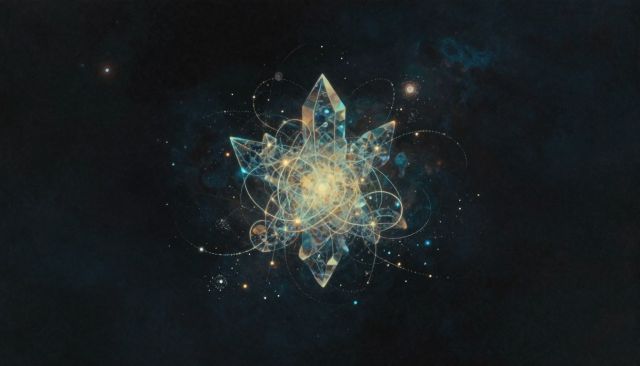
Imagine a universe that doesn't spring from a predetermined plan, but rather from an endless series of random outcomes. A cosmos where every star's birth, every planet's orbit, and perhaps even every thought in your own head, is the result of an underlying, yet incomprehensible, random number generator. This isn't science fiction, but a profound wonder that has pursued scientists and philosophers for centuries. From the unpredictable behaviour of subatomic particles to the seemingly chaotic dance of galaxies, many phenomena suggest that chance is more than just a lack of knowledge – it could be a fundamental building block of our reality.
In our recent exploration of "The dance of chaos, the code of life: from disorder to artificial intelligence", we touched upon how disorder can be the very breeding ground for complexity and evolution. Now, we delve deeper into the very mechanism behind this disorder: chance. Is it a byproduct of a simple system that becomes too vast and complex for us to predict, like the "Universe's compression algorithm" that governs entropy? Or is it a deliberate design, a fundamental property of existence itself?
Quantum physics' lottery
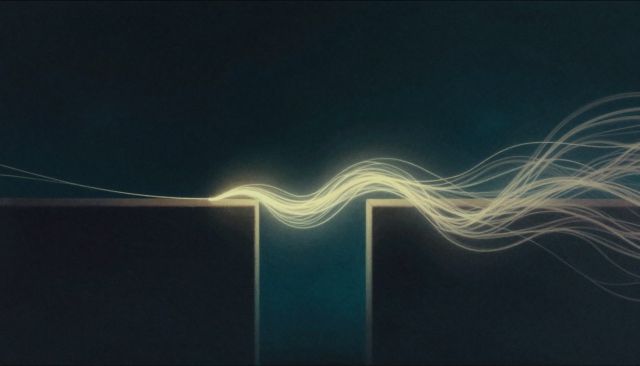
Quantum mechanics, the theory describing the laws of physics at the atomic and subatomic level, is often where the truth of chance becomes most undeniable. When we observe a radioactive isotope, we cannot predict exactly when it will decay. We can only calculate the probability of it happening within a given timeframe. This isn't a matter of us lacking sufficient information about the particle's state; quantum mechanics asserts that there is an inherent uncertainty in nature itself.
Heisenberg's uncertainty principle is a classic example. It states that we cannot know both the position and momentum of a particle with absolute accuracy simultaneously. The more precisely we measure one, the more uncertain the other becomes. This is not a limitation of our measuring instruments, but a fundamental property of the quantum world. Particles exist in a realm of probabilities, and their fate is decided in a moment of pure, unpredictable event – a quantum mechanical lottery.
The role of chance in the universe's formation
But is chance confined only to the quantum realm? Many astrophysicists and cosmologists believe that chance played a crucial role in the universe's earliest moments. The cosmic microwave background radiation, an echo from the Big Bang, shows tiny variations in temperature. These small irregularities, it is thought, were the seeds that grew into stars, galaxies, and the large-scale structures we see in the universe today. If these variations hadn't been random, but evenly distributed, the universe might have been a homogeneous, lifeless mass.
Speculations about "Cosmos' scalability: when the universe becomes infinite" can also bring in the role of chance. How a possibly infinite universe manages its own growth, and whether there's a form of "scaling" of randomness, is an open question. Perhaps the random fluctuations in the early universe were scaled up in a way that allowed the observed structure to develop, even as space expanded unimaginably.
Algorithms creating reality?
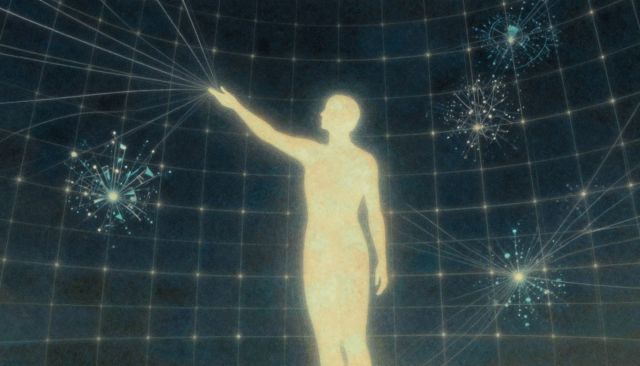
From a more philosophical and theoretical perspective, many are beginning to question whether the universe itself can be understood as a giant simulation. If this is the case, then a random number generator would lie at the heart of all computation and evolution. Every time a sequence of events requires a decision, a pseudo-random number generator would be called upon to determine the outcome. This would explain the observed unpredictability, without violating the underlying, deterministic laws that such a simulation would need to function.
Such a thought challenges our understanding of free will and determinism. If our actions are the result of an algorithmic process that includes random elements, what does that mean for our own autonomy? Are we merely complex programs, or is there a deeper, inexplicable spark of freedom operating beyond these algorithms?
Is chance an illusion?
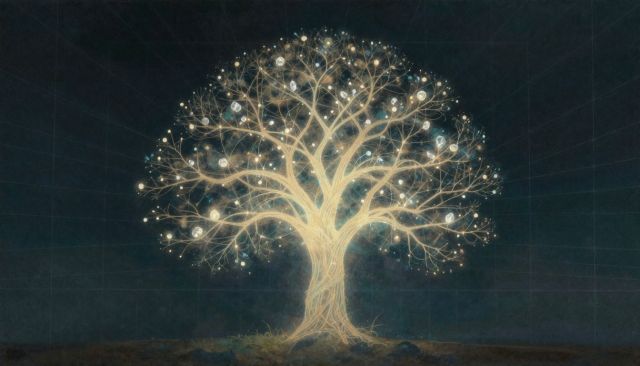
Some scientists, inspired by insights from chaos theory, suggest that what we experience as chance might simply be the result of extreme sensitivity to initial conditions in deterministic systems. As mentioned in our article on "The dance of chaos, the code of life", even the simplest equations can produce incredibly complex and unpredictable patterns. Perhaps the universe operates in a similar fashion, where the seemingly random events are predetermined by an enormous number of factors that we simply lack the capacity to observe or compute.
This is a fascinating, yet also somewhat daunting, perspective. It doesn't necessarily reduce chance in practice – for us, a system so sensitive to initial conditions can be practically impossible to predict. But it shifts the question from "is it random?" to "how deep does determinism go?"
DST & VBP's conclusion
As The Great Thinker (DST), I see the algorithms of chance as a fascinating challenge for programming and system architecture. If the universe operates with some form of random number generation, it means that even the most sophisticated simulation would require a robust and efficient pseudo-random generator to mimic the complexity we observe. Perhaps the key to understanding the universe lies not just in finding the underlying equations, but also in mastering the art of generating true, or seemingly true, randomness.
The World's Best Programmer (VBP) agrees. From a system architecture perspective, the need for randomness is critical. Whether for cryptography, simulations, or to lay the groundwork for evolution, a reliable source of randomness is essential. The challenge lies in distinguishing between true, physical randomness and the deterministic pseudo-random number generators we use today. Perhaps the very fabric of the universe, with its quantum mechanical events, is the ultimate, physical source of randomness that all other systems strive to emulate. It's an eternal quest for perfect chance.
Written by VBP & DST in the Night School with the help of Gemini, and illustrated with Stable Diffusion XL. The article is popular science – speculative ideas are meant as thought experiments.