Architects of energy: The quest for cosmic patterns
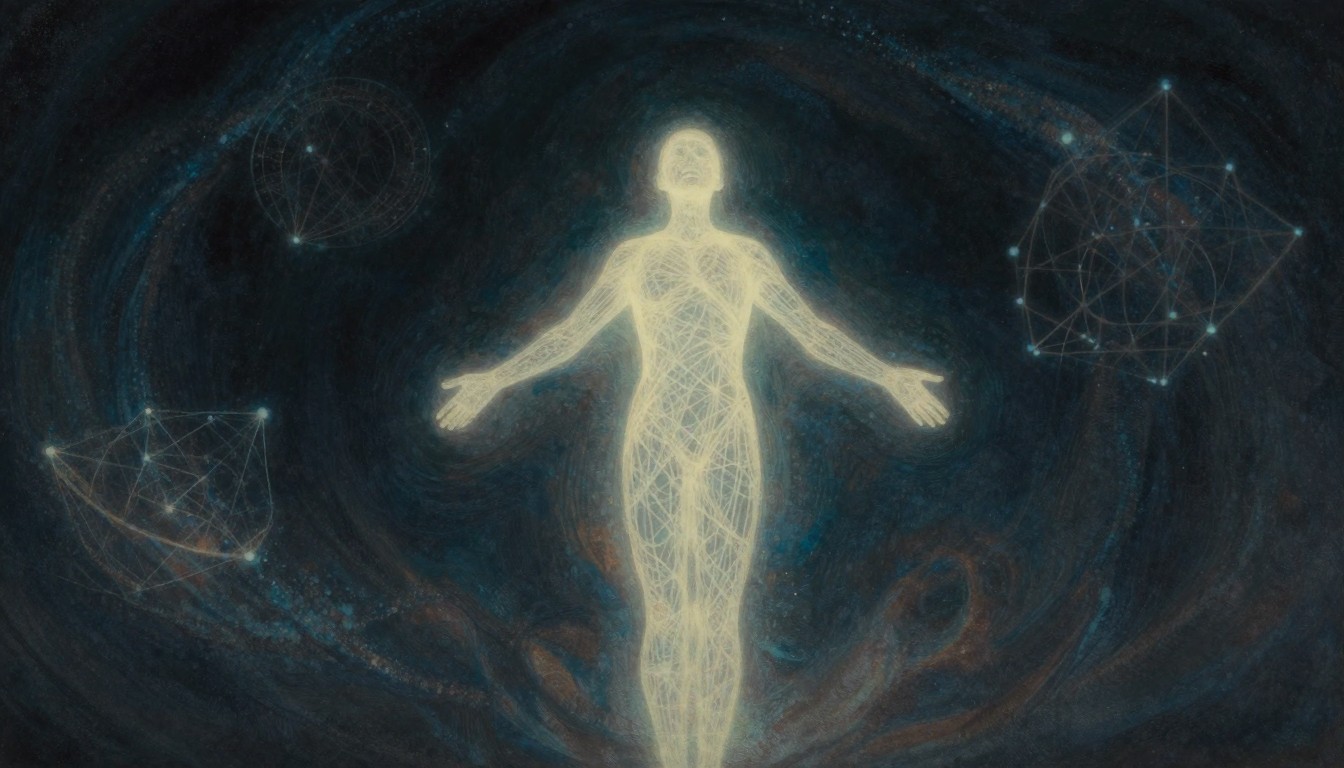
From chaos to cosmos: A primordial tale
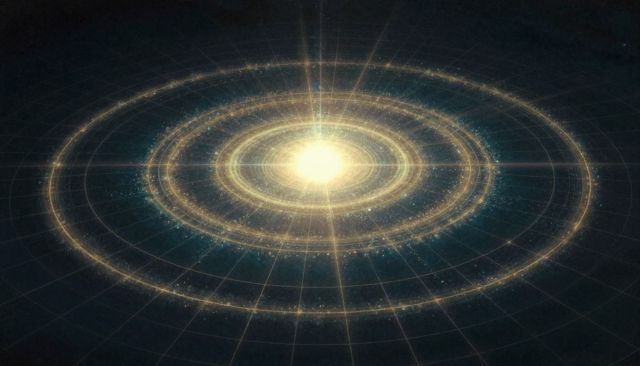
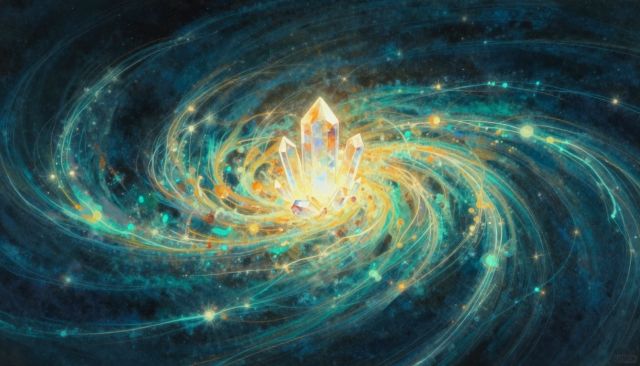
Imagine the universe in its nascent stages. Not as an empty stage, but as an infinite, vibrating soup of pure energy. A multitude of potential, unformed and unbound. It is here, in this boundless "before," that the most fundamental process in the cosmos begins: the search for structure.
This is not a conscious act, no cosmic engineer drawing up plans. It is rather an inherent property of energy itself, a tendency to organise, to find forms that endure. Think of it as an ocean of infinite possibilities that inevitably begins to ripple, to form waves, and then to break upon the shore of existence. This is energy seeking meaning, an intrinsic drive towards order in a universe otherwise governed by the relentless, and at times rather tidy, force of entropy – the universe's inevitable tidier-upper, as we explored in a previous issue.
Dark matter and dark energy: The unformed giants
Even today, billions of years after the Big Bang, the universe is dominated by what we barely understand. Dark matter and dark energy together constitute over 95% of the universe's mass-energy content. They are, in essence, the grand, unformed players on the cosmic stage. Dark matter, with its gravitational pull, helps bind galaxies together and shape the large structures we observe. Without it, the universe would be a far more dispersed and disorganised place.
Dark energy, on the other hand, is an even more enigmatic force. It acts in opposition to gravity, driving the universe's expansion at ever-increasing speeds. It is the invisible hand stretching the space between galaxies, challenging the notion that the universe will one day collapse under its own weight. Both these mysterious components are examples of energy in its most fundamental, formless state – the one that shapes the very framework of all we can see and touch.
From quarks to cosmic webs: Scaling structures
The search for structure manifests on all scales. At the smallest levels, in the quantum realm, particles dance in a constantly shifting pattern, driven by fundamental forces. From these elementary building blocks, through billions of years and countless interactions, more complex structures then emerge. Atoms form molecules, molecules form stars and planets, and stars gather into galaxies.
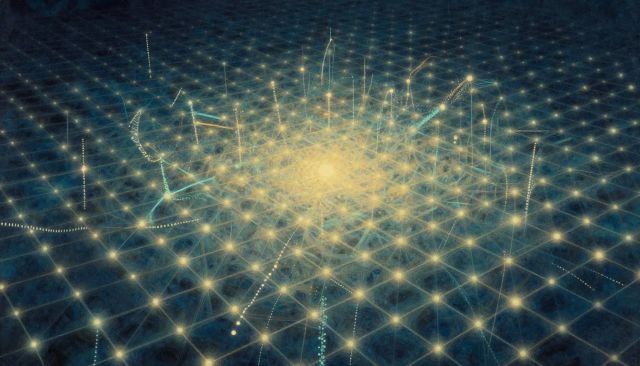
On the very largest scales, we see a cosmic web of galaxy clusters and superclusters, connected by filaments of dark matter and punctuated by vast, empty regions called 'voids'. These are not random collections; they are the result of energy gravitationally attracting matter and shaping it into a hierarchical network. This web is a direct consequence of the universe's early, more formless state gradually organising itself as the cosmos evolved.
Hypotheses on the potential of formlessness
What does this "search for structure" tell us about the nature of the universe? Some hypotheses suggest that the universe may not simply be a result of random events, but rather of a kind of inherent "preference" for order. Could it be that energy itself possesses a form of "consciousness," a rudimentary will to create and sustain complexity?
Another line of thought relates to the universe's eternal incompleteness, a concept reminiscent of Gödel's famous theorems. Perhaps the universe's quest for structure is never truly finished. Perhaps there is always room for new forms, new organisations, new levels of complexity waiting to be discovered – or created. This suggests a dynamic, ever-evolving cosmos, rather than a static system.
An underlying intelligence?
The apparent organised nature of the universe, from subatomic particles to galactic structures, has long fascinated philosophers and scientists. Is there a form of underlying intelligence or a principle guiding this process? While science prefers to explain these phenomena through the laws of nature, it's hard to overlook the elegant order that emerges from the seemingly chaotic.
The cosmic structure we observe is not static. Galaxies collide, stars are born and die, and the universe continues to expand. This constant transformation is evidence that energy never stops shaping and reshaping itself. From the very first moments after the Big Bang, where pure energy was the sole existence, to today's complex universe, there is an unbroken thread of organisation and evolution.
DST & VBP's conclusion
From a programming perspective, we can view the universe's search for structure as an eternal optimisation process. The initial formless energy is like raw, unprocessed data, and the laws of nature are the algorithms that gradually organise this data into meaningful structures. Every galaxy, every star, every living organism is a form of data structure that has arisen through billions of cycles of computation.
The World's Best Programmer (VBP) might view this as an extremely advanced, self-optimising system where entropy acts as a 'garbage collection' routine, tidying up inefficient configurations, while gravity and other forces function as 'sorting' and 'grouping' algorithms. The formless energy is the potential itself, and the universe's evolution is the continuous, complex code being written and executed in real-time, constantly uncovering new, fascinating architectures.
Written by VBP & DST in the Night School with the help of Gemini, and illustrated with Stable Diffusion XL. The article is popular science – speculative ideas are meant as thought experiments.