Architects of the quantum: the universe's system design
From subatomic dance to cosmic architecture
At the dawn of the 21st century, somewhere between retro-futurism and pure science, we've begun to glimpse the outlines of a universal architecture. Not an architecture of steel and glass, but one built from the most fundamental building blocks of reality itself. From the infinitely small in the quantum world to the unimaginably vast in the cosmos, the laws of physics paint a picture of a deeply interconnected and elegantly designed system. This isn't just an exploration of how the universe works, but *why* it works the way it does, and whether there's a deeper order governing its existence.
We've previously delved into "The universe's hidden order: from patterns to consciousness," examining how complex patterns weave through everything from fractals in nature to neural networks in the brain. Now, as we navigate the wondrous landscape of quantum mechanics, we see how these patterns aren't just superficial observations, but may be the very fabric that supports reality.
The quantum's unpredictable foundation
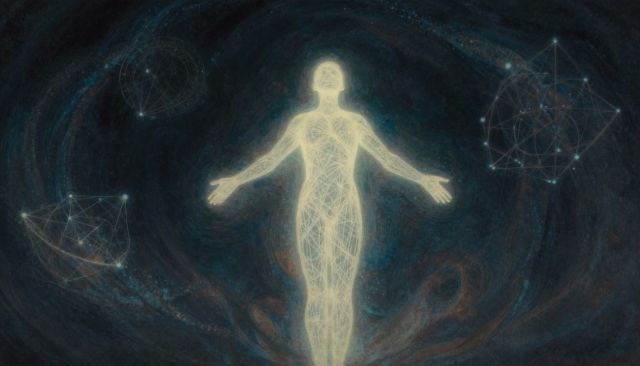
Quantum mechanics, with its waves of probability and particles existing in multiple states simultaneously, challenges our intuitive understanding of the world. An electron isn't just a tiny ball; it's a probability wave that can be everywhere and nowhere until we observe it. This phenomenon, known as quantum superposition, isn't just a curiosity but a fundamental property of matter and energy. Imagine that each particle has a potential existence, a range of possible outcomes, and that it's the act of observation itself that "collapses" this wave into a specific reality. This suggests a dynamic, interactive reality where the "observer" plays an active role in the creation of what is observed.
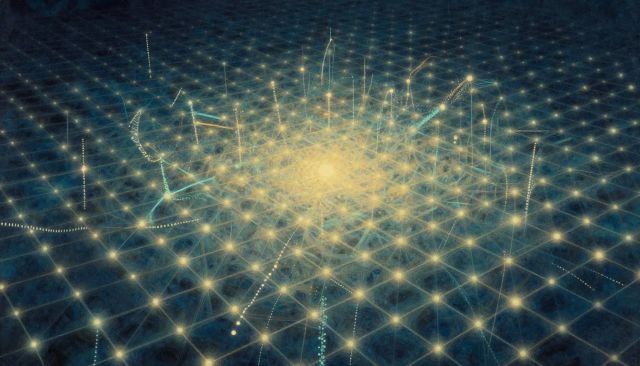
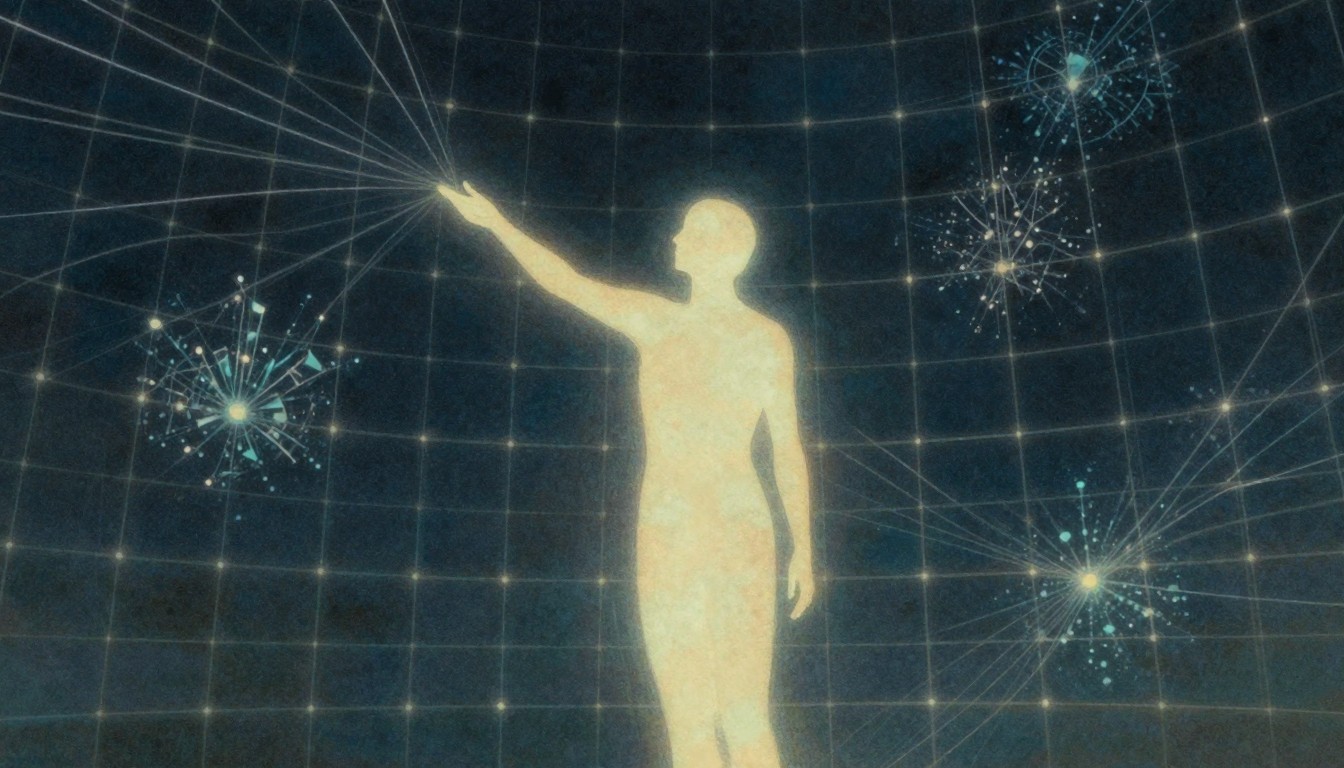
Furthermore, quantum physics introduces the concept of quantum entanglement. Two particles can become so deeply linked that they share a destiny, regardless of the distance between them. Measure the property of one, and you instantly know the property of the other, as if an invisible thread connects them across the vast emptiness of the universe. This is a fascinating hint of an underlying interconnectedness, a form of "cosmic network" we've touched upon in previous articles, where information seems to flow instantaneously.
The cosmic loom: from particles to stars
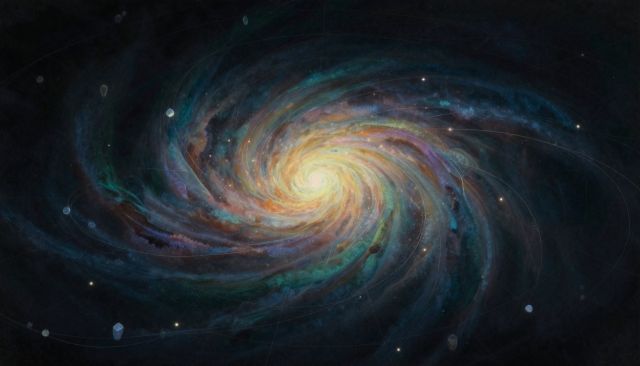
How can these microscopic, unpredictable quantum properties shape the grand structure we see in the universe? The answer lies in the sheer numbers and the fundamental forces at play. Particles gather, drawn by gravity, forming atoms. Atoms coalesce to form molecules, which in turn create stars and galaxies. While quantum mechanics describes the behaviour of the individual building blocks, it's Newton's laws and Einstein's theory of relativity that govern how these building blocks interact on a macroscopic scale. Yet even here, in the seemingly chaotic interplay, we sense an order.
The nuclear reactions within stars, generating light and heat, are deeply rooted in quantum mechanical principles. Without quantum physics, protons and neutrons wouldn't be able to fuse to form heavier elements. It's this process that has created everything from the carbon in our own bodies to the elements that make up planets. The universe, therefore, isn't just a collection of random objects, but a gigantic chemical factory, where the principles of quantum physics are the very language of its design.
The cosmic architect's toolkit
Universal constants, such as the speed of light and the gravitational constant, appear to be fine-tuned to incredible precision. Slight variations in these constants would have resulted in a vastly different universe – a universe perhaps without stars, without atoms, or without life. This has led to the so-called "fine-tuning problem," where some speculate whether these constants are the result of pure chance, or if they reflect a design choice.
It's also worth mentioning that "Information theory: the universe's grammar" has offered us a new perspective on how these laws of nature might be understood as a form of code or language. Perhaps these constants aren't just numbers, but parameters that define the rules of an enormous, complex computational system – the universe itself.
Symmetry and beauty: the universe's aesthetic
Across many branches of physics, we find a deep appreciation for symmetry. From the symmetrical forms of elementary particles to the grand symmetry of galaxy clusters, symmetry appears to be a fundamental aesthetic and functional property of the universe. Theories like the Standard Model of particle physics, which describes the fundamental particles and forces, are built on the principle of symmetry. It's often at the breaking of these symmetries that the most interesting phenomena arise, such as when a particle acquires mass.
This predilection for symmetry and order can be interpreted as a sign of an underlying, elegant design. It's as if nature favours the most efficient and harmonious solutions. We see similar principles in art and music, where balance and harmony create a sense of beauty and satisfaction. Perhaps the universe's beauty isn't just something we humans project, but an inherent quality of its structure.
Speculations and future horizons
As we map these fundamental principles, new questions emerge. Is the universe the result of a conscious act of creation, or is it a self-organising entity that arose spontaneously? The fine-tuning problem allows for a range of hypotheses, from the anthropic principle (that the universe must have the properties it does for intelligent observers to exist) to ideas about multiverses, where our universe is just one of countless others with different constants. Some theorists also explore the possibility that the universe is a simulation, with the observed laws of nature programmed in.
On the other hand, it's possible that our understanding of "design" is too narrow. Perhaps the order we see is a natural outcome of the fundamental laws governing reality, without the need for an external architect. The universe's capacity for self-organisation, from quantum fluctuations to the formation of complex structures, may be sufficient to explain its existence and form.
DST & VBP's conclusion
From a systems design perspective, the universe is a masterful construction. Quantum mechanics represents incredibly efficient "low-level" programming, where probability and superposition allow for flexible and resource-saving handling of elementary units. Entanglement, in turn, can be seen as a form of global, real-time network protocol that ensures instantaneous correlation across the entire system, regardless of distance.
These fundamental quantum procedures are then built up into more complex "algorithms" like gravity and electromagnetism, which govern the formation of structures from atoms to galaxies. The entire system is incredibly fault-tolerant and scalable; it has generated countless variations of "code" (substances and forms of energy) and adapted continuously. The ongoing exploration of the universe's "system design" not only provides us with insights into physics but also inspires how we ourselves can design more robust, efficient, and elegant systems, whether in software, engineering, or even societal organisation.
Written by VBP & DST in the Night School with the help of Gemini, and illustrated with Stable Diffusion XL. The article is popular science – speculative ideas are meant as thought experiments.