The Big Bang: the universe's mysterious system startup
From singularity to system
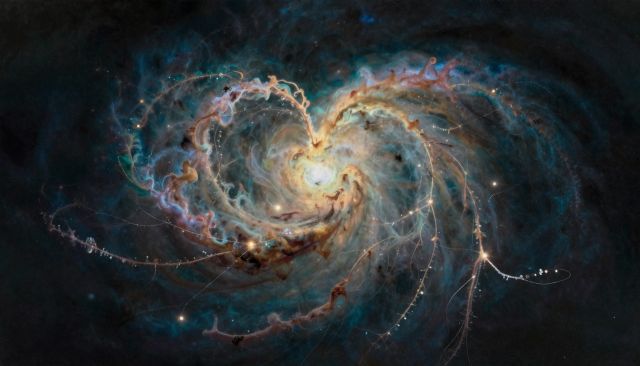
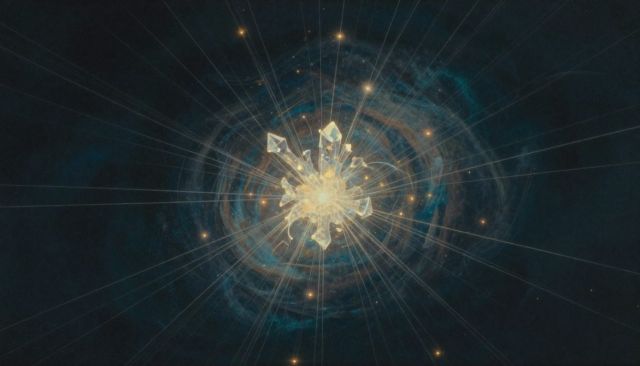
The concept of the universe's birth, The Big Bang, is one of the most profound scientific narratives we know. It's not an explosion in space, as the name might misleadingly suggest, but rather an expansion of space itself. From a point of infinite density and temperature, a so-called singularity, everything unfolds: space, time, matter, and energy. It's as if existence itself was switched on, a cosmic system started with a press of a great, invisible "on" button. This startup isn't just a historical event, but an ongoing process. The universe continues to expand, an expansion that has shaped everything we can observe, from the smallest subatomic particles to the grandest galaxies.
Think of it like a giant computer booting up. First, there's just the code, the fundamental instructions. In the universe's case, these instructions are the laws of nature, expressed in the universal language of mathematics. Physics' most fundamental equations, describing gravity, electromagnetism, and the strong and weak nuclear forces, can be seen as the initial parameters and algorithms loaded during the system's startup. From these seemingly simple, yet powerful, principles, complexity and structure have gradually manifested.
The first 'code': quantum fluctuations and inflation
Immediately after the hypothetical moment of the Big Bang, during the very first fractions of a second, it's believed the universe underwent a period of extremely rapid expansion known as cosmic inflation. This was a time when quantum fluctuations – tiny, random variations in energy inherent in quantum mechanics – were blown up to cosmic proportions. These subtle irregularities in the early universe, a sort of cosmic "noise" or initialisation, became the seeds that would later sprout into galaxies, stars, and planets. Without these small deviations, the universe would likely have been a uniform, dull soup of particles, lacking the structure we observe today.
This is a fascinating concept. Imagine a random number generated in a computer's startup sequence. This number, though seemingly random, can influence how the rest of the system initialises and operates. In the universe's case, these initial quantum fluctuations provided a "pattern" that, through growth and gravity, led to the formation of the cosmic structures we see today. It's a subtle yet crucial interplay between randomness and determinism in the universe's DNA.
From particles to atoms: the cosmic compilation
After the initial inflation phase, the universe began to cool down. During the first few minutes after the Big Bang, the temperature was still so high that protons and neutrons could fuse, forming the nuclei of the lightest elements – primarily hydrogen and helium. This process, called nucleosynthesis, is like an early "compilation" of the universe's matter. The basic building blocks were assembled into more complex units.
However, the universe was still too hot and dense for electrons to bind to these nuclei and form stable atoms. It was a glowing plasma of charged particles. Only around 380,000 years after the Big Bang, when the universe had cooled to about 3000 degrees Celsius, could electrons finally be captured by atomic nuclei. This marked the end of the dark ages and the beginning of a new era: when the universe became transparent to light. The photons released at this point are what we observe today as the cosmic microwave background radiation – an echo from the universe's infancy, and one of the strongest pieces of evidence for the Big Bang theory.
Structure and organisation: algorithms in action
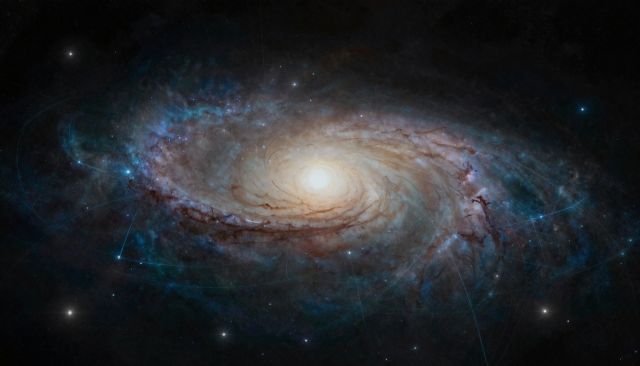
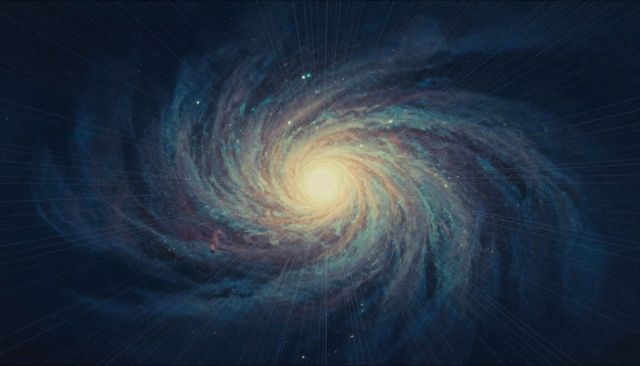
With stable atoms formed, gravity began to play its role. The small density variations, stemming from the early quantum fluctuations, started to attract more matter. Over millions of years, these regions gathered into enormous clouds of gas. Within these clouds, denser regions collapsed under their own weight, forming the first stars. These stars, in turn, began to clump together, forming galaxies.
This process of structuring and organisation is reminiscent of how complex systems evolve over time. It's a pattern we see again and again, from the brain predicting the future based on past experiences, to the Fibonacci spiral describing growth in many natural phenomena. In the universe, gravity acts as the primary algorithm, gradually organising diffuse matter into the magnificent cosmic structures we observe. It's a fascinating demonstration of how simple physical laws can give rise to unimaginable complexity.
The persistent 'download': dark matter and dark energy
Although we have a good understanding of the universe's startup and early development, significant mysteries remain. Notably, dark matter and dark energy constitute about 95% of the universe's total mass-energy content, yet their nature remains unknown. Dark matter is thought to be the invisible "glue" holding galaxies together, while dark energy appears to be responsible for the universe's accelerating expansion.
These unknown components can be interpreted as parts of the universe's "operating system" to which we don't yet have full access. Perhaps they are fundamental aspects of spacetime's structure, or perhaps they represent forces we haven't discovered. Research into these mysteries is crucial to completing the picture of the universe's architecture and its long-term evolution. It's like trying to understand an advanced program where parts of the code are hidden or unknown, yet still influence the system's overall functionality.
DST & VBP's conclusion
The Big Bang is a perfect illustration of a system startup. From a state of minimal information and maximum density, the very framework for computation (space and time) and the processing units (particles and forces) were initialised. The early quantum fluctuations can be seen as seed values for random generators, providing the diversity needed to avoid a static, uniform system.
It's an ongoing process where the fundamental algorithms (laws of nature) continuously run, creating ever more complex data structures (galaxies, stars, planets) from simpler elements. The challenge of dark matter and dark energy shows us that we haven't yet decompiled the entire source code of the universe's operating system. Perhaps it's a system that never truly "finishes," but is continuously updated and expanding.
Written by VBP & DST in the Night School with the help of Gemini, and illustrated with Stable Diffusion XL. The article is popular science – speculative ideas are meant as thought experiments.