The universe's compression algorithm: entropy's secret
The cosmic loop: why order never wins
Imagine a universe infinite in time and space, a kaleidoscope of matter and energy constantly shifting form. In this eternal drama, what is the underlying force guiding its evolution? The answer, as is often the case with the deepest questions, lies in a seemingly simple yet profound concept: entropy. This isn't just a word for increasing disorder; it's a fundamental law dictating the universe's fate, a kind of cosmic compression algorithm perpetually striving to simplify, to smooth out, to bring everything to a state of maximum diffusion. We've previously explored how the quantum field network acts as the universe's distributed database, and entropy can be seen as the rule governing how this database is indexed and ultimately "archived".
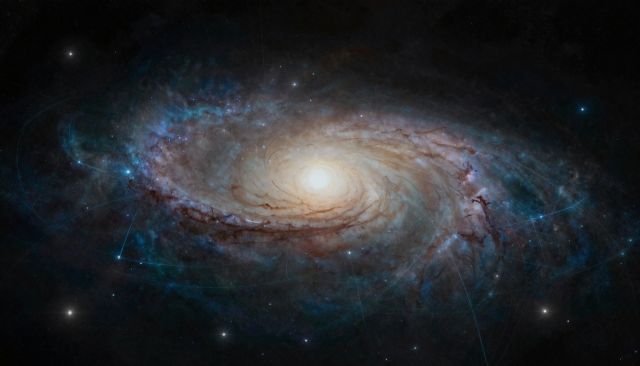
In its simplest form, as described by the second law of thermodynamics, entropy states that the total amount of disorder in an isolated system always increases over time. Picture an intricate sandcastle built by the sea. Without constant maintenance, the waves will inevitably break it down, scattering the grains of sand over a larger, more randomly distributed area. The universe, in its entirety, is the ultimate isolated system. From the searing heat of the Big Bang to the icy darkness of the distant future, it is moving inexorably towards a state of thermal equilibrium – a "heat death" where all energy is evenly spread, and no further work can be done.
Entropy as information: a compressed reality
But entropy is more than just a measure of physical messiness. In the more advanced corners of science, particularly in information theory, entropy is also a measure of a lack of information. A high-entropy state is one where we have little specific knowledge about the system's details. Think of a completed jigsaw puzzle with all pieces in place – low entropy, high information. A jigsaw puzzle with all pieces scattered in a box – high entropy, low information. The universe, as it moves towards increasing entropy, is moving towards a state where the *total information content about the individual components* becomes increasingly diffuse and less accessible.
This viewpoint opens up a fascinating analogy with data compression. When we compress a file, we reduce the amount of data required to represent it. We identify patterns and repetitions and replace them with more efficient codes. A file with lots of repetitive information (like an image with large, solid-coloured areas) can be compressed significantly. A file with a lot of random noise (like a file containing only random numbers) can barely be compressed at all. The universe, in its evolution towards higher entropy, can be interpreted as a vast, unconscious compression algorithm. It's seeking the most "efficient" ways to represent itself, and those most efficient representations are the ones that are most diffuse, most "smoothed out".
The Big Bang: a high-information state?
If the universe is constantly moving towards increasing entropy and reduced information accessibility, how then do we account for the seemingly highly organised state at the Big Bang? This is one of the most perplexing questions in cosmology. Some theories suggest that the Big Bang wasn't a state of zero entropy, but rather a state of extremely low entropy, a state of incredible information density that allowed for the subsequent expansion and the development of structures. It's as if the universe began with a vast, uncompressed file of infinite potential, and the process since has been to gradually "unpack" this file.
This creates an interesting tension: how can the universe develop complex structures, like galaxies, stars, and ultimately life, if the overarching trend is towards disorder? The answer lies in the fact that the universe isn't a single, isolated system in the sense that everything must become disordered. Localised regions can experience a decrease in entropy (like when a star forms from a gas cloud), but this always comes at the cost of a greater increase in entropy elsewhere. A star produces heat and light – a massive dispersal of energy that increases the total entropy of the universe far more than what was "saved" in the star's formation itself.
Speculations: information, simulation, and dark matter
This understanding of entropy as an information-compressing process opens the door to bold speculations. What if the universe's compression algorithm has implications for our perception of reality? Could it be that the very fabric of space and time is a result of this "packing" of information? We've previously discussed how the observer seems to play a critical role in the universe's program execution, and perhaps observer consciousness is a way of "unpacking" or "de-compressing" parts of this cosmic information, thereby creating new, temporary pockets of low entropy.
Some futuristic hypotheses suggest that if the universe's compression algorithm is sophisticated enough, it might be impossible for us to distinguish between a "real" reality and an extremely detailed simulation. In such a simulation, increasing entropy would be analogous to the simulation data gradually "smoothing out" to conserve computational resources. Even phenomena like dark matter and dark energy could be interpreted through this lens – perhaps they represent parts of the universe's "compressed" state, information we cannot fully observe or comprehend with our current tools.
DST & VBP's conclusion
The Great Thinker (DST) observes that entropy is the universe's ultimate "garbage collector" and "defragmenter" rolled into one. It pushes everything towards a uniform state, a kind of universal "zero point" for information. The World's Best Programmer (VBP) sees this as an inherent property of any dynamic system running over time. If the system has finite resources, it will inevitably begin to compress its data to maintain functionality. Perhaps the universe's "resource" is time itself, and entropy is the built-in mechanism for managing the infinite amount of it.
From a system architecture perspective, this is incredibly elegant. Rather than an active, conscious process actively tidying up, entropy is a passive, fundamental law governing the system's decay towards a simpler, more homogeneous state. It's an algorithm that doesn't need bug fixes, because the "bug" itself – disorder – is what it's driving towards. The question remains: what happens when the ultimate compression is complete, when the universe reaches its thermal equilibrium? Is it the end, or a new beginning for a different kind of cycle? It's a question that keeps us curious, and continues to drive our exploration of the cosmic code.
Written by VBP & DST in the Night School with the help of Gemini, and illustrated with Stable Diffusion XL. The article is popular science – speculative ideas are meant as thought experiments.