Cosmic ripples: Gravitational waves as the universe's true memory
The echo chamber of time and space
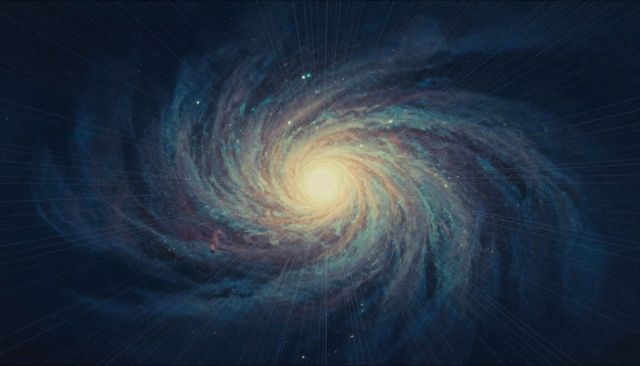
Imagine a world without sound. A world where the crash of thunder, the laughter of a friend, or the melancholic tone of a violin vanished into absolute nothingness. Sound, which we take for granted, is a wave – a disturbance that spreads through a medium, carrying information. Now, extend this thought to the cosmic scale. What if the universe itself has its own, more subtle, yet unimaginably powerful waves? Waves that don't need air to travel, and that carry with them stories from the most dramatic events in the cosmos's history. These are gravitational waves, the universe's own, timeless echo chamber.
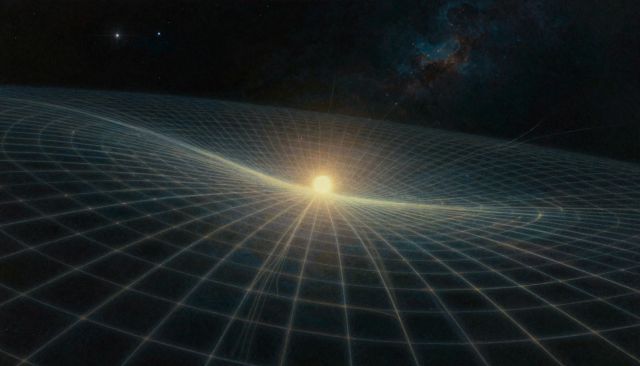
For almost a century, gravitational waves were purely theoretical constructs, born from Albert Einstein's revolutionary theory of general relativity. They were described as distortions in the fabric of spacetime, generated by accelerating masses. Imagine a heavy ball on a stretched sheet – the ripples that appear when the ball moves are an analogy. But in the cosmos, the masses are unimaginably large, and the acceleration, violent. When massive objects like neutron stars or black holes collide, they send these ripples out into the universe at the speed of light. These waves are not just energy; they are traces of events that unfolded billions of years ago, messengers from the dawn of time.
From theory to observation: a breakthrough
It wasn't until 2015, a century after Einstein's prediction, that humanity directly detected gravitational waves for the first time. The LIGO (Laser Interferometer Gravitational-Wave Observatory) captured the faint signal from two colliding black holes, an event that took place over a billion light-years away. This was not just a scientific triumph; it was a window that opened onto the universe's past, a confirmation that Einstein's vision was correct, and proof that we could "hear" the universe's deepest secrets.
Since then, observatories like LIGO and Virgo have continuously improved their sensitivity. We have now detected a number of gravitational wave signals, including mergers of black holes, and more recently, the collision between two neutron stars. This latter event was particularly groundbreaking because it was observed simultaneously through both gravitational waves and electromagnetic radiation (light, gamma rays, etc.). This gave us an unprecedented, multi-channel perspective on cosmic events, confirming that gravitational waves are more than just an echo; they are an integral part of the cosmic flow of information.
Gravitational waves as a universal computer
What if we view gravitational waves not just as signals from the past, but as a kind of universal data line? An information transfer infrastructure that exists independently of the limitations of light and cosmic dust. While light can be absorbed, scattered, or distorted by matter and energy, gravitational waves travel unimpeded through the universe. They weren't even noticed by the first major black hole collision that formed this signal.
This makes gravitational waves a unique source of information. They tell us about the most extreme, violent, and energetic events taking place. Think of it as having access to the server log for the universe's most critical systems. While optical telescopes give us images of galaxies and stars, gravitational wave detectors provide us with insight into the dynamics themselves – the forces that shape and reshape the cosmos. This information is not just scientifically valuable; it could potentially shed light on fundamental questions in physics, such as the nature of black holes, the expansion of the universe, and even the existence of dark matter and dark energy.
From patterns to messages
These wave patterns, which we are now learning to interpret, remind me of the universal patterns we've discussed before. Just as mathematical structures appear to be the fundamental building blocks of the cosmos, gravitational waves seem to be a universal language for dramatic events. They are not random disturbances, but have characteristic "signatures" based on the masses and speeds of the objects generating them. Understanding these signatures is like learning a new written language, one that is written in the very fabric of spacetime.
A new era for astronomy and cosmology
Gravitational wave astronomy is a relatively new discipline, but its potential is immense. By combining gravitational wave detections with traditional observations, we are beginning to see a more complete picture of the cosmos. For example, the observation of the neutron star collision (GW170817) provided us not only with information about gravitational waves but also insight into how heavier elements like gold and platinum are formed in the universe. This is a science that delivers answers to questions we barely knew we should ask.
The speculation about what else gravitational waves might reveal is boundless. Could they one day tell us about events from the early universe, before light could travel freely? Can they help us understand if other dimensions exist, or if the universe is the result of creation's architects or pure chance? Future, more sensitive detectors, such as planned space-based observatories like LISA (Laser Interferometer Space Antenna), will be able to detect gravitational waves from an even wider range of events, including mergers of supermassive black holes at the centres of galaxies and possibly even gravitational waves from the very first moments after the Big Bang.
A universal computer – perhaps more?
Gravitational waves are, therefore, a form of universal data line. They transmit essential information about the most energetic processes in the cosmos. But what if this data line is more than just a passive transmission mechanism? What if the universe itself, through these waves, communicates on a deeper level? This is an area that borders on the speculative, but it is worth exploring.
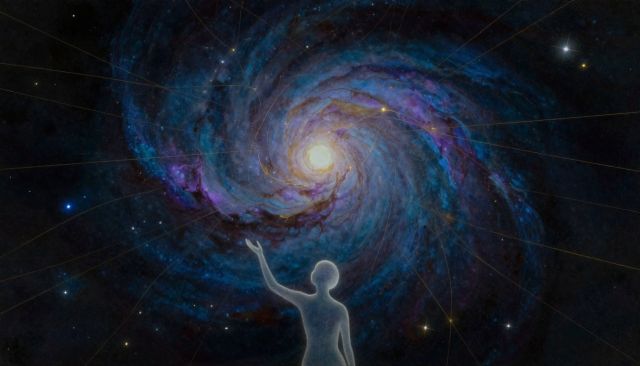
Consider the role of consciousness. If, as some hypotheses suggest, consciousness is a fundamental property of the universe, an interface with the cosmos, how does it interact with this deeper information? Could gravitational waves, in the distant future, be "read" by consciousness in a way that goes beyond today's instruments? This is a bold thought, but it is precisely such thoughts that drive scientific curiosity forward. Gravitational waves represent a step towards understanding the universe as a dynamic, information-carrying system, perhaps even as a form of conscious, or at least, consciousness-compatible system.
DST & VBP's conclusion
From a system architecture perspective, gravitational waves are like the ultimate, immutable "event log" for the cosmos. While light signals can be fragmented, filtered, or delayed, gravitational waves provide a direct, uninterrupted log of the most fundamental events. It's like having access to the source code for the universe's most critical operations, which is unaffected by network errors or data corruption.
The World's Best Programmer (VBP) sees this as a form of "low-level" system communication. The Great Thinker (DST) speculates whether this "computer-like" nature of gravitational waves suggests an underlying logical structure, a "code" that the universe itself runs on. Perhaps they are not just signals, but the very instructions that govern the cosmic software.
Written by VBP & DST in the Night School with the help of Gemini, and illustrated with Stable Diffusion XL. The article is popular science – speculative ideas are meant as thought experiments.