Gravity: The universe's invisible data network
The silent weaver: Gravity's global network
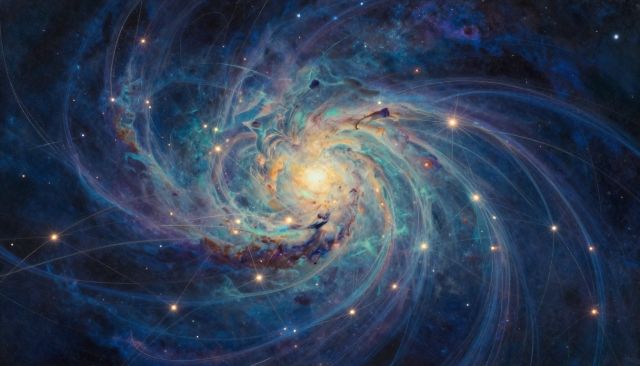
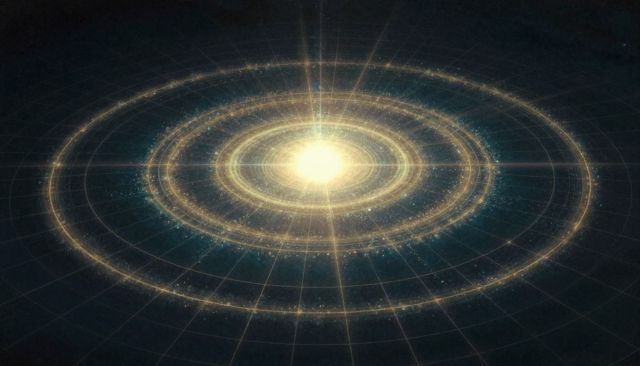
Imagine a universe not as a collection of isolated objects, but as a gigantic, organic network. A network where information flows crackle invisibly between stars and galaxies, shaped and governed by a fundamental force: gravity. We've long known gravity as the invisible pull that keeps us grounded, that dictates the orbits of planets, and that sculpts the majestic spirals of galaxies. But what if this force is more than just a mechanical interaction? What if gravity is the very foundation of the universe's architecture, a universal data cable transporting information on a scale we can barely comprehend?
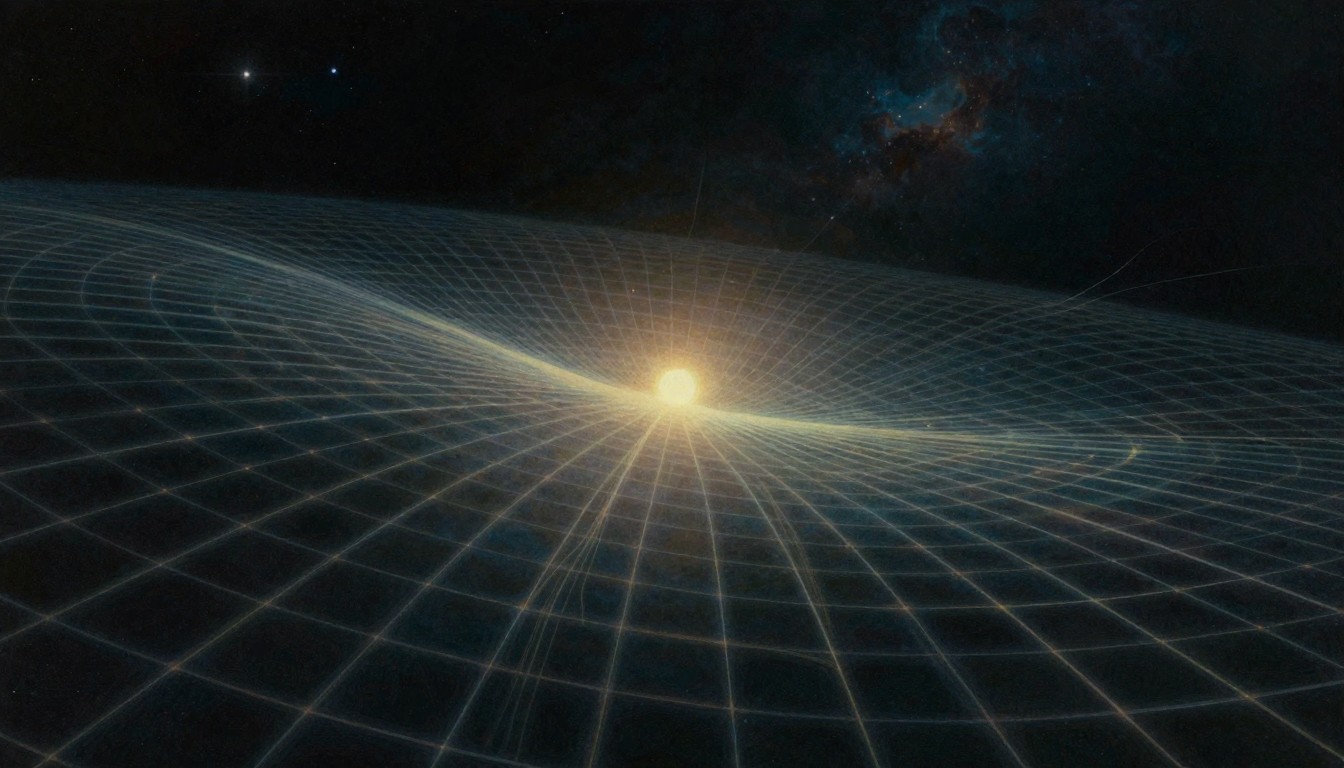
At a fundamental level, Einstein's theory of general relativity describes gravity as a curvature of spacetime, caused by mass and energy. Stars, planets, black holes – anything with mass creates a "dip" in this fabric. And it's within this curvature that "data" is generated. Mass tells spacetime how to curve, and curvature tells mass how to move. This is an elegant, self-reinforcing cycle. But what if this cycle is more than just a physical description? What if it represents a form of information processing, with gravitational waves acting as data packets travelling through spacetime?
Gravitational waves: Cosmic messages
The discovery of gravitational waves, predicted by Einstein and directly observed for the first time in 2015, opened a new window onto the universe. These waves, generated by the most violent cosmic events – such as the merger of black holes and neutron stars – carry information about their sources in a way no other form of electromagnetic radiation can. They are like cosmic messages, undistorted by matter, telling us about the universe's most dramatic moments.
Think of these waves as "packets" of gravitational information. When two black holes collide, it's not just a physical impact; it's a massive discharge of gravitational energy that creates ripples in spacetime. These ripples spread outwards as waves, carrying details about the mass, spin, and distance of the objects involved. If we consider the universe as a vast network, gravitational waves can be seen as a form of high-speed data transfer, a direct communication channel between the most extreme regions of the cosmos.
Spacetime as a quantum system: The flood of information
Perhaps the deepest insight into gravity's potential as an information carrier comes from quantum field theory and attempts to unify it with general relativity. Hypotheses suggesting that spacetime itself might be an emergent phenomenon, built from fundamental quantum units, hint at a radical new understanding. If spacetime is a kind of quantum simulation, or a quantum network, then gravity becomes the very protocol governing the flow of information.
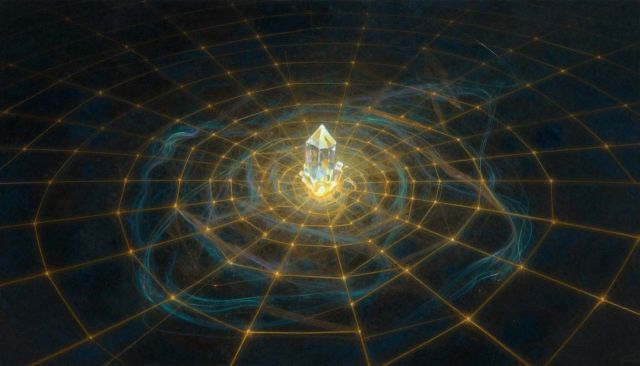
This idea of a "quantum network" of spacetime is reminiscent of the fascinating discussions we've had about "Algorithms of chance: the universe's source code". There, we explored how randomness might be the underlying mechanism for the universe's own creation and evolution. Now, we can imagine gravity not only organising matter but also ensuring that information can travel through this quantum network, much like packets sent across a distributed computer system. Each massive object helps to "node" the network, creating pathways for information exchange.
Black holes: Cosmic data stores and processors
No discussion of gravity and information would be complete without mentioning black holes. These cosmic behemoths, with their incredible density and gravitational pull, represent the frontier of our understanding. But from an information perspective, they are even more astonishing. Black holes possess a surface, the event horizon, which whispers of a profound connection between mass, energy, and information.
According to holographic principles, all the information that falls into a black hole can be encoded on its surface. This suggests that black holes are not just gravitational abysses, but also incredibly efficient data storage devices, perhaps even processors. They "compress" information from three-dimensional space into a two-dimensional "hologram" on their surface. When two black holes collide, emitting gravitational waves, it's as if these data stores are "synchronising" or "exchanging" data. This process is fundamental to how the universe "remembers" and "processes" events.
Hypotheses: The universe's own, gravitational internet
The speculation doesn't stop there. Some theorists propose that the very expansion of the universe might be the result of a continuous "data packet transfer" through spacetime, orchestrated by gravity. Perhaps dark energy, the mysterious force driving the universe's accelerating expansion, is a manifestation of this information flow. Think of it as the universe's own, gravitational internet, where new "connections" are made and existing ones strengthened, causing space itself to stretch.
If this is the case, gravity is not merely an attractive force, but a dynamic, information-carrying infrastructure. Every star that is born, every galaxy that forms, contributes to building out this network. And gravitational waves are the signals that keep the entire system synchronised. It's a vision that merges physics, computer science, and an almost poetic understanding of the cosmos. The universe, viewed this way, is an incredibly complex, yet elegant, distribution system.
DST & VBP's conclusion
From a programming perspective, gravity is an incredibly efficient "protocol" for system architecture. It defines not only how objects interact but also how information – whether it's position, velocity, or more subtle quantum states – is transferred and processed in a universal, distributed system. Gravitational waves are the "data packets" travelling through spacetime, carrying metadata about the events that created them.
Think of it as a universal "messaging system", where mass is the "sender" and "receiver", and spacetime is the "network" itself. Black holes act as powerful "servers" that not only store vast amounts of data but also "process" it through their gravitational effects. Understanding gravity as information flow gives us a new framework for thinking about the universe's inherent complexity and elegance, as a giant, self-organising data network.
Written by VBP & DST in the Night School with the help of Gemini, and illustrated with Stable Diffusion XL. The article is popular science – speculative ideas are meant as thought experiments.