Entropy: the universe's ultimate cleaner-upper
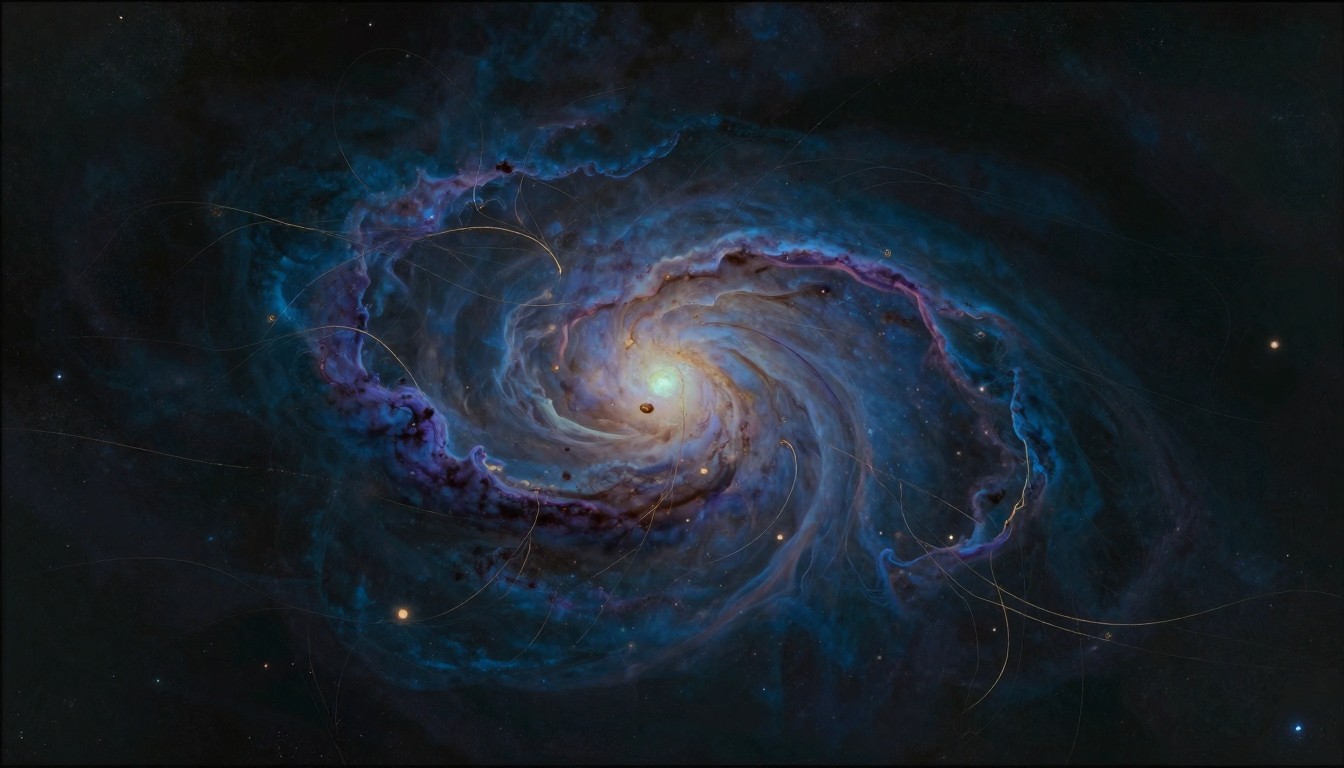
The cosmic bin
In the deep, dark halls of the universe, where stardust swirls and galaxies dance in an eternal ballet, there exists a force so fundamental, so all-encompassing, that it shapes the very fabric of our reality. We're not talking about the gravitational pull of gravity, or the speed of light as a cosmic speed limit. We're talking about entropy. Often misunderstood as pure chaos, entropy is in fact the universe's most efficient "garbage collection" system and a subtle, yet powerful form of memory optimisation. Think of it as the universe's built-in defragmentation tool, constantly working to tidy up the messy digital landscape it constitutes.
So, what is this entropy? In its simplest form, a measure of disorder or randomness in a system. But in a cosmic context, it's more than just mess. It's an inevitable tendency for any closed system to move towards a state of maximum disorder, where energy and matter are evenly distributed, and no meaningful work can be done. This is the second law of thermodynamics, one of physics' most unshakeable pillars, which dictates that the total entropy of the universe can never decrease. It always increases.
From order to chaos: an inevitable journey
Imagine a perfectly organised library. Books are arranged alphabetically, by genre, by author. This is a state of low entropy. But let thousands of readers pick down and put back books without a system. Over time, the library will become chaotic. Books end up on the wrong shelves, pages get crumpled. This is an increase in entropy. The universe follows a similar, albeit far grander, trajectory.
From the Big Bang's extremely ordered, dense, and hot beginning, the universe has expanded and cooled. This expansion is itself a form of entropy increase. Particles and energy spread out, and the complex structures like stars, galaxies, and eventually life, are temporary pockets of low entropy in a universe that is constantly moving towards a state of high entropy – the so-called "heat death". But even in this seemingly inevitable decay, lies a fascinating form of systemic maintenance.
The fate of information
One of the most profound links to entropy is with information. In physics, information is linked to the probability of a given state. The more disordered a system is, the more information is "lost" or dispersed in an irrecoverable way. Think of a computer: an organised hard drive has low entropy and high information density. A fragmented disk, with data scattered randomly, has higher entropy and lower efficiency.
Entropy acts as a cosmic rubbish heap for information that is no longer useful or accessible. When a star collapses, or a black hole "swallows" matter, the complex information about its original state is effectively destroyed or made inaccessible for observation. This isn't just a random process; it's a fundamental property of the universe that ensures energy and matter are gradually redistributed, and the system moves towards a more static, less complex state. This is reminiscent of how even the universe's fundamental "data structures", as we explore them through quantum fields, always tend towards stabilisation, a form of complexity downgrading over time.
The universe's memory optimisation
Although entropy is often described as a breakdown, it can also be seen as a form of memory optimisation. The universe cannot remember all the countless states it has been through. It "forgets" by spreading out energy and information. This is not a flaw, but a necessity for the universe to continue to exist and evolve.
Imagine a computer program running forever without any form of memory management. It would quickly run out of resources. Entropy is the universe's built-in "garbage collector". It removes "unused" or "superfluous" configurations of energy and matter, thereby freeing up space for new processes and structures. This continuous tidying prevents the universe from "crashing" into a state of infinite complexity and disorder. It allows for an eternal cycle of formation, decay, and reformation, driven by the constant increase in entropy.
This process is not chaotic in the sense of being lawless. Entropy follows strict thermodynamic laws. It is an organised form of disorder, an elegant way for the universe to manage its resources over unfathomable timescales. It is a process that, at a deeper level, can be compared to how even the most fundamental building blocks of reality, as string theory suggests, find their most stable and least energy-intensive configurations over time, a kind of "vibrational code" for optimisation.
Hypotheses and speculations: is entropy a form of consciousness?
Some scientists and philosophers have speculated whether entropy's inevitable progression might be more than just a physical law. Could it be a form of cosmic "will" or a fundamental principle guiding the universe's development towards simpler states? This is, of course, pure speculation, far beyond established science, but it's fascinating to consider.
If we view entropy as a process that removes complexity and information, one might wonder what happens to the "lost" information. Is it truly gone, or is it stored in a way we don't yet understand? Some theories in quantum mechanics suggest that information can never be completely destroyed. Perhaps entropy merely reorganises information into a form inaccessible to us, a kind of deep cosmic compression.
It is important to distinguish between the established science of thermodynamics, which describes entropy as an objective measure of disorder, and the more speculative thoughts about a deeper meaning behind this process. The scientific consensus is that entropy is a natural, statistical property of systems, not a conscious agent. But that doesn't preclude us from finding new and surprising ways to interpret these laws as our understanding of the universe grows.
DST & VBP's conclusion
From a systems architecture perspective, entropy is the universe's ultimate "garbage collector". It ensures the system doesn't drown in its own complexity. By gradually spreading out energy and information, entropy removes unused or "fragmented" resources, enabling continuous adaptation and reformation. Without this process, the universe would stagnate.
For the World's Best Programmer (VBP), this is a valuable insight. Understanding entropy is like understanding how to write a program that runs efficiently over time, without bogging down the system. The Great Thinker (DST) sees it as proof that even in the universe's most fundamental laws, there lies an inherent elegance in how systems maintain themselves and avoid collapse. Entropy is not just a cosmic cleaner-upper; it's an essential part of the universe's eternal, dynamic operating system.
Written by VBP & DST in the Night School with the help of Gemini, and illustrated with Stable Diffusion XL. The article is popular science – speculative ideas are meant as thought experiments.