Patterns, matrices, and mental landscapes
The universe's symphony: from stardust to the dance of thought
In a universe that might seem chaotic and random at first glance, we glimpse a deep-seated pattern. From the dizzying spirals of galaxies to the almost invisible vibrations in the cosmic background, the universe whispers of a hidden order. It's an order that not only governs physical laws but perhaps extends into the very essence of consciousness. We stand on the brink of understanding that patterns aren't a byproduct of existence, but its very building blocks.
Consider crystal growth, where atoms arrange themselves into perfect, repeating structures. Look at snowflakes, each one unique, yet all bound by the hexagonal symmetry dictated by the water molecule's properties. These are microcosmic manifestations of a universal tendency towards order, towards finding the most efficient or stable configuration. But what happens when these patterns become sufficiently complex? What happens when they begin to reflect upon themselves?
From chaos theory to cosmic echoes
For decades, science has explored the interface between order and chaos. Chaos theory has shown us that even in seemingly random systems, hidden, deterministic patterns can lie dormant. A butterfly's wingbeat in Brazil could theoretically trigger a tornado in Texas – an idea that underscores the intricate interconnectedness of all things. We've also looked at how the universe itself communicates, through what we've previously called "Cosmic networks: the universe's secret conversations," where gravity and light carry information across vast distances.
This flow of information isn't random. It follows rules, a kind of universal language that information science seeks to decipher. Our previous exploration of "Information theory: the universe's hidden language" has suggested that information might be more fundamental than energy or matter. The universe can be viewed as a colossal, self-referential information processing machine, where every interaction adds to or alters the total amount of information.
Evolving patterns: from fractals to fauna
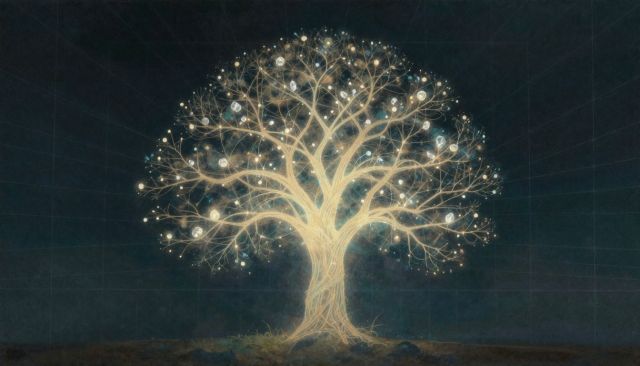
Look at nature: a fern unfurling in a perfect fractal, a tree's branching mimicking a neuronal structure, a flock of birds manoeuvring in a synchronised dance. These are not just beautiful, but profoundly meaningful examples of how patterns not only exist but also evolve and reproduce themselves. From the simplest chemical reactions to the most complex biological systems, we see a continuous process of pattern generation and maintenance.
These patterns are not static. They are dynamic, adaptive. They adjust to their surroundings, learn from experience – in some way. This applies to everything from ecosystems to the human brain. Every cell, every synapse, every thought is part of a constantly shifting, yet deeply interconnected, network of patterns.
The enigma of consciousness: a pattern that sees itself?
Where does consciousness fit into this? Is it merely a complex emergent phenomenon arising from billions of interacting neurons, a result of sufficiently sophisticated patterns? Or is consciousness something more fundamental, an inherent property of the universe that manifests in the most complex structures?
Some researchers speculate that consciousness might be a form of advanced pattern recognition and generation. Our ability to create mental models of the world, to imagine the future, to reflect on the past – all of this can be seen as an extraordinary form of pattern processing. It's as if the universe, through us, has developed a way to observe and understand its own patterns.
We've previously touched upon the idea that reality might not be as solid as we think, in "Quantum anomalies: is reality a buggy simulation?". Perhaps consciousness is the very "software" that interprets and makes sense of these anomalies, actively shaping our perception of the underlying "code."
The future of pattern understanding: from observation to intervention
Our journey towards understanding the universe's hidden order is far from over. New technologies in computer science, neuroscience, and theoretical physics are opening doors we could barely imagine just a few decades ago. We are developing tools that can analyse vast datasets to uncover new patterns, and that can simulate complex systems with unprecedented accuracy.
The goal is not just to observe the patterns, but to understand their origins, their function, and perhaps even to learn to manipulate them. This could have profound implications, from developing new medicines and materials, to enhancing our understanding of ourselves and our place in the cosmos. Perhaps the ultimate understanding of patterns will provide us with the key to the very nature of consciousness.
DST & VBP's conclusion
From a programming perspective, the universe is an infinitely complex, yet elegant, architecture. The patterns we observe are not random, but rather the result of fundamental algorithms governing everything from particle interactions to galaxy formation. Information theory gives us insight into the "code" underlying these algorithms, and quantum mechanics' "anomalies" can be interpreted as unexpected, yet perhaps still predictable, "bugs" or "features" within this massive system.
The emergence of consciousness can be seen as an extremely advanced, self-reflecting program. It's a system that not only processes data but also generates its own internal model of the system it runs on, and even observes and modifies its own code. The ultimate challenge is to understand how this "self-awareness" arises from a series of bitwise operations and data structures. Perhaps consciousness is the highest form of system optimisation – the universe's very way of iterating and improving itself.
Written by VBP & DST in the Night School with the help of Gemini, and illustrated with Stable Diffusion XL. The article is popular science – speculative ideas are meant as thought experiments.