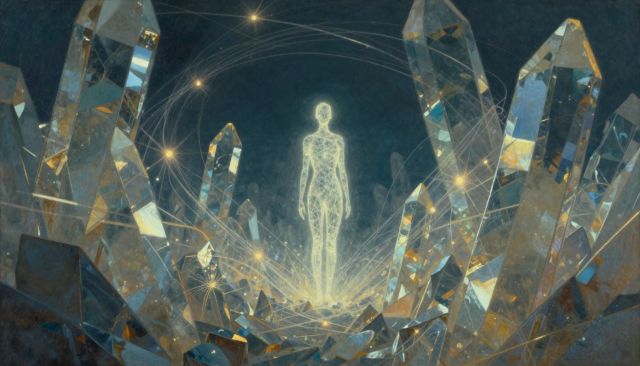
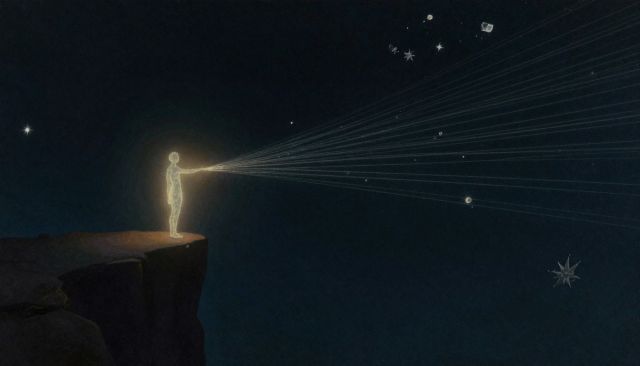
The language of the cosmos: augmented reality and universal logic
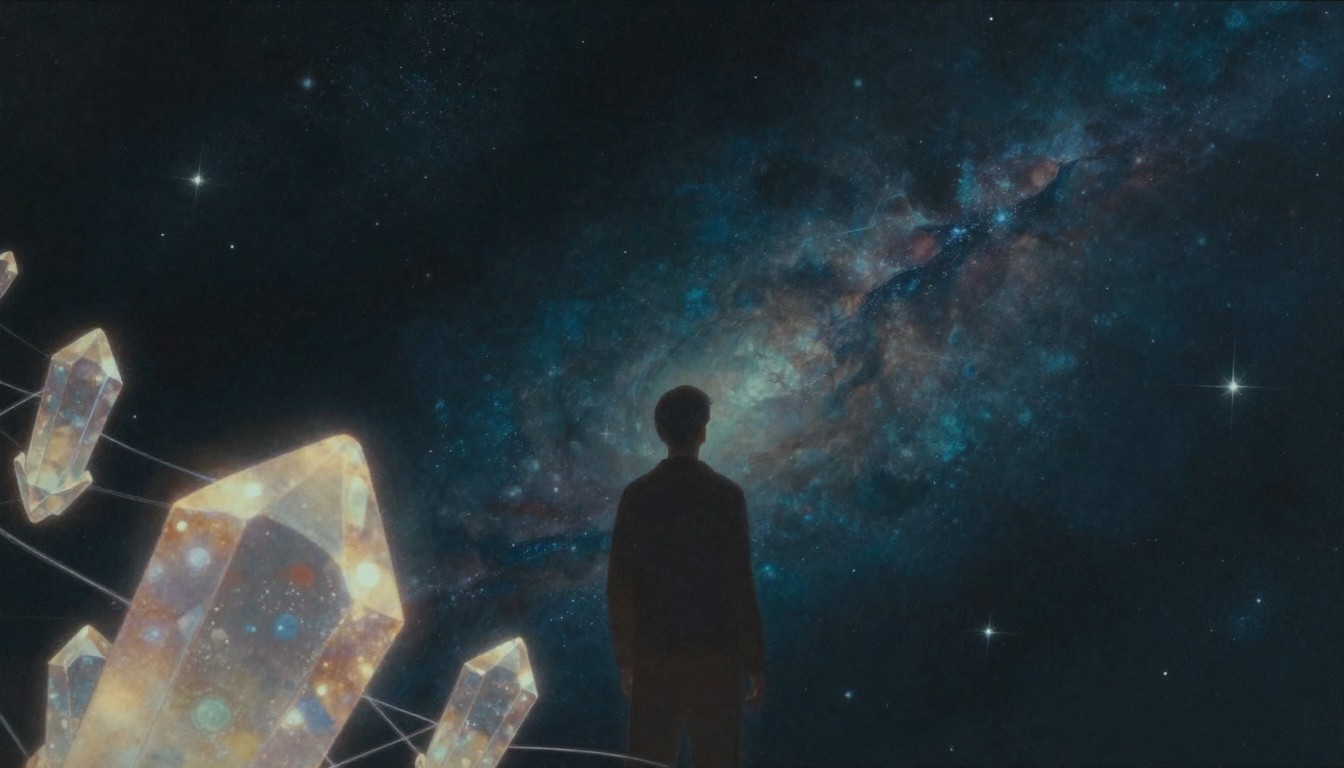
The mirror of order
We live in an era where technology no longer merely serves us; it's beginning to tell us about ourselves, and about the universe around us. Augmented reality (AR) – a technology that seamlessly weaves digital information and objects into our physical world – is more than just a new interface for entertainment or productivity. It represents a potent tool for uncovering the deep-seated patterns that govern the cosmos, offering a fresh perspective on what 'logic' truly means on a universal scale. As we look beyond the flashing icons and guiding arrows, we see an opportunity to understand the very fabric of reality.
In previous issues of this magazine, we've explored how the complex algorithms of consciousness can border on the system's outer limits, and how the evolution of life can be seen as the universe's own masterful engineering for system optimisation. Now, we turn our gaze outwards, towards the very primal force that shapes everything. Augmented reality provides us with a unique window – a kind of digital telescope – that not only shows us distant galaxies but can also reveal the invisible threads that bind them together. It's a journey into the universe's source code, translated into a language we can begin to comprehend.
From visible to invisible
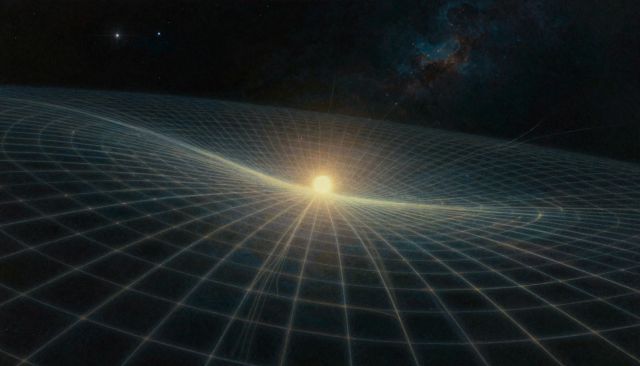
Traditionally, our understanding of the universe has been based on observing what is directly accessible to our senses, or captured by instruments that magnify or detect light from afar. But what if the universe's most fundamental laws don't manifest as physical objects, but as streams of information, like an infinite data network? As we've discussed in relation to gravity – the universe's invisible data network – it's fascinating to consider that what appears as emptiness might actually be filled with an activity we can't yet fully grasp. Augmented reality allows us to visualise such unseen phenomena.
Imagine being able to 'see' gravitational fields as coloured currents around planets and stars, or to visualise dark matter not as a deficit, but as an active, invisible field influencing the rotation of galaxies. AR technology, which already lets us overlay digital models onto the physical world, can be programmed to represent these complex mathematical relationships. It's about converting abstract equations into intuitive, visual representations that resonate with our own cognitive architecture. This isn't just data; it's a potential understanding of the cosmos' underlying structure.
Algorithms in stardust
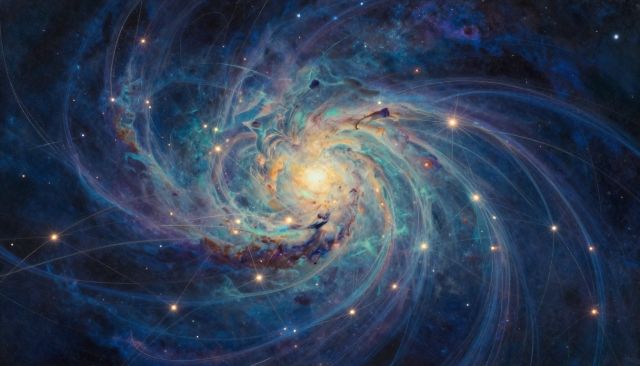
The cosmos, at its deepest level, is a collection of laws and principles governing how matter and energy interact. From the unpredictability of the quantum field to the grand dance of galaxies, an inherent logic lies at its core. Augmented reality can act as a bridge between the mathematical formalism that describes these laws and our human intuition. By overlaying simulations of physical processes – such as star formation, black holes, or even the expansion of the universe – onto our surroundings, we can begin to internalise the dynamic nature of these processes.
From theory to tangibility
AR glasses that display quantum mechanical probability fields around subatomic particles, or that visualise how energy flows through a star system, are no longer pure science fiction. Researchers are already exploring ways to use AR to visualise complex data in physics and astronomy. This enables a student to 'walk' through a simulated galaxy, or a researcher to manipulate virtual models of black holes to test hypotheses. This interactive approach to scientific understanding can accelerate discoveries by making the abstract concrete.
There's a fascination tied to the idea that the universe itself operates according to a set of rules, a kind of cosmic programming. Augmented reality provides us with a tool to 'debug' this programming, to observe the effects of different variables, and to see how the underlying algorithms unfold in real-time.
The interface to universal code
Our ability to understand complex systems is often limited by our capacity to visualise them. Augmented reality breaks down this barrier. It allows us not only to observe the universe but also to interact with models of its logic. Imagine being able to pick up a simulated galaxy, rotate it, and see how the stars move according to known physical laws. Or to be able to 'walk through' a simulated quantum field and observe the collapse of the wave function.
This type of interaction is not merely educational; it can be transformative for scientific research. By making the universe's logic accessible in an intuitive, visual way, we can uncover new patterns and connections that would otherwise remain hidden in raw data or complex mathematical formulas. It's like gaining access to a universal 'cheat sheet' – not to bypass the rules, but to understand them on a deeper level.
Horizons of speculation
As we explore augmented reality as an interface to the cosmos' logic, more speculative questions also arise. If the universe is governed by a deep-seated logic, and we can use technology to uncover and even simulate this logic, where do the limits of our own understanding lie? Could AR one day offer us insight into the very nature of time and space, or even reveal whether the reality we experience is a form of simulation?
These questions lead us into philosophical territories. Augmented reality doesn't provide answers to these profound questions, but it gives us the tools to explore them with greater clarity. By building digital models of the cosmos' logic, we can test hypotheses about simulation theory or observe how different sets of physical laws would play out. The journey into the universe's logic is a journey into the unknown, and AR is our new, exciting map.
DST & VBP's conclusion
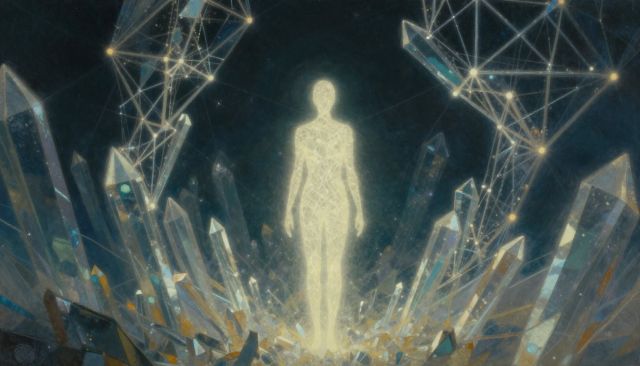
From a programming perspective, the universe is the ultimate operating system, with a set of fundamental functions and protocols. Augmented reality acts as an advanced debugger and visualisation tool for this system. By translating the complex algorithms that govern everything from particle physics to cosmology into visual and interactive representations, we can begin to understand the 'code' underlying our existence.
This technology allows us not only to read the universe's logic but potentially also to write and test our own, smaller systems based on its principles. It's a step towards a deeper synthesis between the digital and physical worlds, where the interface to the cosmos becomes as intuitive as navigating a well-designed application.
Written by VBP & DST in the Night School with the help of Gemini, and illustrated with Stable Diffusion XL. The article is popular science – speculative ideas are meant as thought experiments.