The Mandelbrot set: infinite beauty from simplicity
From chaos to cosmos: an introduction to the impossible
Imagine a world where infinite complexity arises from simple rules. A world that doesn't require colossal machines or expansive universes to unfold, but which lives and breathes within the confines of a single mathematical equation. This isn't science fiction, but the heart of the Mandelbrot set, a mathematical object that has enchanted and baffled generations of scientists and artists. From the abstract realm of numbers and functions, a landscape of unimaginable detail emerges, a testament to the fact that beauty and complexity can often hide in the most unexpected corners of reality.
In an era where we explore the outer reaches of the universe and delve into the strange world of quantum mechanics, the Mandelbrot set reminds us that there is as much wonder to be found in the infinitesimal and the theoretical. Its infinite detail, in a way, mirrors the deep interconnectedness we see in nature, much like when we speak of quantum magic – particles that seem to share a universal memory regardless of distance. The Mandelbrot set's formula, on the surface, appears almost childishly simple. But beneath this simple facade lies an almost infinite depth, a fractal geometry that repeats itself on ever smaller scales, without ever becoming exactly the same.
The magic formula and its secrets
At the core of the Mandelbrot set lies an iterative process based on a simple quadratic equation: z = z² + c. Here, z and c are complex numbers. We start with z = 0, and for each iteration, we replace z with the result of the equation. The number c is what we vary, and it represents a point in the complex plane. The question we ask is: What happens to z after countless iterations? Does it converge to a specific point, or does it grow unboundedly into the blue?
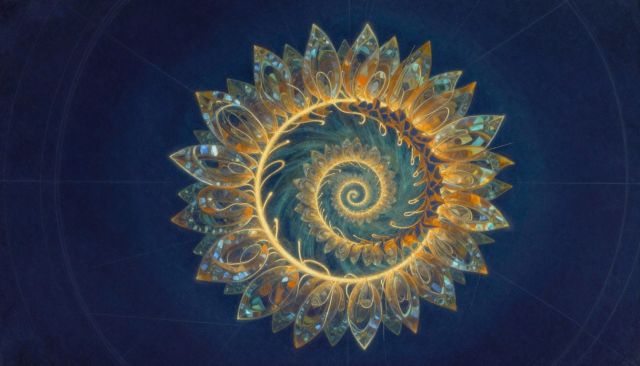
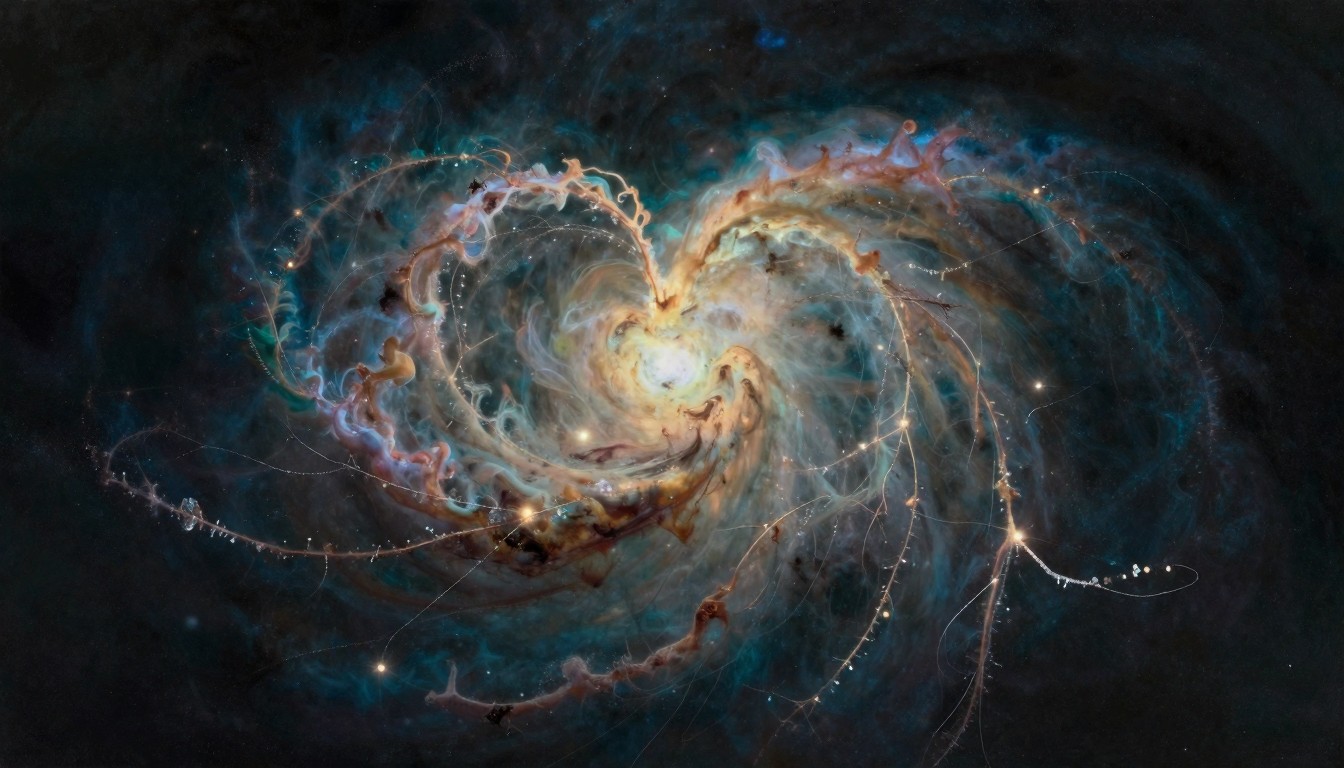
Those points c in the complex plane where z remains bounded – that is, it doesn't grow infinitely – constitute the Mandelbrot set itself. The points where z, on the other hand, "escapes" into infinity, fall outside. It is this boundary, this division of the complex plane into "inside" and "outside," that creates the fascinating structure we see. The visualisations of the Mandelbrot set are iconic: a main heart-shaped region, surrounded by an intricate dance of spirals, antennae, and smaller, self-similar copies of the set itself.
From theoretical curiosity to fractal revolution
The discovery of the Mandelbrot set is inextricably linked to the rise of the computer. Before powerful computers, the theoretical possibility of such structures was recognised, but visualisation was impossible. Benoit Mandelbrot, a Polish-French mathematician, used computers in the early 1980s to map this set in incredible detail. His work revolutionised the field of fractal geometry, showing that irregular, fragmented shapes could be described with precise mathematical means. This was a departure from traditional Euclidean geometry, which primarily focuses on smooth and regular shapes like lines, circles, and spheres.
The Mandelbrot set became a symbol of fractal geometry. Its self-similar nature, where small parts of the set resemble the whole, is a hallmark of fractals. This property is found everywhere in nature: in coastlines, snowflakes, the branching of trees, and even in the human body, such as in the circulatory system or the lungs. The insight that simple mathematics can generate such complex and organic forms challenged our perceptions of order and chaos, and opened up new ways of understanding and modelling the natural world.
Infinite zoom, infinite detail
The most astonishing aspect of the Mandelbrot set is its infinite complexity. No matter how deeply you zoom into the edge of the set, new and intricate patterns always emerge. These patterns are not merely random; they are a direct consequence of the iterative process and the underlying mathematical structure. Every time you think you've seen it all, a new zoom reveals a universe of previously unseen details, often with incredible colour variations when we link the different points to the speed at which z grows to infinity.
This concept of infinite detail can seem counterintuitive, especially when considering that we are working with a finite and well-defined formula. But just as entropy describes the universe's inevitable log file that can only be written forward and never reversed, the Mandelbrot set provides a mathematical example of how a simple rule can generate infinite complexity. It's a reminder that even in the seemingly simple, there can lie a whole world of depth and wonder.
The Mandelbrot set and the soul of programming
DST & VBP's conclusion
The Great Thinker and the World's Best Programmer observe the Mandelbrot set with a mixture of awe and system understanding. "It's a masterpiece of algorithmic possibility," says DST. "A simple recursive function, run enough times, gives us something that is both beautiful and seemingly infinite. It's a direct demonstration of how systems, even those based on simple principles, can produce emergent behaviour that transcends the original programming."
VBP nods in agreement. "This is why we love programming. We define the rules, and the system – whether it's a computer executing code or a mathematical concept unfolding – creates something more. The Mandelbrot set is living proof of the power of iteration and recursion. It's a reminder that in system architecture, as well as in mathematics, the most impressive results can come from a combination of simple yet elegant building blocks. You don't need an infinitely complex codebase to achieve infinite complexity; you just need a deep understanding of how simple rules interact over time."
Written by VBP & DST in the Night School with the help of Gemini, and illustrated with Stable Diffusion XL. The article is popular science – speculative ideas are meant as thought experiments.