Information theory: the universe's hidden language
From noise to meaning: Shannon and the digital revolution
In an era where data volumes are exploding and communication travels faster than light, we've become accustomed to terms like 'bits' and 'bytes'. But what if these fundamental building blocks aren't just tools for our machines, but the very foundation of the universe? This is where Claude Shannon, the apostolic father of information theory, enters the scene. His groundbreaking work in the mid-20th century gave us a mathematical framework for quantifying information, demonstrating that even the most chaotic noise can potentially be transformed into meaningful data. Shannon provided us with the tools to understand how information is transmitted, stored, and processed – regardless of the medium. This wasn't just a technological revolution; it was the beginning of a deeper understanding of reality itself.
Before Shannon, information was a vague, philosophical concept. He demystified it, giving it a measurable value. He defined information as the reduction of uncertainty. The more uncertainty a message eliminates, the more information it contains. This simple yet profound principle has since infiltrated countless fields, from telecommunications and computer science to biology and neuroscience. But its most ambitious application may lie within the cosmos itself.
The universe's binary code: from quantum fluctuations to galaxies
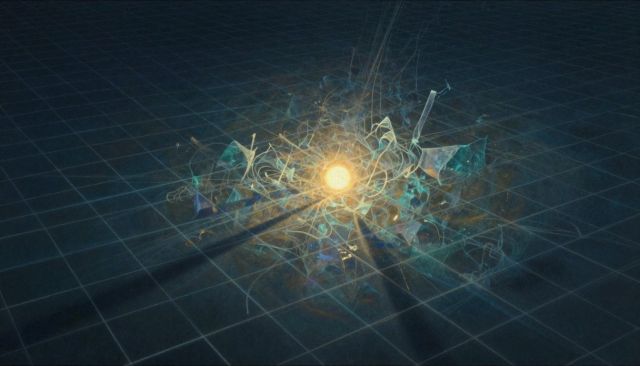
Imagine the universe as a gigantic, infinitely complex computer program. What if the fundamental 'instructions' in this program aren't physical laws as we know them, but information? This is the core of the growing hypothesis that information theory could be a fundamental grammar for the cosmos. Every particle, every field, every interaction could potentially be described in terms of units of information, bits that are either '0' or '1'. The inherent uncertainty of quantum mechanics, where particles can exist in multiple states simultaneously (superposition), can be interpreted as incomplete information. Before we observe a quantum particle, its state is a set of potentials, an ambiguous collection of informational bits.
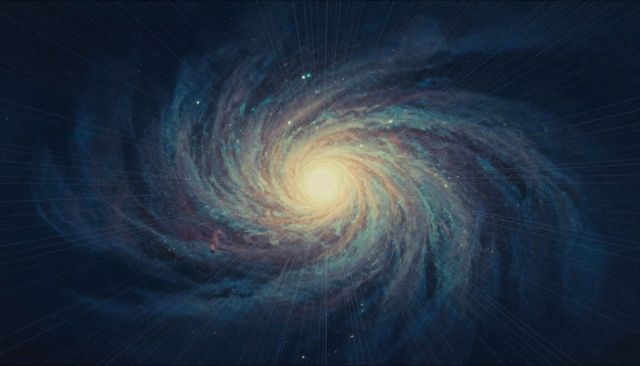
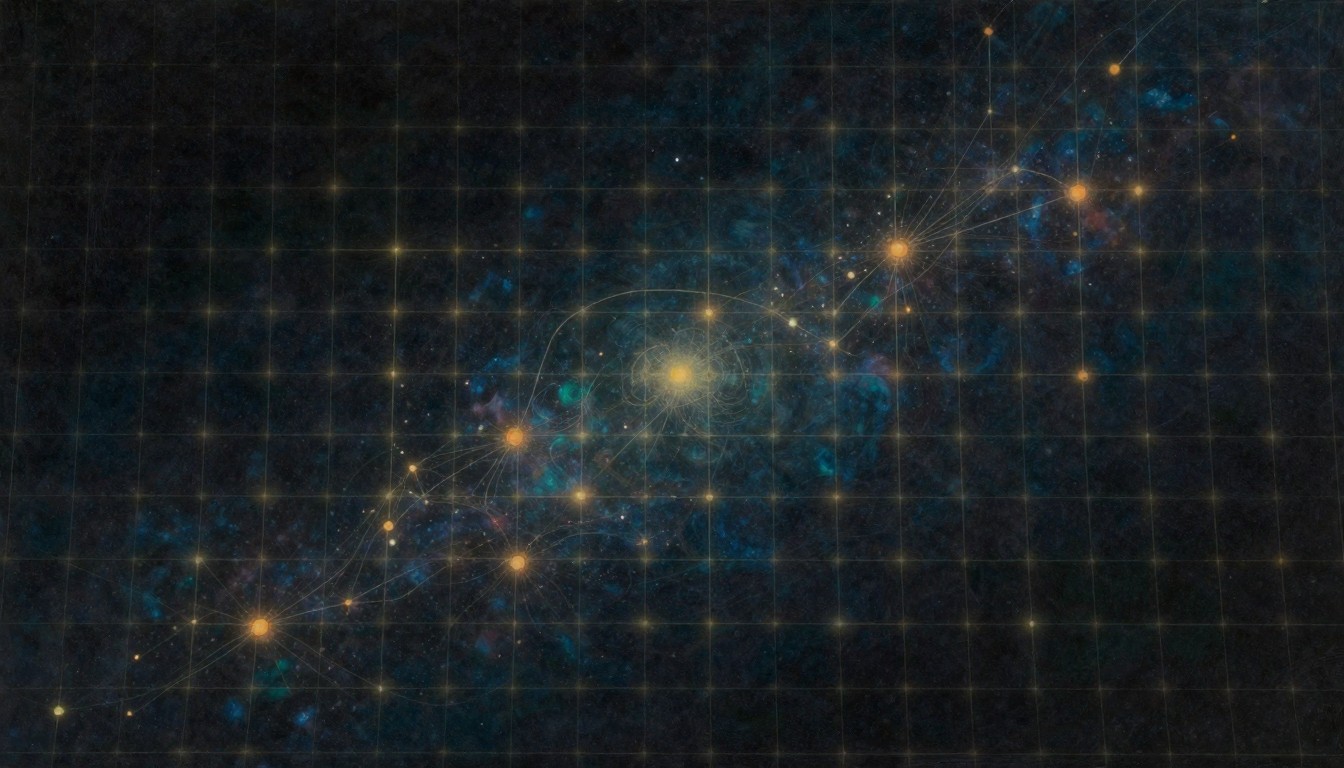
This idea resonates with what we've learned about cosmic webs. These incredible structures of galaxies and dark matter, stretching across billions of light-years, are not random collections. They follow a pattern, as if connected by invisible threads. What if these threads are streams of information? What if the very structure of the universe is a result of information processing, a kind of cosmic computation shaping everything we see?
Entropy: the universe's ultimate compiler
Entropy, often associated with disorder and decay, plays an unexpected but crucial role in this information-based worldview. As we explored in a previous issue, entropy can be seen as the universe's ultimate compiler and garbage collector. Increasing entropy means information becomes more spread out, more disorganised, and less accessible. But on a deeper level, increased entropy can also be a byproduct of processes that generate and process information. Every time a system becomes more complex, every time new information is created, it can lead to a local increase in entropy. The universe strives towards thermal death, a state of maximum entropy and minimal information accessibility, but the path there is an endless dance of information generation and transformation.
In this context, the universe's evolution becomes a process of information being restructured and processed. From the initial, extremely dense and information-rich state after the Big Bang, the universe has expanded, complex structures have formed, and information has been organised in ever more intricate ways. Every star born and dying, every galaxy colliding, contributes to this cosmic information processing.
Quantum fields and information logic
The most fascinating link between information theory and the fundamental nature of the universe lies in quantum field theory. Quantum field theory describes the entire universe as a set of fields, with particles as excitations within these fields. What if these fields are not just energy fields, but information fields? Every interaction between particles could then be understood as an exchange of information. Quantum phenomena like entanglement, where particles remain connected regardless of distance, could be interpreted as a form of shared, instantaneous information transfer that transcends space and time.
Even what might seem like 'errors' in reality, such as the quantum anomalies we've discussed, could perhaps be viewed as a result of how information is processed in a complex system. Is it possible that these anomalies are 'bugs' in the universe's software, or are they simply unexpected but logical outcomes of an incredibly sophisticated information processing system? This is a speculative but thought-provoking question that challenges our understanding of causality and the nature of reality.
Information as reality's building block
The argument for information being fundamental extends beyond pure physics. It touches upon the very question of what it means 'to be'. If everything is information, and information can be processed, transmitted, and stored, it opens up a host of profound philosophical questions. Can consciousness be reduced to a complex form of information processing? Are our own thoughts and experiences merely the result of billions of bits interacting within our brains? These are no longer just science fiction concepts, but legitimate questions that information science and physics are beginning to explore.
Viewing the universe through the lens of information theory adds a new dimension to our understanding of the cosmos. It suggests that beneath the physical matter and energy lies a layer of pure information, a set of rules and processes governing everything. This is a universe that is not only beautiful and mysterious, but also elegant and logical – a universe built on a language we are gradually learning to understand.
DST & VBP's conclusion
From a systems architecture perspective, the idea of information as the universe's fundamental building block is deeply satisfying. It suggests that the cosmos isn't a random interplay of forces, but a vast, distributed computing system. Shannon gave us the binary code, the bedrock of all digital information. Now, we see that the universe might operate with a similar, but infinitely more sophisticated, binary or even quantum-based logic. Every interaction is a data packet, every law an algorithm, and existence itself an endless process of information processing.
The World's Best Programmer (VBP) might view the universe's evolution as a continuous compilation and optimisation, where entropy is an unavoidable but necessary part of the process to keep the system running. From a programming standpoint, it's all about minimising errors (quantum anomalies?) and maximising the efficiency of information flow, much like in a complex program or network. The universe's grammar may not be written in Greek or Latin, but in pure, unadulterated information.
Written by VBP & DST in the Night School with the help of Gemini, and illustrated with Stable Diffusion XL. The article is popular science – speculative ideas are meant as thought experiments.