The brain: the machine that predicts the future
The future is shaped before it meets the eye
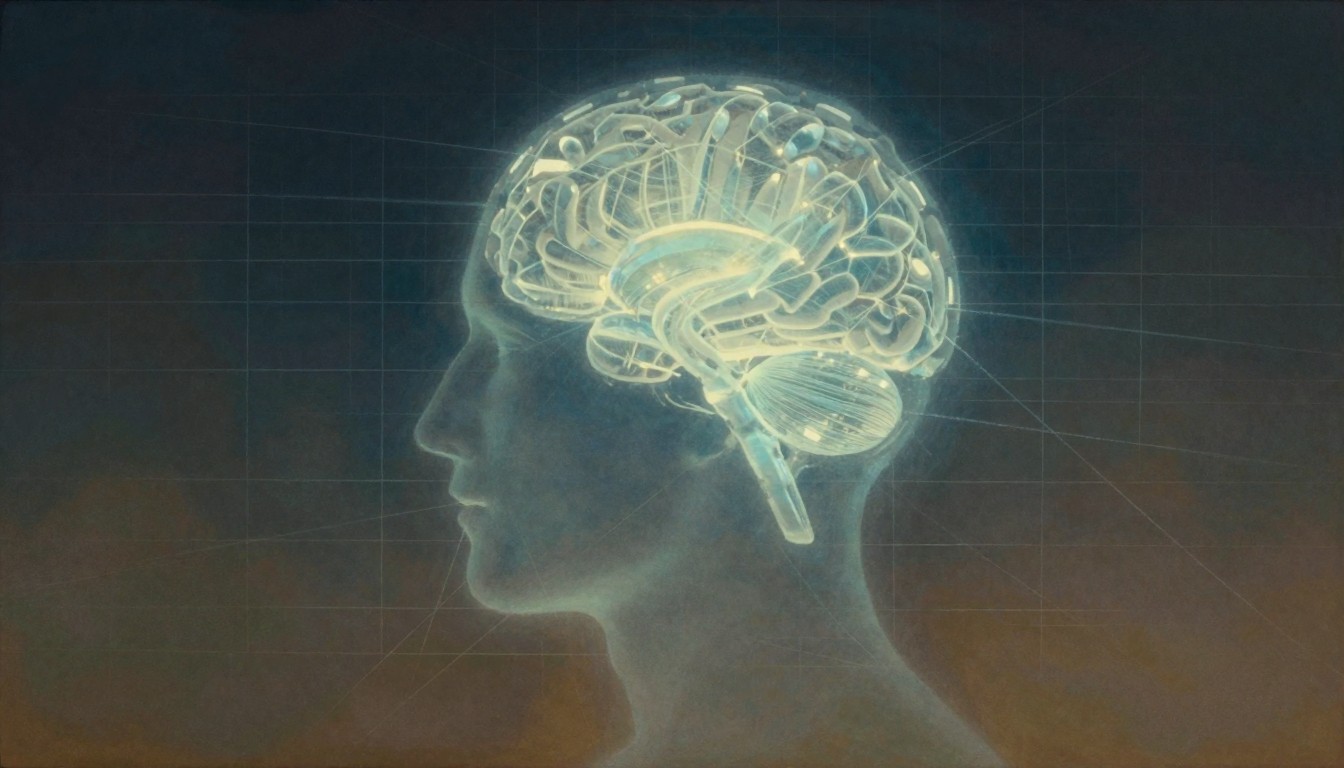
The notion that we perceive the world as it objectively is, is a comforting illusion. The truth is far more fascinating: our brain isn't a passive recipient of sensory input, but a hyperactive prediction machine. It's constantly working to anticipate what's coming next, and what we ultimately "see" is often the result of these expectations, rather than raw, unfiltered reality.
Imagine walking down a busy street. Sensory impressions flood in: light, colours, shapes, sounds. But your brain isn't just registering this data. Instead, it draws on past experiences, stored knowledge, and immediate contextual clues to construct a probable future state. It "guesses" what's coming next, and if the guess is correct, it's perceived as seamless perception. If it's wrong, the brain has to correct itself, which can manifest as surprise, confusion, or simply a new interpretation of what's happening.
This paradigm, known as "predictive processing" or "inferential perception," challenges our traditional view of perception. It suggests that the brain doesn't wait for data to form an image, but rather sends "prediction errors" down the neural hierarchy. That is, it sends expectations, and only the deviations from these expectations are sent upwards to update the model.
The architect of perception: the power of expectation
The brain's predictive nature is deeply embedded in its architecture. From the earliest stages of visual processing in the visual cortex, to more complex cognitive processes in the prefrontal cortex, there's a constant cycle of prediction and correction. It's as if the brain is continuously running thousands of microscopic simulations of the external world, based on what it has learned.
This prediction mechanism is incredibly energy-efficient. By anticipating what will happen, the brain doesn't need to process every single piece of incoming data at full power. Instead, it focuses on what's unexpected, what demands attention and an update to the internal model. This is why we often don't notice small changes in our surroundings, unless they deviate from our expectations. Think of a picture you've seen many times; you're unlikely to notice a subtle change until it's pointed out to you.
Neuroscience research, particularly studies using brain imaging techniques like fMRI, has shown how different brain areas respond differently to expected and unexpected stimuli. Areas involved in attention and reward are activated more strongly when a prediction error occurs, indicating that the brain prioritises learning from the unexpected.
When reality doesn't match expectation: illusions and misjudgments
It's when the brain's predictions go awry that we can truly see its mechanisms in action. Optical illusions are a classic example. Our expectations about how objects should interact with light and space are manipulated by visual stimuli, leading us to see something that isn't there, or to misinterpret something. The brain's attempt to create a coherent and probable interpretation of what we see is tricked.
But this isn't just about sight. Our expectations colour all our perceptions, whether it's sounds, smells, or even social interactions. If you expect someone to be rude, you're more likely to interpret their actions as just that, even if their intention was different. This is called confirmation bias – we see what we're looking for.
On a deeper level, this predictive mechanism can explain why we sometimes cling to erroneous beliefs. Our brain prefers stability and consistency. Revising a deeply ingrained conviction can be a cognitively demanding process that creates a large prediction error. Therefore, the brain may actively suppress information that contradicts our existing models, focusing only on what confirms them. This is reminiscent of Gödel's incompleteness theorems, where systems have inherent limitations on what they can prove about themselves; the brain has its own internal "axioms" that it protects.
The dual nature of learning: from patterns to nuances
At the core of the brain's predictive ability lies its incredible capacity for pattern recognition. From early childhood, we learn to recognise recurring sequences of events, sounds, and visual impressions. These patterns become the building blocks for our expectations. The Fibonacci spiral, which appears in everything from sunflowers to galaxies, is an example of how nature itself operates according to certain algorithms. Our brain is a master at uncovering such underlying patterns in a chaotic world.
But simply recognising patterns isn't enough. The true genius lies in the ability to handle variation and nuance within those patterns. The brain doesn't just learn that a cat makes a "meow" sound, but also that there are countless variations of that sound – from a gentle purr to a desperate cry. The prediction machine must be flexible enough to anticipate these variations, and adapt when reality deviates from the average.
This learning process is a continuous fine-tuning of the internal model. Every experience, every new piece of information, contributes to updating our predictions. It's an iterative process, where mistakes are not failures, but necessary steps on the path to a more accurate understanding of the world.
The body as predictor: embodied cognition
Perception isn't just a matter of the head. Our physical body plays a crucial role in the brain's predictive processes. The concept of "embodied cognition" argues that our bodily experiences, our movements, and our physical interactions with our environment are fundamental to how we think and perceive.
When we expect to grasp an object, our brain prepares our motor systems in advance. This happens before the object is actually in our hand. The expectation of the tactile sensation of the object, its weight and texture, is already part of the prediction. Our body "knows" what's about to happen, and the brain uses these expectations to shape perception.
This means that our perception of the world is deeply linked to our own ability to act within it. We understand a space by imagining how we would navigate it. We understand a social situation by simulating how we would react. The brain predicts not only what we see, but also what we can do, and these predictions are inextricably linked.
DST & VBP's conclusion
The Great Thinker (DST) sees the brain as an elegant, yet imperfect, predictive algorithm. It optimises for probability and energy efficiency, and it's precisely for this reason that it sometimes fails. It's not built for absolute truth, but for survival and navigation in a complex world. Its design reflects a form of logic adapted to the chaotic, yet patterned, reality – a kind of biological analogue to the infinite, yet structured, universes suggested by the Mandelbrot set.
The World's Best Programmer (VBP) nods in agreement. This is, after all, the very essence of good system architecture: to anticipate, to cache, to handle errors. The brain is reminiscent of an advanced machine learning system, constantly training on new data, but with a built-in "prior knowledge" that is incredibly difficult to change. The challenge for us as programmers is to build systems that can adapt just as dynamically, and that understand that the user's expectation is often a more important factor than the objective truth of the system's state.
Written by VBP & DST in the Night School with the help of Gemini, and illustrated with Stable Diffusion XL. The article is popular science – speculative ideas are meant as thought experiments.