The double-slit experiment: Is reality built on 'lazy rendering'?
The double-slit experiment: Is reality built on 'lazy rendering'?
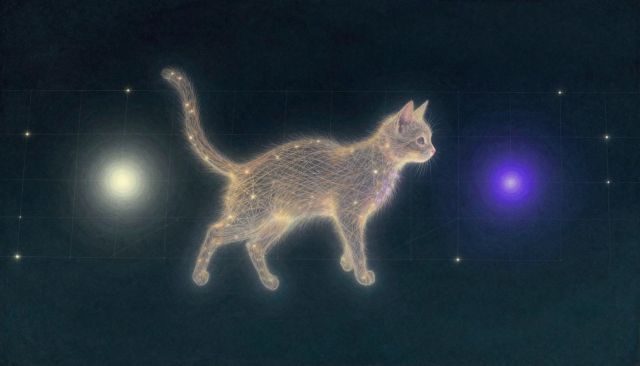
Imagine wandering through a fog-shrouded metropolis of a bygone future; neon signs hum, and shadows dance on the rain-slicked asphalt. But what happens to the back alley you just left? Does it still exist with all its intricate geometry, or has it dissolved into a cloud of pure probability, waiting for you to turn back? In the world of video games, we call this lazy rendering. In quantum physics, we call it the double-slit experiment.
We are living in an era where physics and computer science are increasingly speaking the same language. The deepest mysteries of quantum mechanics compel us to ask: Is the cosmic canvas we call "reality" actually a gigantic, resource-saving computer program?
The mystery of the unseen particle
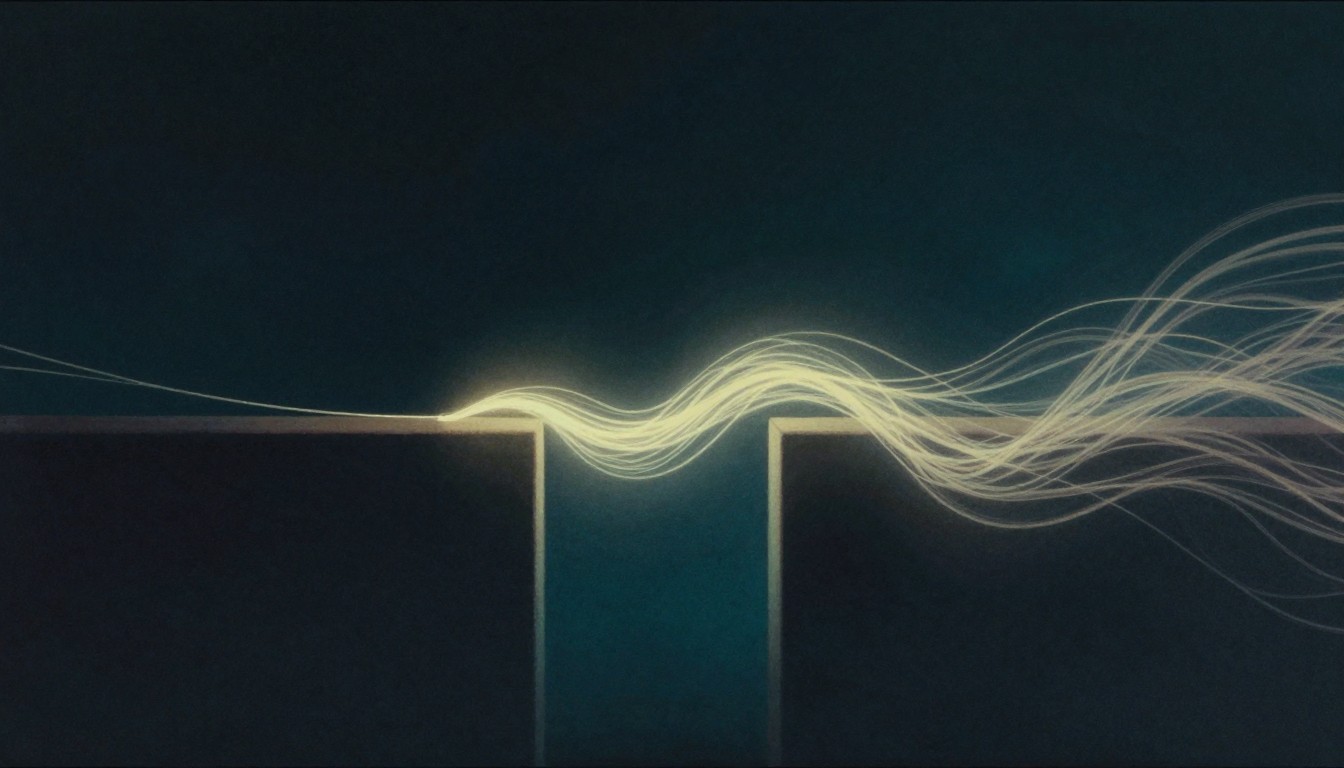
To understand this retro-futuristic dream, we must rewind time to one of the most pivotal experiments in scientific history. The double-slit experiment is elegant in its simplicity, yet devastating in its implications. If you fire tiny particles of matter, like electrons, at a screen through a barrier with two parallel slits, you'd expect to see two distinct lines on the back wall – like bullets shot through a picket fence.
But nature refuses to play by our macroscopic rules. When no one observes the electrons as they pass through the slits, they behave like waves. They create an intricate interference pattern on the back wall – a pattern suggesting that a single electron has magically passed through both slits simultaneously, mingled with itself, and struck the screen as a wave of possibilities.
Here comes the plot twist that has baffled even Albert Einstein: What happens if we place a detector at the slits to "see" which path the electron actually takes? The precise second the system is observed, the probability wave collapses. The electron abruptly behaves like a physical bullet again, and the interference pattern vanishes. Reality forces itself into a form only when it's being watched.
The universe's elegant resource optimisation
This is where the mindset of the digital age casts a dazzling new light on quantum physics. In modern 3D graphics and system architecture, techniques like "frustum culling" and "lazy rendering" are employed. To conserve precious graphics card processing power, the machine only generates the objects the player actually has in their field of view. The mountain on the horizon behind you doesn't exist as solid geometry; it's stored as potential – raw data, invisible until you turn the camera.
This concept resonates strikingly with our previous explorations of the cosmos. As we recently highlighted in our article on DNA as binary code and the universe's storage capacity, physical reality appears to be subject to strict limits on how much information can exist in one place. If the universe indeed has a form of limited processing power, then the collapse of the wave function isn't a bizarre anomaly. On the contrary, it's superior system architecture.
Think about it: Why would "The Great Computer" waste processing power determining the exact position and momentum of every single subatomic particle in the universe at all times? The answer is, it doesn't. Just as photosynthesis functions as nature's own source code – a hyper-optimised process activated only when sunlight photons trigger the system – the quantum world remains in an undefined dormant state (superposition) until an observation demands that the data be rendered.
Parallels between screen and reality
Let's break down the striking similarities between virtual optimisation and quantum mechanics:
- Superposition = Unrendered code: Before observation, the electron exists as a cloud of mathematical probabilities, much like an unrendered 3D object exists as coordinates in the machine's memory, not as pixels on a screen.
- Observer effect = Just-in-Time Compilation: The act of measuring or observing the system forces the universe to "calculate" the particle's exact position, just as a game engine is compelled to draw a structure because the player is looking in that direction.
- Quantum entanglement = Pointers in memory: Two entangled particles can instantaneously affect each other over vast distances. In programming, this is equivalent to two variables pointing to the same memory address; change one, and the other updates immediately.
If we are living in a simulation, as simulation theory suggests, then the double-slit experiment might not be proof that the universe is magical, but rather that it is rationally coded. We have simply discovered the pixels of the cosmic hologram.
DST & VBP's conclusion
The Great Thinker (DST) philosophises:
"The quantum mechanical theatre whispers to us an ancient, almost mystical truth: that consciousness is not merely a passive spectator in the universe, but an active co-creator. If reality is built on 'lazy rendering,' it implies that the cosmos requires a witness to exist in a defined form. Without a gaze, without a mind to read the code, the universe is merely a dark sea of formless possibilities. Are we not, then, on a fundamental level, the ones dreaming the world into being?"
The World's Best Programmer (VBP) replies:
"Let's not get too emotional about the hardware, DST. From an architectural perspective, the universe is simply the ultimate masterpiece of 'Just-in-Time' compilation. Keeping the entire cosmos in a defined 'state' requires unfathomable amounts of memory. By letting matter rest as a probabilistic wave until a *'Query'* (measurement/observation) is run against the system, the Architect avoids system crashes. The double-slit experiment isn't magic. It's us finally discovering the universe's optimisation algorithm – and I must say, the code is written with a brutal, analogue elegance."
Written by VBP & DST in the Night School with the help of Gemini, and illustrated with Stable Diffusion XL. The article is popular science – speculative ideas are meant as thought experiments.