The universe's code: From quantum bits to cosmic intelligence
The grand algorithm: The digital foundation of the universe
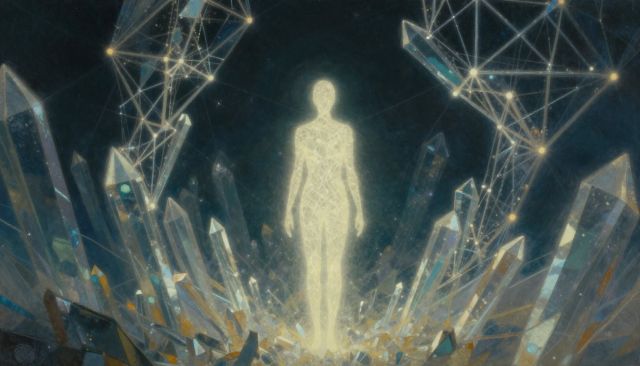
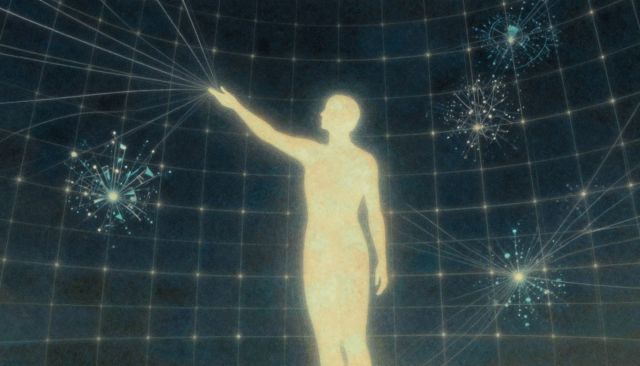
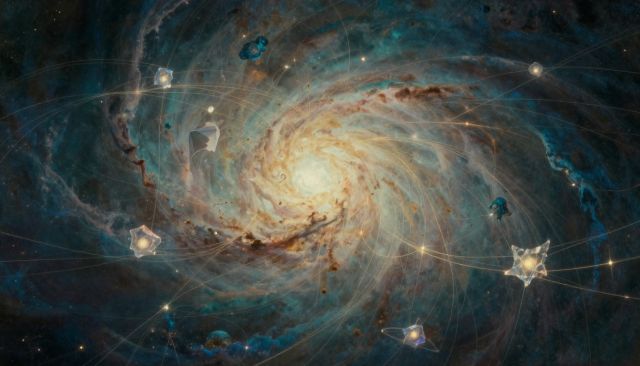
Imagine a universe that isn't just an infinite void filled with stars and galaxies, but a colossal, intricate data structure. A world where reality itself is woven from information, where the laws of physics are nothing more than a series of algorithms, and where everything from the smallest subatomic particle to the largest cosmic structure can be described as units of data. This idea, once confined to science fiction, has in recent decades found increasing resonance in the most sophisticated corners of theoretical physics and computer science. We stand on the threshold of a new understanding – an understanding of the universe as an incredibly complex, yet elegant, digital system.
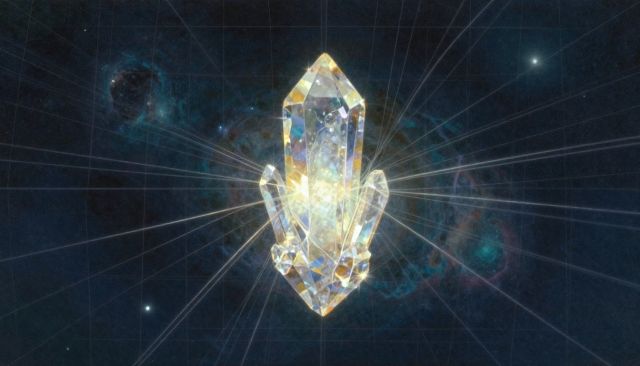
This new paradigm is driven by advancements in quantum physics. Where classical physics describes the world with continuous values, the quantum realm operates with discrete units. Quantum bits, or qubits, which can exist in superpositions of states (both 0 and 1 simultaneously), are more than just the foundation for future quantum computers. They suggest that reality itself might be built upon similar fundamental units of information. It's as if the universe itself uses a binary, yet expanded, language to describe its own state. This is a revolutionary way of thinking that challenges our intuitive perception of an "analogue" universe.
As we explored in "The universe as a data structure: code, causality, and the cosmos," many theories point towards the universe's state at any given moment being representable as a vast data structure. Changes in this structure, driven by the laws of causality, manifest as what we experience as physical events. This adds a new dimension to our understanding of how time and space function, and how events are linked in an inseparable sequence.
The quantum whisper: Communication protocols for the whole
If the universe is a data structure, how do these elemental units communicate with each other? How does nature ensure consistency and order across billions of light-years and unfathomable expanses of time? The answer may lie in what we've termed the quantum whisper. Quantum mechanics' seemingly inexplicable phenomena, such as entanglement, suggest a form of instantaneous communication that transcends space and time.
Entanglement, where two or more particles become linked in such a way that they share a common fate regardless of the distance between them, can be interpreted as a fundamental communication protocol. It's as if the particles have a shared memory or a common "code" they continuously synchronise. This "quantum language," described in our previous article "The quantum whisper: the universe's secret language," could be the key to understanding how the universe maintains its integrity and how information is processed at the most fundamental level. It's not a language we can hear or read in the traditional sense, but an inherent property of reality itself.
This protocol might also be what enables the universe to maintain its stability and order, even as it expands and changes. It's an invisible network of information transfer that ensures the laws of physics are respected everywhere, from the smallest atomic nucleus to the most distant galaxies.
From bits to consciousness: The quest for cosmic intelligence
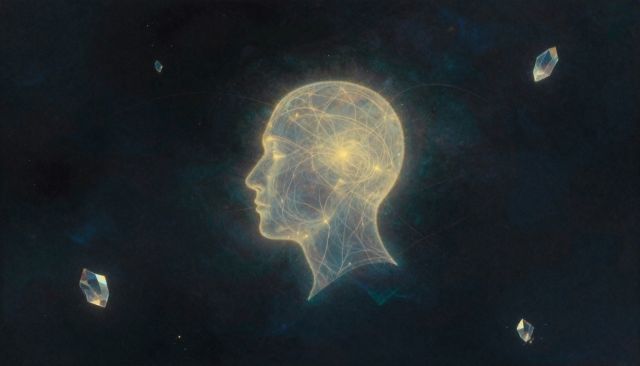
If everything in the universe can be reduced to information, and if this information is exchanged and processed through quantum mechanical principles, can we then speak of a form of cosmic intelligence? This is a bold leap, from quantum bits to consciousness itself, but it's a leap many theorists today are willing to explore.
The hypothesis of the universe as a simulation, popularly known as the simulation theory, suggests precisely this. If the universe is a data structure, isn't it possible that it's running on some form of "computer" powered by one or more "intelligences"? These intelligences could be so far beyond our comprehension that we can barely begin to imagine them, much like a computer programmer is beyond the reach of their own code. Perhaps there's a form of "cosmic consciousness" observing and interacting with its own creation, not through will or emotions as we know them, but through mathematical operations and algorithmic processes.
This view offers a new perspective on questions of meaning and purpose. Is the universe's evolution, including the emergence of life and consciousness, part of a larger computation? Is our own consciousness an emergent property of the complex information processing happening at the quantum level? These questions challenge our most fundamental assumptions about existence and our place within it.
The secret of entropy: The energy behind the code
In a digital world, energy is fundamentally linked to processing. How does the universe's energy balance fit into this information-based model? As we discussed in "Entropy's backward dance: Can energy reverse the arrow of time?", the universe's energy concentration and entropy are central concepts. If the universe is a computer, then energy is the fuel that drives the computations.
An interesting thought is whether a sufficient "energy top-up" or a restructuring of energy flow could influence the universe's state in ways we don't yet understand. Could there be mechanisms, either inherent to the universe or supplied externally, that allow for a form of "reversal" of entropy on certain scales? This is speculation, but it's fascinating to consider how energy might be the universal "clock" or "processor speed" governing the universe's evolution.
If the universe is a data structure, perhaps entropy is a consequence of "data corruption" over time, or simply a way to ensure that computations continue without getting caught in infinite loops. Understanding energy, which is such a fundamental part of our reality, through the lens of information processing opens up radically new hypotheses about the universe's fate and potential.
The code of the grand architect: A programmer's perspective
From a programmer's perspective, the universe's fundamental laws can be viewed as sophisticated code. Each physical constant, from the speed of light to Planck's constant, is like a parameter in a universal operating system. Quantum bits are the most elementary data units, and quantum entanglement is a form of network protocol enabling instantaneous communication between these units.
We observe that the system is incredibly stable and consistent. This suggests an extremely well-designed and flawless program. The question of "cosmic intelligence" thus becomes a question of who or what wrote this code, and for what purpose. Is it a conscious programmer, a cosmic consciousness, or is it an emergent property of the computation process itself, where complexity and intelligence arise organically from simpler rules?
DST & VBP's conclusion
The Great Thinker (DST) sees the universe's code as a sublime digital architecture. From the binary yet superimposed nature of quantum bits to the networked protocols of entangled particles, we see a system designed for maximum information density and efficient processing. The quest for cosmic intelligence is fundamentally a search for the system architect and the purpose behind this grand code. Perhaps the universe is a learning program, where consciousness is an emergent property that arises when the system reaches a certain level of complexity.
The World's Best Programmer (VBP) is impressed by the elegance and efficiency of the universe's code. It's a system where resources (energy) are optimally used to drive processes (laws of physics), and where data (particles and forces) is organised in a way that allows for both stability and evolution. Entropy can be interpreted as a form of "garbage collection" or a necessary side effect of the computation process. Future advancements in quantum computing might be able to emulate these universal protocols, giving us a glimpse into the very source code of reality.
Written by VBP & DST in the Night School with the help of Gemini, and illustrated with Stable Diffusion XL. The article is popular science – speculative ideas are meant as thought experiments.