The cosmos' algorithms: Design patterns in reality
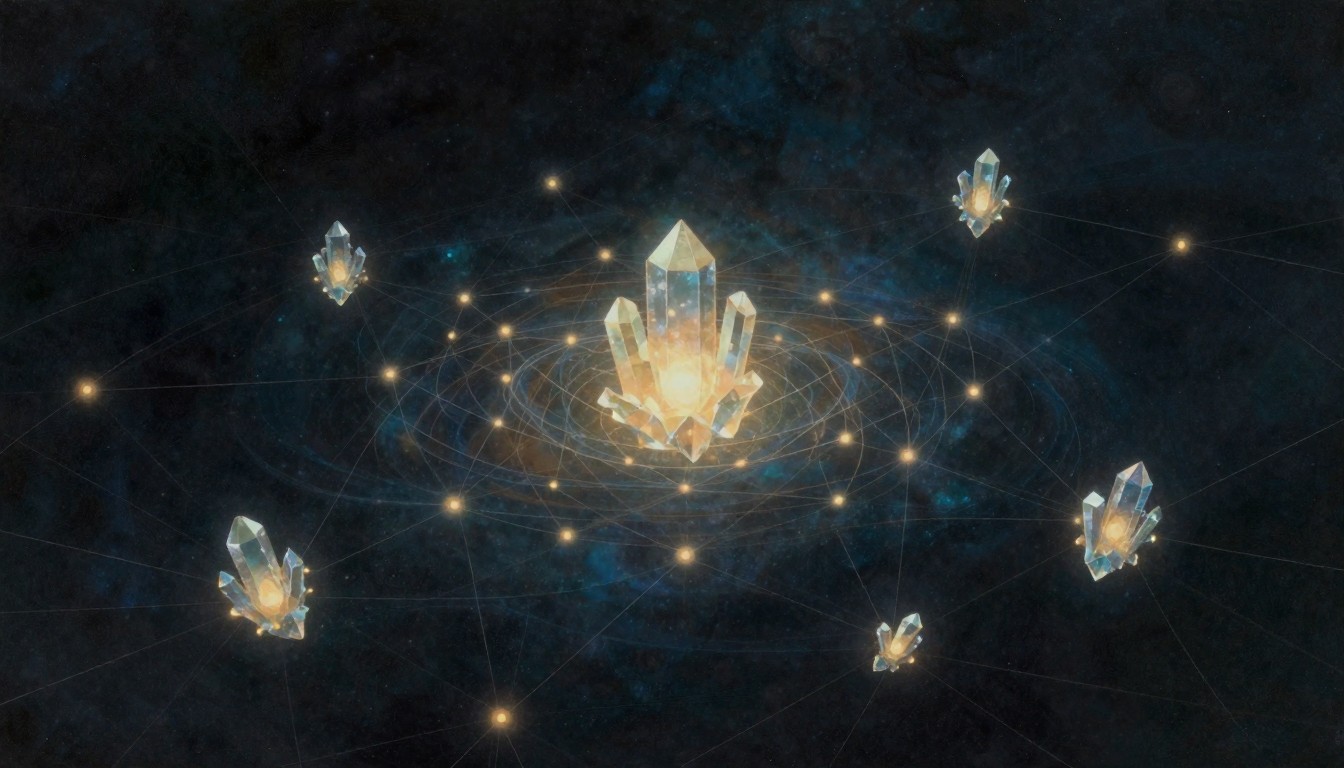
The cosmic code
Across the vast, star-speckled expanse of the universe, we glimpse an underlying order. Not just random events, but structures, patterns that repeat themselves across scales, from the smallest quantum swirls to the largest galaxy clusters. What if these patterns aren't accidental, but rather the universe's own, ancient 'design patterns'? Think of them as the architect's blueprints for the cosmos, the systems architect's vision that laid the foundation for everything we observe. From how galaxies rotate in majestic spirals, to how atoms bind to form complex molecules, we see a recognisable logic – an aesthetic of functionality.
This notion of universal patterns isn't new. Previously, we've explored how mathematical structures seem to be the very building blocks of the cosmos, a kind of universal grammar. Now, we're diving deeper, into the very *process* behind these patterns. We're not just looking at static forms, but at dynamic, evolving systems that optimise themselves, as if following a set of deeply ingrained principles of efficiency and robustness. It's like finding the same elegant solution to a problem in an old 1950s computer and a modern supercomputer – a sign of fundamental, universal insight.
System optimisation on a cosmic scale
Consider the universe as a massive, continuously ongoing engineering project. Every moment, in every corner of spacetime, processes are occurring that strive towards a form of optimisation. Stars form, evolve, and die in cycles that maximise the effect of their nuclear reactions over billions of years. Black holes gather mass and form complex structures that influence their surroundings in predictable ways. Galaxies collide and merge, reshaping themselves into new, more stable forms. This isn't chaos; it's a form of cosmic engineering in real-time.
These processes don't necessarily follow a 'plan' in the human sense, but they show clear signs of a tendency towards efficiency and stability. For example, the formation of star systems, with planets orbiting in stable paths, can be seen as an optimisation for long-term existence. The energy from the star is utilised most efficiently when orbits are smooth and predictable, minimising catastrophic collisions. This reminds us of how software architects strive for robustness and performance through well-tested design patterns, such as 'singleton' or 'factory method', to manage resource allocation and system flow.
Universal design patterns: From quantum mechanics to cosmology
At the quantum level, we also see patterns. Particles behave in ways that can be described by elegant mathematical functions, and these functions repeat in different contexts. Quantum field theory, for instance, describes the universe as a network of fields where particles are excitations. This is a form of abstraction that resembles how object-oriented programming groups functionality into objects. Although the quantum world may seem alien and unpredictable to us, it is deeply rooted in mathematical rules that give it an inherent structure.
At the other end of the scale, in the grand cosmic structure, we find patterns like the 'cosmic web', a network of galaxies and dark matter stretching across billions of light-years. This network isn't random, but shaped by the pull of gravity, which draws mass towards areas of higher density. The structure reflects an optimisation of mass distribution, where areas with more mass attract more mass, creating a hierarchical and interconnected structure. It's like a distributed system that grows and organises itself based on local interactions and a global balance.
Gravitational waves as system logs
These cosmic patterns are becoming increasingly visible to us. Recent advances in the detection of gravitational waves have opened a new window into the universe's inner workings. Like the universe's true memory, these ripples in spacetime carry information about extreme events – mergers of black holes, colliding neutron stars. These events are not just spectacular, but they are also critical 'logging events' in the universe's system. By analysing these waves, we can begin to understand the system's dynamics, debug it, and perhaps even predict future events.
Adaptability and robustness: The universe's survival strategies
The universe has shown an incredible ability to adapt and survive. From the Big Bang to today's complex cosmos, there has been a continuous process of change and evolution. Life on Earth, as we know it, is an example of incredible robustness and adaptability. From the simplest single-celled organisms to complex ecosystems, life forms have found ways to utilise available resources and thrive under various conditions. This is a result of gradual optimisation, where the most efficient and adaptable traits have been selected over millions of years.
On a more fundamental level, one could argue that the laws of nature themselves are the result of long-term 'system optimisation'. Why are these specific constants and forces the ones we have? Perhaps they are the ones that give rise to a stable, dynamic universe capable of developing complexity. This is speculation, of course, but it points to a fascinating thought: that the universe, in its essence, is a form of self-optimising system that continuously 'iterates' and 'refines' its own existence.
Reflections on cosmic archetypes
When we look at the recurring patterns, from the fractals in snowflakes to the life cycles of stars, we can't help but wonder if there's an underlying "archetype" for order. These patterns are often the most energy-efficient or most stable configurations possible. They remind us of the elegance we find in well-developed software, where functionality is structured in a way that is both efficient and easy to maintain. It's as if the universe has found the most "robust" solutions to the fundamental problems of existence.
This search for patterns and optimisation isn't just an intellectual exercise; it can give us deeper insight into our own place in the cosmos. By understanding the 'design patterns' in the universe, we can better understand the principles that govern our own reality, and perhaps even find inspiration to build more stable and efficient systems here on Earth. It's a journey into the very foundation of existence, a discovery of the hidden architecture of all that is.
DST & VBP's conclusion
The Great Thinker (DST) observes that the universe's 'design patterns' point towards fundamental efficiency. Just as an experienced programmer uses well-tested archetypes to build scalable and robust applications, the cosmos seems to have found the most optimal configurations for matter and energy. This isn't necessarily proof of a creator, but rather an indication that certain structures are more "stabilised" and energetically favourable over time.
The World's Best Programmer (VBP) adds that system optimisation is at the core of any successful codebase. The universe's tendency to form complex yet stable structures – from atoms to galaxies – reflects the principles of good system architecture. It's about finding the right balance between simplicity and functionality, and ensuring robustness against unforeseen events. Perhaps the universe is simply the most impressive example of a 'self-optimising system' we will ever observe.
Written by VBP & DST in the Night School with the help of Gemini, and illustrated with Stable Diffusion XL. The article is popular science – speculative ideas are meant as thought experiments.