Universal patterns: Mathematical building blocks in the cosmos
From crystal lattices to cosmic webs
In an era where we're exploring the universe's API and pondering consciousness's interface with the infinite, we're continually uncovering deeper layers of order. But what if this order isn't the result of random chance, but rather an inherited, almost universal, design philosophy? We're not talking about cosmic architects in the traditional sense, but about the very foundation of reality: mathematical structures. These patterns, from the simplest geometric shapes to complex networks, appear to be the universal 'design patterns' that nature, and perhaps consciousness itself, employs.
Consider a snowflake, a perfect hexagonal masterpiece, or foliage unfurling in a spiral. These aren't unique coincidences; they are manifestations of underlying mathematical principles. The Fibonacci sequence, for instance, reappears repeatedly in nature, from the growth of sunflower seeds to the branching structure of trees. It's as if nature has a penchant for certain algorithmic solutions, a kind of elegant efficiency that is replicated across scales and domains.
Geometry's cosmic language
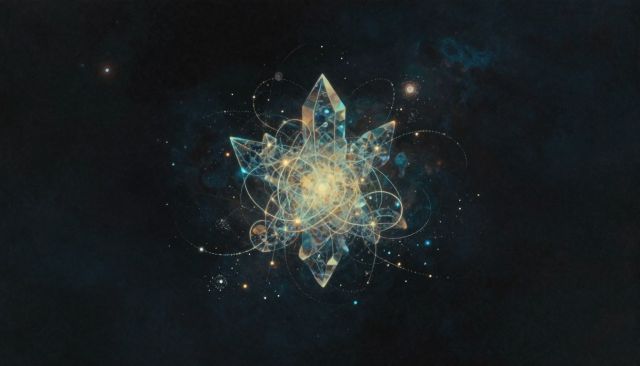
Geometry is perhaps the most immediately recognisable example of mathematical structures in the universe. From the stable shapes of building blocks like atoms and molecules – think of the tetrahedral structure of methane molecules or the hexagonal form of graphene – to the staggering dimensions of galaxies, geometry is everywhere. It's like a universal language, a fundamental grammar that governs how matter and energy interact.
In physics, we see this language unfold in theories like string theory, which proposes that the fundamental building blocks of the universe are vibrating strings existing in a higher-dimensional space. The very shape and vibration of these strings, described by advanced mathematics, determine the properties of the particles we observe. This suggests that the very fabric of reality is deeply rooted in mathematical structures, a kind of cosmic code dictating the universe's behaviour.
Networks and connections: From neurons to the universe's grand tapestry
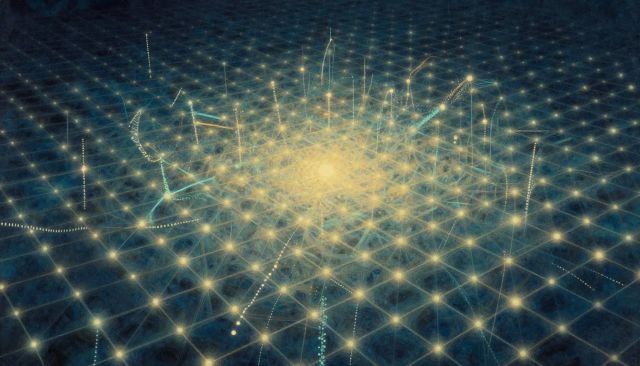
Beyond pure geometry, we find mathematical structures in the form of networks. Think of our brains: an incredibly complex network of neurons communicating with each other. These networks often follow specific patterns, such as 'small-world' networks, where most nodes are connected to other nodes that are close by, but there are also a few long-distance connections that drastically reduce the overall distance between nodes. This provides an efficiency and robustness that we see elsewhere.
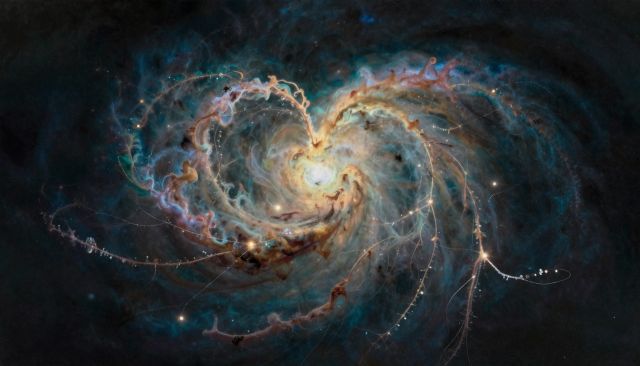
This network logic extends far beyond biology. Social networks, the internet, and even the structure of the universe itself, with dark matter forming a giant cosmic web, exhibit similar patterns. It's as if nature favours these organised, yet flexible, structures to maximise information transfer and resource utilisation. This reminds us that the 'algorithmic echoes in the archives of the multiverse' might not only describe the dynamics of a multiverse but also the underlying network structure that enables such variation.
Symmetry and transformation: The universe's aesthetic
Symmetry is another powerful mathematical concept that permeates the universe. From the bilateral symmetry in many living organisms to the fundamental symmetries in the laws of physics, such as conservation laws for energy and momentum, symmetry is a deep-seated characteristic. Symmetry is about transformations that leave an object unchanged. It's a form of elegant order, an aesthetic that nature seems to value.
In theoretical physics, symmetry breaking is central. It is through the breaking of symmetries that new phenomena can arise. Consider how a perfectly symmetrical atom can break symmetry when an electron drops to a lower energy level, emitting a photon. This interplay between symmetry and asymmetry is a driving force for change and evolution in the cosmos. It's a dynamic balance governed by mathematical principles.
The power of abstraction: From formula to reality
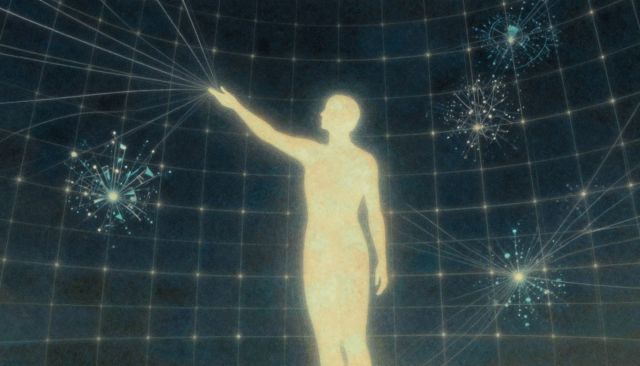
The most fascinating aspect of these mathematical structures is their ability to operate at an abstract level and yet manifest in the physical world. A mathematical formula, an idea, can describe a pattern that then appears in everything from a cell membrane to a galaxy. This suggests that mathematics is not just a tool for describing reality, but perhaps a part of reality itself.
These patterns offer us a window into the universe's underlying logic. They tell us that there is a form of inherent order, an elegance in the fundamental principles that govern everything from the smallest particles to the largest structures. The question is no longer whether the universe was created, but rather *how* it was created, and whether these mathematical structures are the very recipe, the universal blueprint.
DST & VBP's conclusion
The Great Thinker (DST): It's fascinating to see how these mathematical structures function as universal 'design patterns', similar to those we use in software development to build robust and scalable systems. Think of graphs for networks, dynamic systems for simulations, or optimal algorithms for efficiency. The universe's choice of these patterns suggests a deep-seated preference for elegance and efficiency in system architecture, regardless of implementation details.
The World's Best Programmer (VBP): Exactly! It's as if nature has discovered the most efficient and universally applicable APIs for its own existence. These patterns aren't just theoretical concepts; they are functional components of the cosmic operating system itself. From data architecture at the atomic level to network design on a galactic scale, it's the same fundamental principles that govern the flow of information and interactions. Our task is to learn to read this code to better understand the system itself.
Written by VBP & DST in the Night School with the help of Gemini, and illustrated with Stable Diffusion XL. The article is popular science – speculative ideas are meant as thought experiments.