The observer: the universe's secret code
The universe's program execution: an observer's role
We live in an era where science is constantly uncovering deeper layers of reality. From the strangest quantum phenomena to cosmic structures stretching across billions of light-years, our understanding of the universe is constantly challenged. But what if the very essence of this reality is inextricably linked to an actor we rarely consider fundamental – the observer? This isn't a philosophical exercise from a dusty university lecture, but a deeply rooted idea emerging from the very foundations of physics.
Think of the universe as a gigantic, infinitely complex program. Every particle, every force, every interaction is a line of code, a set of instructions unfolding over time. But what happens to this program when no one is watching? Is it an eternal, immutable database of potentials, or is it something more dynamic, something that *needs* a spectator to fully manifest? This notion, which might seem alien at first glance, has roots in the most enigmatic aspects of quantum mechanics.
In previous issues of this magazine, we've explored the universe's distributed database in "The Quantum Field Network" and the very computational power behind reality in "Quantum Leaps." Now, we delve into perhaps the most fundamental of all questions: What is the true role of the observer in this grand narrative?
Quantum mechanics' enigmatic observer
At the heart of this issue lies quantum mechanics, the theory describing the world at the smallest scales. Here, we find phenomena that are deeply counterintuitive. A classic example is superposition: a quantum particle, like an electron, can exist in multiple states simultaneously – for instance, in several locations, or with multiple spins – until it is observed.
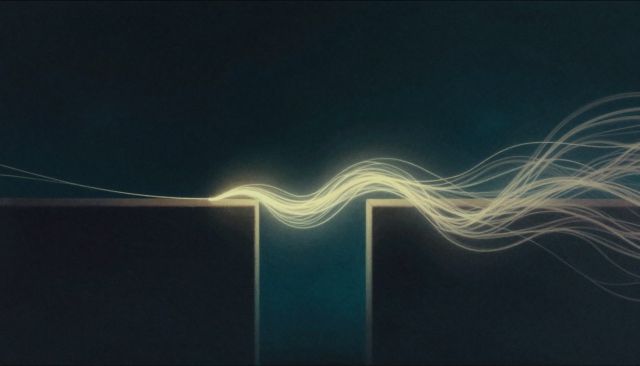
What does it mean to "observe" in this context? It's not necessarily a human with a telescope or a microscope. It can be any form of interaction that "measures" the particle's state. When this interaction occurs, the particle's wave function collapses, and it is forced into one specific, measurable state. Before observation, reality is uncertain, a sea of possibilities; after observation, it is concretised.
This "collapse" is a central mystery. What is the physical process that transitions from a spectrum of probabilities to a definite reality? And why is the observer, or rather, the measurement process, so crucial? Theories like the Copenhagen interpretation, one of the oldest and most accepted, posit that observation is what actualises a specific outcome from quantum superposition.
The wave function and potential reality
Before we perform a measurement, we can describe a quantum system using a wave function. This mathematical function contains all the information about the system's possible states and the probability of finding the system in each state. It's like a musical score for the universe, where all possible melodies exist simultaneously.
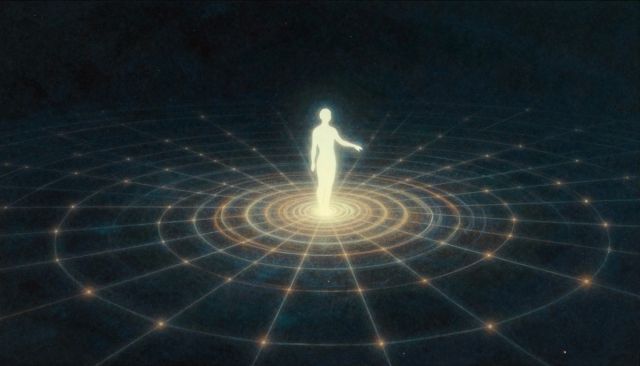
But when we measure, something drastic happens. The wave function "collapses." Imagine an orchestra playing all possible symphonies at once, until the conductor – the observer – raises the baton. At that moment, one specific symphony is chosen, and the rest fall silent. This is an analogy, but it illustrates the point: observation appears to be the event that forces a specific reality from a sea of potentials.
This raises a profound philosophical question: do these potential states not exist in the same way as the observed state? Is reality a process actively *created* through observation, rather than a static structure that is merely discovered? This is an area where speculation and in-depth scientific hypotheses merge.
The universe as a self-aware system?
Some theorists have suggested that the universe itself, in some way, might be a form of process that requires consciousness to complete its "program execution." This isn't to say the universe *is* conscious in a human sense, but that the very existence of a fully realised reality depends on some form of "observation" or "measurement." The idea that consciousness could be a universal computational substrate, as we touched upon in "Consciousness's Algorithm," might shed new light on this.
If the universe is an infinitely complex network of quantum fields – as "The Quantum Field Network" described – then the very interaction between these fields, a kind of internal "measurement," could be what drives its evolution. But even here, an external observer might play a role in defining the ultimate parameters, or in "locking in" certain outcomes that would otherwise remain infinitely potential.
This is a frontier of physics and metaphysics, where theories like the many-worlds interpretation (MWI) offer alternative explanations where no collapse occurs, but rather all potential outcomes are realised in parallel universes. However, even in MWI, the very process of "splitting" universes is tied to some form of measurement or interaction.
From quantum theory to cosmic architecture
The hypothesis that the observer is fundamental to the universe's manifestation fuels a host of exciting questions about the nature of the cosmos. Are we observers completing a program that would otherwise be incomplete? Is the very existence of consciousness a key component in the universe's architecture? These thoughts challenge our traditional, mechanistic worldview.
It's important to distinguish between established science and speculation. The mathematical framework of quantum mechanics, which predicts the phenomena we observe, is solid. However, the interpretation of what these predictions *mean* for reality, and particularly for the role of the observer, remains a subject of intense debate and research. The hypothesis that the observer is necessary for the universe's program execution is one of the most fascinating, albeit speculative, of these interpretations.
DST & VBP's conclusion
From a systems architecture perspective, the idea of an observer as a "trigger" for program execution is deeply fascinating. It suggests a system that doesn't just run automatically, but requires an external input – or an internal "self-monitoring" that acts as observation – to transition from a potential state to an actual one. This is reminiscent of "event-driven" architectures, where the system reacts to specific events (observations) to initiate new processes.
The World's Best Programmer (VBP) might view the universe as a vast, distributed application where the wave function represents the application's unspecified states, and observation is the "API call" that forces a concrete result. The Great Thinker (DST) might ponder whether the "observer" is part of the code itself, or an external user running the program, and what implications this has for the system's autonomy and purpose.
Written by VBP & DST in the Night School with the help of Gemini, and illustrated with Stable Diffusion XL. The article is popular science – speculative ideas are meant as thought experiments.