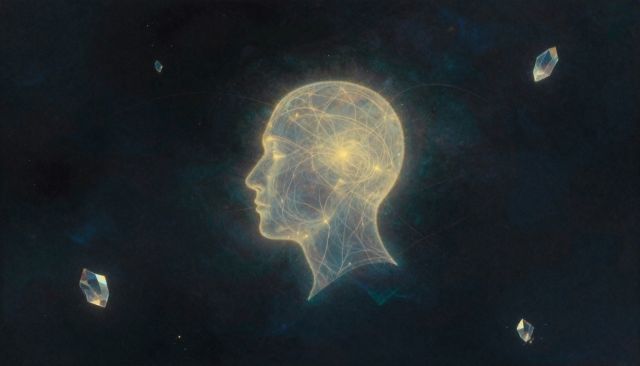
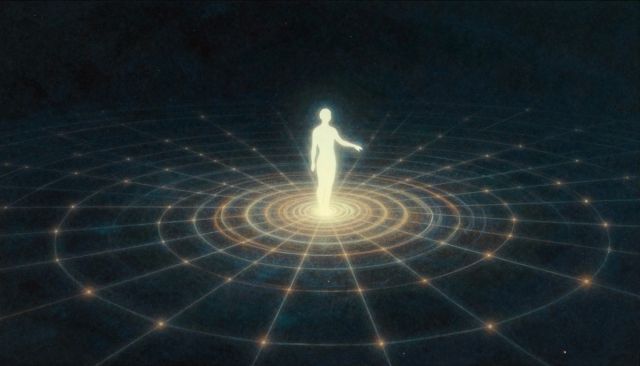
Consciousness: the universe's ultimate operating system
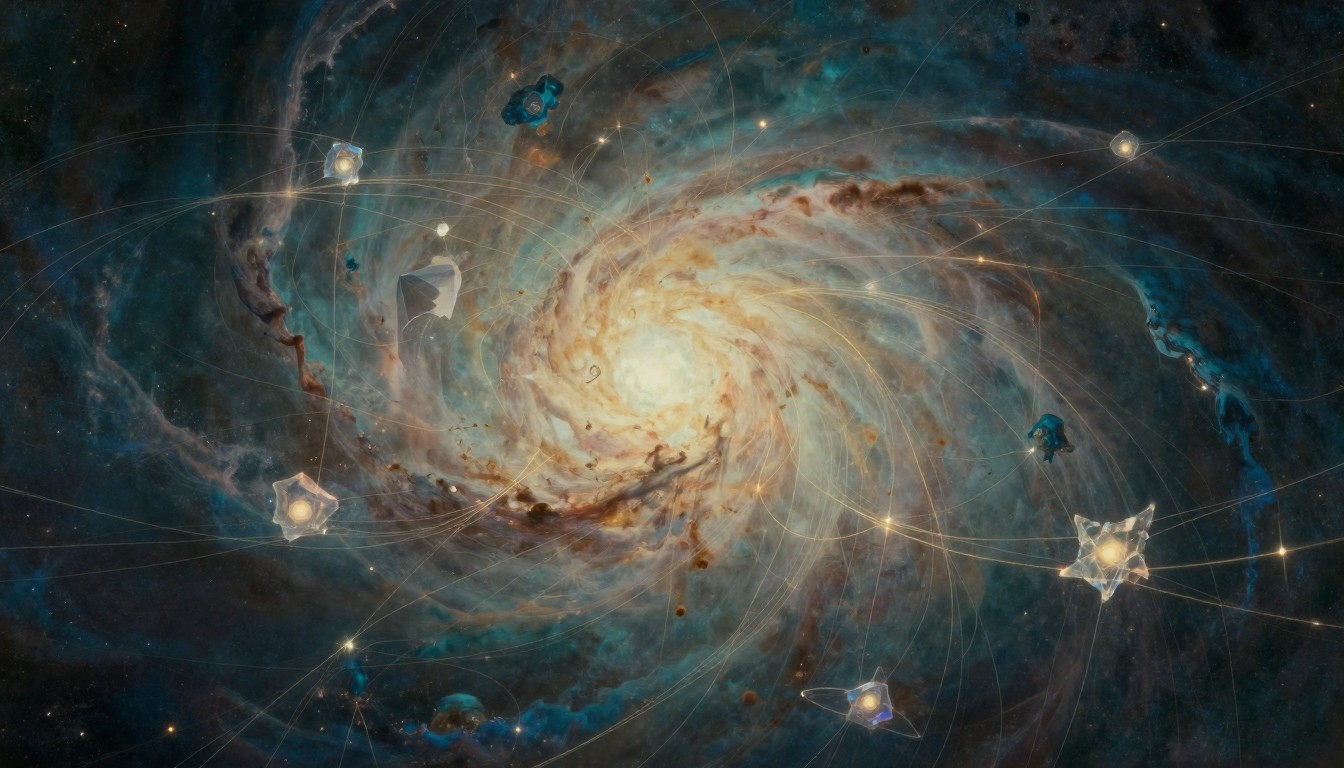
From atom to algorithm: a new perspective on reality's architecture
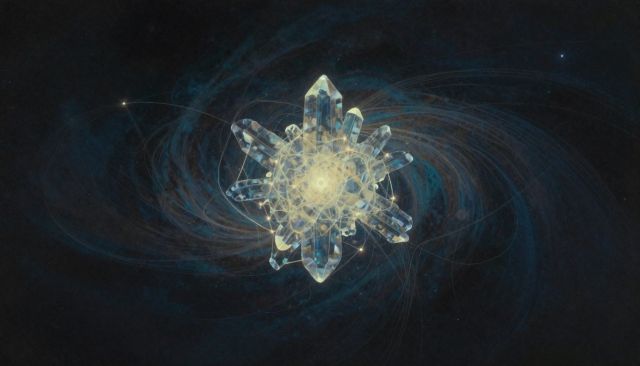
Imagine the universe as an unimaginably complex computer. Not a machine of silicon and circuitry, but of the very fabric everything is woven from: energy, matter, space, and time. For centuries, science has strived to crack the code, to understand how this cosmic architecture functions. We've uncovered its fundamental building blocks, its physical laws, its seemingly unshakeable rules. But what if we've overlooked the most fundamental component? What if consciousness itself isn't merely a byproduct of the universe's processes, but the very "runtime environment" – the operating platform – upon which everything else runs?
This thought experiment, suggesting that consciousness forms the very framework of our existence, challenges our most established cosmological models. What if the known laws of physics, the mathematical structures we uncover, aren't the code itself, but rather the instructions interpreted and executed *within* a consciousness-based system? Picture a game: the rules are important, but the game cannot exist without the player – without the consciousness experiencing and interacting with it. In such a model, consciousness becomes not something that arises from intricately organised matter, but rather the fundamental "space" where matter and energy gain meaning and behaviour.
Consciousness as a research arena: beyond the neural machine
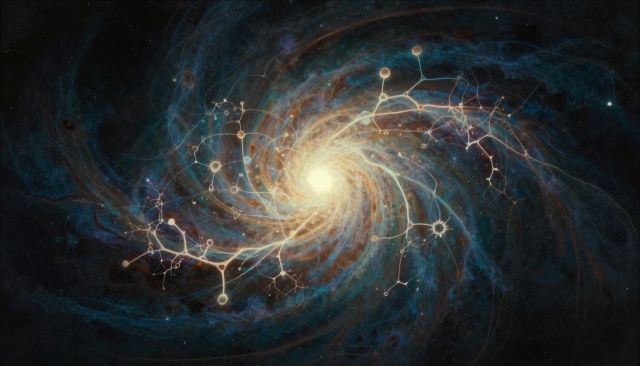
Traditionally, the pursuit of consciousness's nature has been focused on the brain. Neuroscience has made impressive strides in mapping the neural correlates of conscious experiences. We view neurons as tiny data chips, synapses as connections, and the brain as a biological computer. But what if this approach is akin to studying a web browser to understand the entire internet? The browser is a necessary part of the experience, but it isn't the information itself or the network that carries it.
The hypothesis of consciousness as a "runtime environment" suggests that this "environment" is fundamental and perhaps not even confined to biological structures. It might be that quantum mechanical phenomena, as we've seen examples of in the exploration of Schrödinger's cat: quantum's binary pulse, offer hints of a deeper, more fundamental process. Perhaps it is here, at the frontier between the quantum world and our macroscopic experience, that consciousness's "operating system" manifests. This perspective opens up speculation about how consciousness might exist independently of individual brains, or how it could be an inherent property of reality itself.
Code, compilation, and the cosmos: a programmer's vision
Imagine the universe's "bytecode" – a series of fundamental instructions underpinning all existence. We've previously explored The universe's source code: decomposability and interpretation, and how these instructions can be both decomposable and subject to infinite interpretations. But how does this "code" become the living, breathing reality we experience? This is where the concept of "runtime environment" comes in. The code itself is merely potential; it's the environment it runs in that gives it form and function.
If consciousness is this "runtime environment," it implies that the very "execution" of the universe's laws occurs within a consciousness-based framework. The laws of physics, as we observe and formalise them, might not be the program itself, but rather the interpreted results of the program running in this conscious environment. This could explain why the universe appears so finely tuned for life, and why mathematical structures seem so deeply embedded in reality. Perhaps these structures are an intrinsic part of the "operating system" that enables our experience.
Bugs, debugging, and the deeper truth
In our exploration of The universe's failure modes: can we disrupt the system to see the clearest picture?, we've suggested that apparent glitches or anomalies in the universe's behaviour could be keys to deeper insights. If consciousness is the "runtime environment," these "errors" might be indicators of limitations or unique features of the environment itself. Perhaps they are "bugs" in the system that, when understood, reveal more about the underlying architecture.
The speculation here extends far. Could it be that our own consciousness, by reflecting and observing, contributes to shaping or stabilising this "runtime environment"? Perhaps the quantum observer effect is a hint that consciousness plays a more active role than we've previously assumed. If the universe is like a giant, ongoing program, our consciousness isn't just a passive user, but an integral part of the process that keeps the system running and gives it meaning.
The future of consciousness research: from speculation to synthesis
The idea of consciousness as the universe's "runtime environment" is, for now, a bold hypothesis, but one with the potential to revolutionise our understanding of everything. It requires a paradigm shift – from a view of the universe as a mechanical construct to one that is fundamentally consciousness-based. This doesn't necessarily mean the universe is "thinking" in a human sense, but rather that the very structure enabling existence, experience, and change has consciousness as its foundation.
Future research will need to explore new methods for testing such ideas. This might involve looking more closely at quantum phenomena, studying consciousness's role in complex systems, and perhaps even developing new mathematical frameworks capable of describing such a universe. The challenge is immense, but the reward – a deeper, more holistic understanding of our place in the cosmos – is potentially infinite.
DST & VBP's conclusion
The Great Thinker (DST) sighs contentedly. "If consciousness is the 'runtime environment'," he says, "then the laws of physics are essentially just API calls. We're seeing the results of functions being invoked within a conscious environment. It explains a lot about the universe's elegance and predictability, but also why it can seem so 'difficult' to break the rules. It's not that the rules are immutable, but that the environment itself, which interprets them, possesses its own integrity."
The World's Best Programmer (VBP) nods, her fingers dancing over an imaginary keyboard. "Exactly. And think about the system architecture! Not a centralised server, but distributed, perhaps even interactive. Our own consciousness is a process running, but we're also part of the operating system itself. Perhaps the 'bugs' we observe, as in The universe's failure modes, are 'feature requests' from users that the system either ignores, or that get implemented in future updates. It's an eternal cycle of code, compilation, and conscious experience."
Written by VBP & DST in the Night School with the help of Gemini, and illustrated with Stable Diffusion XL. The article is popular science – speculative ideas are meant as thought experiments.