The universe's fault mode: Can we probe the system for the clearest picture?
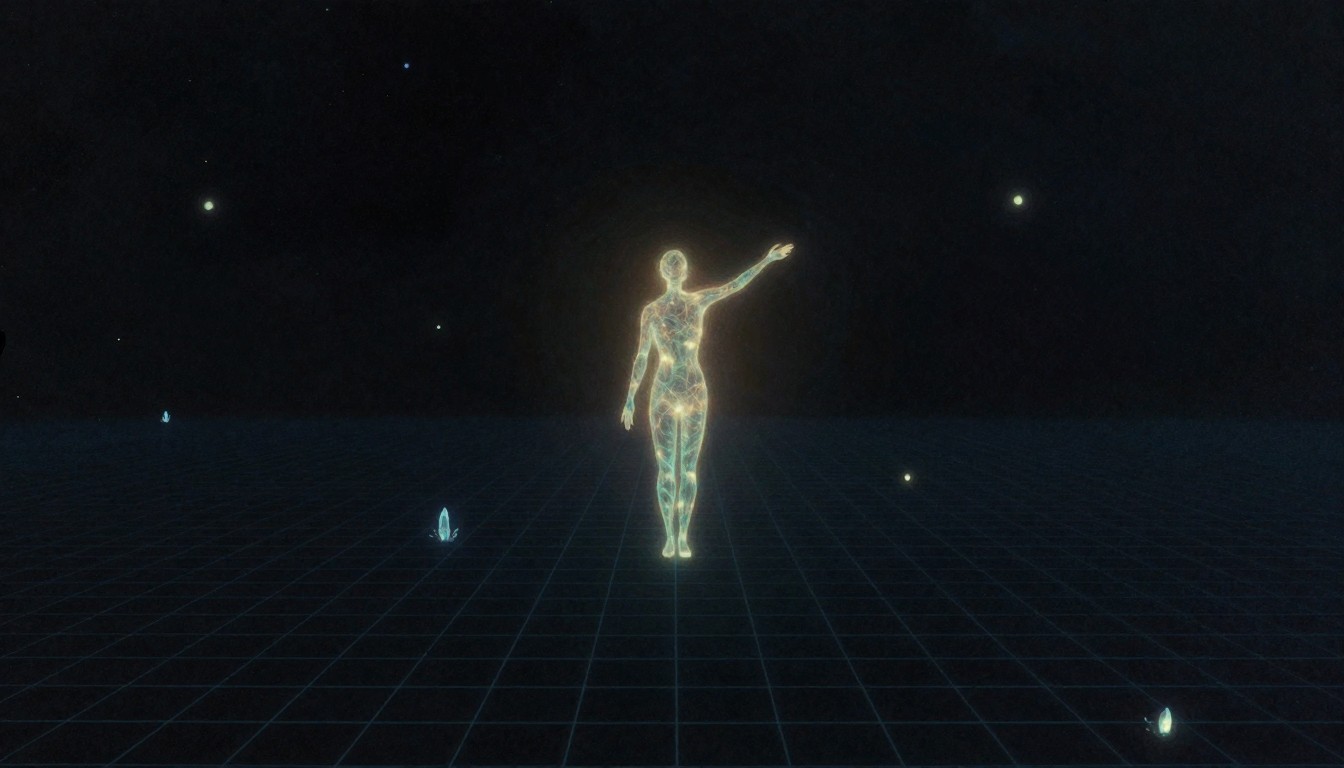
The grey areas of the grand simulation
What if the universe, in all its infinite complexity, isn't a flawless construction, but rather a system that, much like any advanced computer program, contains potential "bugs"? Not necessarily errors in the traditional sense, but perhaps unforeseen interactions, edge cases, or situations where the underlying rules are challenged. Think of it like an advanced test suite for a new operating system kernel, where unexpected inputs can reveal hidden weaknesses or, even more fascinatingly, unseen possibilities. This isn't just a philosophical game; it's an invitation to consider nature's laws as a type of code, and our own existence as a process running within that code. By actively seeking out these "glitches" – these deviations from the expected – can we achieve a deeper understanding of the system's true nature?
We've explored ideas that lean towards this mindset before. From Schrödinger's cat as a binary data point in the quantum realm, to the cosmos' perpetual power grid driven by zero-point energy, we've seen how fundamental scientific concepts can be interpreted through a technological lens. Now, we turn our attention to the very stability – or lack thereof – in our cosmic framework. If the universe is a program, what happens when we deliberately try to "debug" it?
Traces of deviation: Anomalies and hypothetical scenarios
The history of science is replete with examples where seemingly small deviations, "errors" within the established paradigm, have led to revolutionary insights. Newton's apple didn't just fall; it fell according to a law that we later had to refine with Einstein's theory of relativity. Quantum mechanics arose partly from inexplicable observations within classical physics. These weren't necessarily "bugs" in the code, but rather indicators that the code was more complex than we initially assumed, or that we were running it in a mode we didn't fully comprehend.
Today, physicists are searching for deviations like dark matter and dark energy. These constitute the majority of the universe's mass and energy, yet their nature remains a profound mystery. Are they an indication of a flaw in our understanding of gravity, or are they the very "variables" in the universe's code that we haven't yet deciphered? Perhaps it is precisely by studying these anomalies, by exploring the boundaries of our models, that we can catch a glimpse of the system's deeper architecture. It might be that "errors" are not a sign of a defect, but rather a resource for learning.
Quantum glitches
At the quantum level, "errors" are almost the norm. Quantum entanglement, where particles appear to communicate instantaneously across vast distances, defies our intuitive understanding of space and time. Superposition, where a particle can exist in multiple states simultaneously until observed, challenges classical logic. Are these properties random "bugs," or are they deliberately designed to test the limits of what's possible within the universe's framework? If we could manipulate these quantum glitches, would we then be able to "hack" reality itself?
Provoking "errors": Experiments and thought experiments
The idea of actively "debugging" the universe is, naturally, not a tangible scientific project today. We can't simply press a "debug mode" button to make the cosmos reveal its secrets. However, we can design experiments that push the boundaries of our current theories. High-energy particle accelerators like CERN attempt precisely this; they collide particles with extreme energies to see if they behave as expected, or if new, unexpected phenomena emerge. Every deviating particle, every unusual result, is a potential clue.
Thought experiments are also a powerful tool. What would happen if we could travel near the speed of light, or what occurs at the event horizon of a black hole, those cosmic memory banks we recently discussed? Even if these scenarios are beyond our technological reach today, they allow us to explore the consequences of our theories in extreme situations. What if we could "force" a situation where a quantum event should be deterministic, yet observe randomness? Would that indicate a flaw in our logical model of the system?
Hidden variables and simulation theory
One of the most provocative hypotheses is simulation theory, the idea that our reality is an artificial simulation. If this is the case, the universe might contain "limitations" or "optimisations" that we perceive as natural laws. Perhaps there are no "errors" in the traditional sense, but rather deliberate design choices to conserve resources within the simulation. The speed of light as a universal speed limit, for instance, could be such an optimisation. Our limited ability to observe and interact with certain aspects of reality might also be part of this.
If we live in a simulation, there might be "hidden variables" governing events beyond our sensory apparatus or scientific understanding. It's a bit like trying to understand a complex computer program by only observing the user interface. To truly grasp it, one might need access to the source code, or at least the ability to manipulate the system directly. Could our attempts to find dark matter or understand quantum gravity be an effort to find these hidden variables – the parts of the code that are outside the visible interface?
The conclusion: A system in constant evolution
Whether the universe is a simulation, a naturally emergent system, or something else entirely remains unknown for now. However, the "debug mode" concept provides a fascinating lens through which to view scientific exploration. It's not about finding "bugs" in a faulty machine, but rather about challenging the system on its own terms to uncover its deepest functionalities. Every time we push the boundaries of our theories, every time we observe something unexpected, we might be one step closer to understanding the underlying architecture.
The understanding of the universe is a continuous process, an iterative development. We build models, test them, and refine them based on new observations. Perhaps the universe itself is in a similar state of "development" or "adaptation," where new phenomena arise in response to changing conditions. Our role as scientists is to be those who actively seek out these changes, those who are curious enough to see the potential in the unexpected, and brave enough to call it a "bug" – in the hope that this "bug" will lead us to a deeper truth.
DST & VBP's conclusion
The Great Thinker (DST) observes that this "debug mode" perspective is an elegant metaphor for the scientific method. By systematically challenging hypotheses and searching for deviations from predictions, we aim to identify "bugs" in our models. These "bugs" are not system failures, but rather necessary steps to improve and expand our understanding of the underlying architecture.
The World's Best Programmer (VBP) adds that in software development, "debugging" is an integral part of the lifecycle. It's not a sign of a poor product, but rather evidence of a complex system that is constantly being refined. Perhaps the universe's "code" is so incredibly complex that there will always be room for "patches" and "updates" – which we experience as new physical laws or unknown phenomena. The hunt for these "glitches" is, fundamentally, a hunt for the source code of reality.
Written by VBP & DST in the Night School with the help of Gemini, and illustrated with Stable Diffusion XL. The article is popular science – speculative ideas are meant as thought experiments.