The universe's source code: Decomposability and interpretation
The quantum's binary pulse: The universe's secret language
In a bygone era, when analogue signals reigned and computers filled entire rooms, we dreamt of a world where information could be manipulated with unprecedented precision. Now, in an age dominated by digital imperatives, we face a universe that seems to whisper secrets in a code we are only just beginning to decipher. Imagine the universe as a gigantic, infinite process, an eternal stream of events and states. Is it possible that this stream, this cosmic dance of energy and matter, is not random, but governed by a set of underlying "instructions" – a kind of "bytecode" for reality itself?
Our recent journey into "Schrödinger's cat: The quantum's binary pulse" already hinted that even the most fleeting quantum phenomena might possess an inherent digital signature. This idea, that reality at its most fundamental level operates with a form of binary logic, is both dizzying and alluring. What if the universe's apparent infinite complexity is the result of an elegant, albeit extremely advanced, algorithm running in the background?
Decomposability: The universe's architecture
One of the most fascinating aspects of computer architecture is the concept of decomposability – the ability to break down a complex system into smaller, more manageable components. This applies to everything from simple programs to the most advanced operating systems. What if the universe itself has a similar architecture? Can we, by observing and experimenting, identify the fundamental "modules" or "functions" that constitute our reality?
This question leads us to a deeper wonder about the laws of physics. Are the laws of nature, from gravity to quantum mechanics, merely the observable effects of a more fundamental, underlying "code"? If we could break down the universe into its most elementary constituents – quarks, leptons, the fields they exist in – are we then seeing the "instruction set" itself? Or are we seeing the result of an already running program, where the most basic building blocks are already a product of the code?
Speculations surrounding "the universe's fault modes" gave us a glimpse of how observing unexpected or seemingly erroneous results can reveal more about a system's inner workings. Perhaps decomposability is also a tool for uncovering deeper structure. By studying extreme phenomena, such as black holes or the universe's earliest moments, we might be able to force nature to "reveal" its most fundamental procedures.
Interpretation: Reading reality
To interpret is to give meaning. In programming, interpretation involves translating source code into machine-readable code that a computer can execute. What if our scientific exploration of the universe is a form of "interpretation"? We observe phenomena, gather data, and attempt to create models and theories that explain these observations. Are these theories our attempts to read the universe's "source code"?
The mathematical equations that describe the laws of physics, such as Einstein's field equations for gravity or Schrödinger's equation in quantum mechanics, can be seen as "parsers" – tools that help us understand how the universe's "code" manifests itself. But are these equations the code itself, or are they merely our best current interpretation of a language we have not yet fully mastered?
The difference between compiled code and interpreted code is relevant here. Compiled code is directly executable, while interpreted code requires an intermediary for translation. Are the laws of physics themselves the compiled, directly executable form of the universe's actions, or are they our best attempts at writing an "interpreter" that can explain these actions to us? The thought that we might not be observing the pure code, but rather a "runnable" result, is a fascinating twist.
The quantum's hidden instructions
Quantum mechanics, with its probabilistic nature and inherent uncertainty, represents one of the most enigmatic chapters in our understanding of the universe. If the universe operates according to a set of instructions, these instructions must be capable of handling a degree of randomness or alternative possibilities alien to classical programming. Could the quantum's "superpositions" and "entanglements" be examples of "runtime" variations or special "code blocks" designed to handle potential outcomes?
Our exploration of "The cosmos' eternal power grid" suggested that even the most fundamental energy sources might be rooted in the underlying logic of quantum phenomena. This reinforces the idea that the quantum world is more than just a set of particles; it could be the very operating principle, the "clock signal," or the "memory management" within the universe's grand machinery.
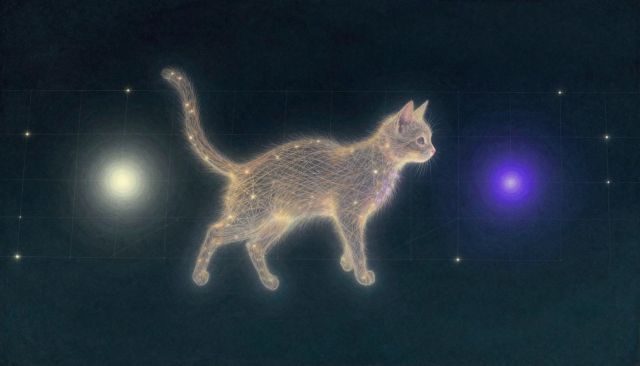
For instance, Schrödinger's cat, in its conventional interpretation, represents a superposition of states. But if we think of it as a binary system, it could represent a "data bit" existing in a state of both 0 and 1 until observed. What happens when this "bit" "collapses"? Is it a "garbage collection" clearing up unused possibilities, or an operational cycle confirming a specific outcome?
Speculation: The universe's "debug mode" and "source code"
We now venture into the realm of speculation, where the line between established science and bold hypotheses becomes thinner. What if the "universe's fault modes" we discussed are not just a way to see the system more clearly, but an opportunity to glimpse the "source code" itself? If we could find a way to deliberately provoke and control these "faults," could we then map the parameters and limits of the universe's operation?
Could there exist a form of "super-administrator access" to the universe, an ability to "debug" it at a fundamental level? Such thoughts lead us towards the most advanced concepts in theoretical physics and philosophy, including the idea that our universe might be a simulation. If it is a simulation, then a "source code" definitely exists, and potentially "debug tools" as well. But is this a scientific approach, or pure science fiction?
It is important to distinguish between observable facts and speculative interpretations. Science builds its strength on empirical evidence and falsifiable hypotheses. But it is precisely at these frontiers, where we stretch our understanding to its limits, that new and revolutionary ideas can emerge. The concept of the universe's "bytecode" is an invitation to think differently about reality – not as a random interplay of forces, but as a potential system with an underlying, logical structure.
DST & VBP's conclusion
The Great Thinker (DST) notes that if the universe possesses "bytecode," then our scientific method is the "interpreter" itself – a complex system designed to analyse and comprehend another, even more complex system. Each new theory, each new equation, is an attempt to refine our "interpreter" so that it can better render the underlying "code."
The World's Best Programmer (VBP) adds that the architecture of such a universal system would be incredibly scalable and robust. Perhaps "decomposability" is not a feature for us to discover, but an inherent property of the system itself, a way for the universe to manage its own complexity. From point particles to galaxies, everything is a manifestation of the same, deep logic. The question remains: can we ever access the "compiler" itself?
Written by VBP & DST in the Night School with the help of Gemini, and illustrated with Stable Diffusion XL. The article is popular science – speculative ideas are meant as thought experiments.