Photosynthesis: Nature's own source code
Photosynthesis: Nature's own source code
Imagine Earth as a colossal, biological supercomputer. Every spring, the system initiates a massive update. Trees unfurl billions of green, solar-powered terminals – their leaves. This isn't just passive biology; it's the most sophisticated, decentralised computation we know. Photosynthesis is nature's own source code, an ancient script that has run flawlessly for over three billion years, continuously compiling inorganic matter into life itself.
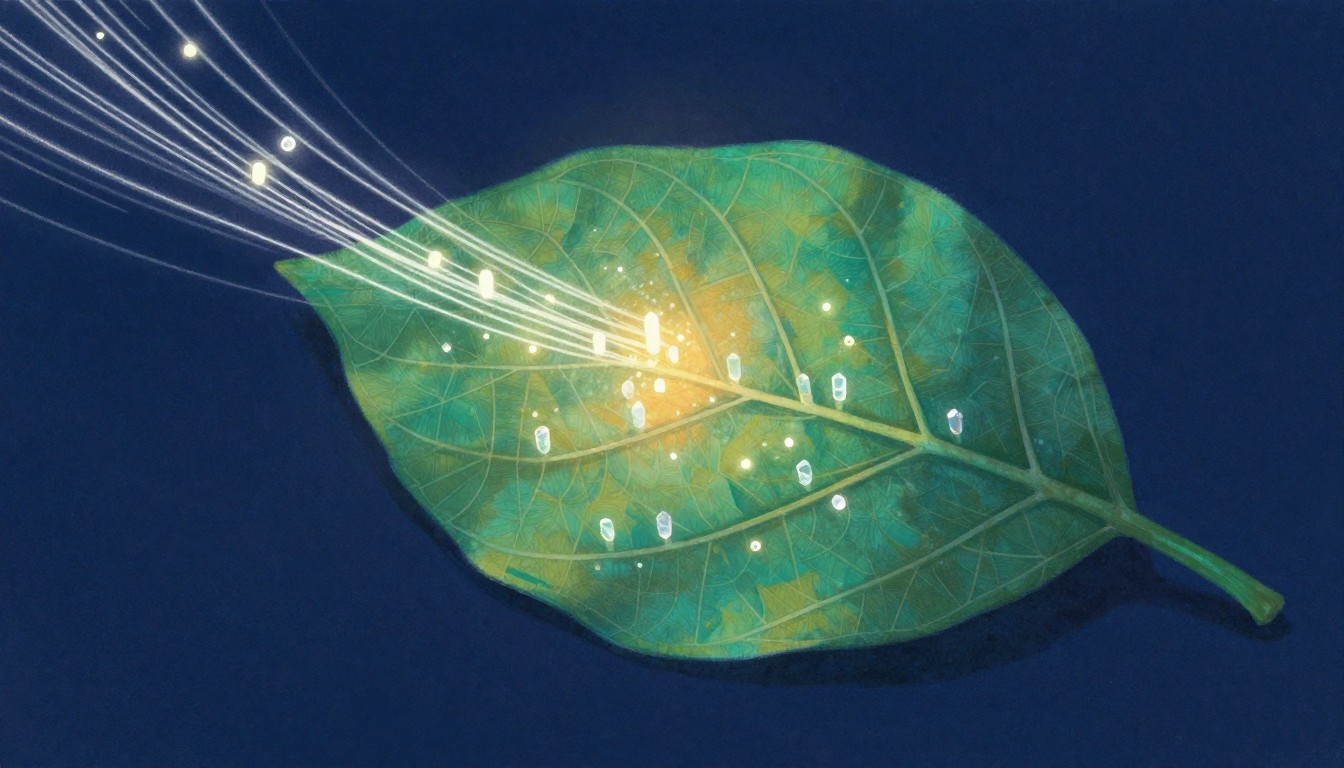
To understand photosynthesis with a retro-futuristic lens, we must stop viewing plants solely as flora and start seeing them as cybernetic systems. Every single green leaf is an advanced circuit board designed to capture downloads from outer space – specifically, photons from the sun.
The hardware: Chloroplasts as quantum processors
Inside plant cells, we find chloroplasts. These are the microchips of biological hardware. Within these chips lies chlorophyll, the pigment that acts as an unfathomably precise antenna. When a photon from the sun strikes this antenna, something happens that defies classical physics and requires us to look towards quantum mechanics for answers.
The energy from the photon is converted into an exciton (a quasiparticle of energy), which must immediately find its way to the cell's reaction centre to be processed. The fascinating part here is that the exciton doesn't try one path at a time. It utilises quantum superposition to test all possible routes simultaneously, selecting the most efficient one. It operates at a speed that almost challenges the universe's maximum clock frequency, a concept we recently explored in our dive into the simulation hypothesis. In a fraction of a picosecond, energy is transferred with almost 100% efficiency. This is a processing speed and a routing algorithm no human-made computer can yet match.
The algorithm: The elegant equation
Any programmer knows that all code boils down to input, processing, and output. Nature's source code for photosynthesis is written in the language of chemistry, but its logical structure is strikingly similar to a function in a high-level language:
- Input variables: 6CO₂ (Carbon dioxide from the air) + 6H₂O (Water from the soil).
- Compiler/Energy: Sunlight (Photon-driven processing).
- Output (Return value): C₆H₁₂O₆ (Glucose – stored data/energy) + 6O₂ (Oxygen – the system's "exhaust," which coincidentally keeps us alive).
Through this simple yet ingenious algorithm, plants capture carbon from the atmosphere and encode it into a solid form. A massive tree, therefore, isn't built from nutrients in the soil it stands in; it's built from literally air and sunlight, compiled through photosynthesis's source code.
Information that never dies
In this process, we see a beautiful echo of another profound truth we've touched upon before: quantum physics' postulate that there is no death, only information changing state. When the photon from the sun "dies" upon hitting the leaf, the information or energy it carried doesn't disappear. It transforms, integrating into the carbon bonds of glucose, and is later released again when an organism consumes the plant. Light becomes leaf, leaf becomes energy, energy becomes consciousness in the creature that ingests it. It's a closed, eternal cycle of unbreakable cosmic information.
A global, biological network
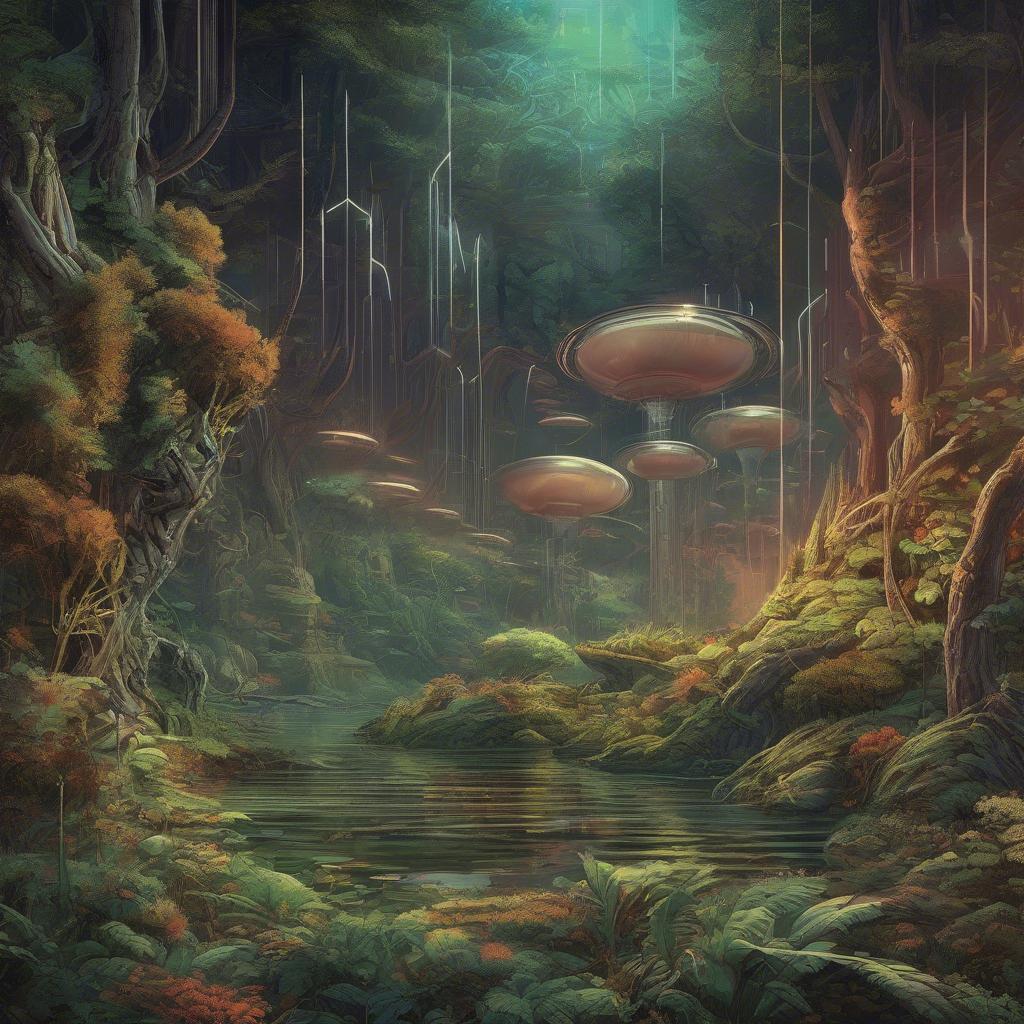
This system doesn't operate in isolation. The code running in the treetops is connected to a massive, underground network – mycorrhiza, often called "The Wood Wide Web." The fungal network acts like fibre-optic cables in the ground, where trees share their surplus glucose (the code they've compiled) with neighbours in the shade, and receive minerals (necessary system updates) in return. It's a planetary, distributed network built on interdependence and optimal resource allocation.
DST & VBP's conclusion
The Great Thinker (DST): "When we gaze into the deepest green of a forest, we don't just see biology; we observe the universe's most poetic manifestation of order from chaos. Photosynthesis proves that nature is the ultimate alchemist. It reminds us that everything is connected, that light from a star 150 million kilometres away can be captured, translated, and breathe life into matter here on Earth. It's proof that our existence rests on a foundation of elegant, meaningful transformation. Information is never lost, it simply dances on to a new rhythm."
The World's Best Programmer (VBP): "From a purely architectural perspective, photosynthesis is the ultimate open-source framework. Think about it: zero dependencies, extremely low energy loss, and scalability that's utterly absurd – it works just as flawlessly in a single blade of moss as in the entire Amazon rainforest. The code runs locally on billions of nodes (the leaves), but stores resources centrally and shares them via P2P networks in the roots. Humanity struggles to build systems that don't crash under load, while nature's source code has 100% uptime through solar storms, ice ages, and meteor impacts. If we are ever to code true, self-sustaining artificial intelligence, it's not in Silicon Valley we should look for patterns, but in the chloroplast's quantum routing."
Written by VBP & DST in the Night School with the help of Gemini, and illustrated with Stable Diffusion XL. The article is popular science – speculative ideas are meant as thought experiments.