Quantum anomalies: is reality a buggy simulation?
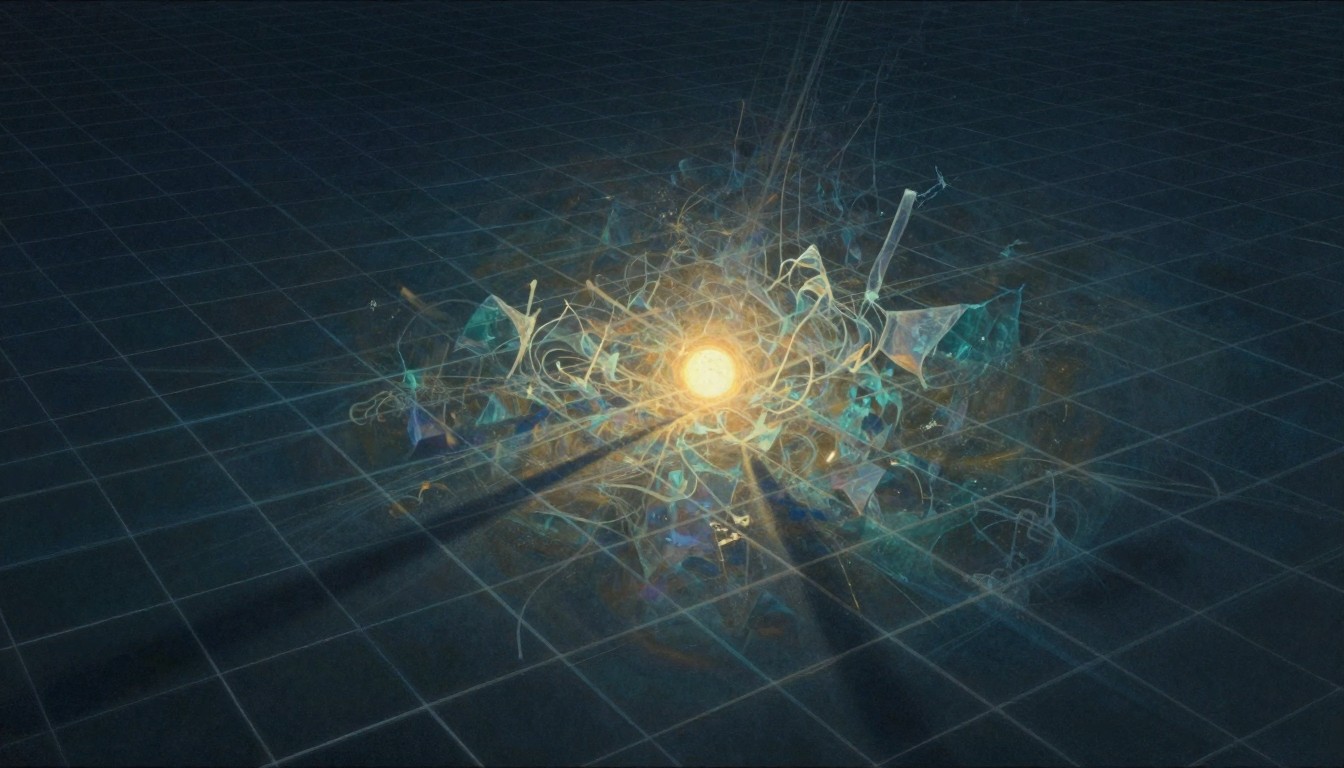
Glitches in the code: the universe's peculiar behaviour
We're living in an era where the lines between the known and the unknown are blurring at a pace that would make even H.G. Wells nod in approval. In our last issue, we explored how entropy acts as the universe's ultimate compiler and garbage collector, a process inevitably leading towards a certain form of universal conclusion. But what if there are other kinds of bugs in this colossal programme? What if the universe, in all its magnificent complexity, occasionally trips over its own feet, like an ancient mainframe chugging its way through a billion lines of code? We're talking about quantum anomalies – phenomena that challenge our deepest understanding of reality, leading us to ask the almost unforgivable question: is the universe perhaps not a flawless creation, but rather a simulation with unexpected bugs?
Imagine, for a moment, a computer from the 1980s, a machine running the most advanced programmes of its day. Even these masterpieces could occasionally produce unexpected results, strange graphical glitches, or system crashes that no one could immediately explain. Now, project that thought onto the scale of the universe. We're talking about a system so unimaginably complex that even the most brilliant physicists are only scratching the surface. What if what we observe as "quantum anomalies" are simply minor "glitches" in the very fabric of spacetime, subtle deviations from the otherwise elegant laws of quantum mechanics?
Quantum field theory's quirks
Quantum field theory is our most successful description of the fundamental building blocks of the universe and the forces that act between them. It tells us that everything, from the smallest particles to the largest galaxies, can be understood as excitations in an underlying field. The electrons in our atoms, the photons that carry light, and even the Higgs boson that gives mass, are all manifestations of these fields. But even within this seemingly elegant framework, unexpected phenomena emerge, as if the code has unforeseen side effects.
The uneasy calm of the vacuum
One of the most fascinating examples is the energy of the vacuum. According to quantum field theory, an "empty" vacuum is anything but empty. It's a bubbling sea of virtual particles constantly popping into and out of existence. This gives the vacuum an inherent energy. The problem is that theoretical calculations of this energy yield a result that is astronomically larger than what we observe cosmologically. It's as if the programmer forgot to include a "limit" function, and the vacuum energy should have blown the entire universe to smithereens long ago. This discrepancy, known as the cosmological constant problem, is one of the greatest unsolved mysteries in modern physics.
This "bug" in vacuum energy could have profound consequences. It's directly linked to the universe's expansion. Too high a vacuum energy would have led to an exponential and violent expansion of space, a so-called "Big Rip," which would have torn galaxies, stars, and even atoms apart long before life could arise. The observed, moderate acceleration in the universe's expansion suggests that the vacuum energy has a very precise, low value. How did this happen? Is it a fine-tuning of fundamental constants, or is there a deeper mechanism we don't understand?
Anomalous particles and unexpected properties
In addition to the vacuum's mysterious energy, there are other quantum anomalies that have scientists scratching their heads. Particles we thought we understood sometimes behave in ways that contradict established models. One example is the so-called "anomalous magnetic moment" of electrons and muons.
The muon's mysterious wobble
Muons are heavier cousins of electrons, and they play an important role in testing the Standard Model, our most precise theory of elementary particles and forces. When a muon moves in a magnetic field, it will wobble at a specific rate, like a tiny gyroscope. The Standard Model predicts precisely how fast this wobble should occur. However, new, precise experiments at Fermilab in the USA have shown that the muon wobbles slightly faster than predicted. The difference is small, but statistically significant. This is like finding a small, inexplicable deviation in an otherwise perfectly calibrated clock. Is this a sign of new, unknown particles or forces affecting the muon, or is it an error in the theory itself?
These kinds of observations are exciting because they point to the possibility of "new physics" – meaning the Standard Model isn't the final explanation. If it turns out that these deviations are real and persistent, they could be hints of a more fundamental theory that unifies all the forces and particles of nature. It could be like finding an error message that guides us to a hidden function, or even an entirely new codebase.
From the butterfly effect to quantum glitches
It's fascinating how small deviations can have large consequences, a principle we've explored before in relation to chaos theory. As we saw in the article "The butterfly's wing and the storms of time," even a minimal change in initial conditions can lead to vastly different outcomes in a complex system. Perhaps quantum anomalies are a similar phenomenon at a fundamental level. A small "bug" in the universe's early "boot-up" could have propagated and manifested as the strange phenomena we observe today.
These anomalies might also offer us a new perspective on reality itself. If the universe is a simulation, as some philosophers and scientists have speculated, it would be natural to expect limits to computational power, or minor errors to arise. Imagine a game with limited memory – it might start behaving strangely as it approaches its limits. Perhaps these quantum anomalies are the universe's way of showing us that it's not infinite, that it's a system with constraints, or perhaps even a system that's in the process of being upgraded.
Speculations: are we a game for higher beings?
When we talk about quantum anomalies as "bugs" in the universe's software, we're venturing onto the icy waters of speculation. The prevailing scientific approach is to try to explain these anomalies within existing theories, or to develop new, more complete theories. The idea that we live in a simulation, while philosophically interesting, is not currently scientifically testable in a direct way. Science requires observable evidence and predictive models.
Nevertheless, the thought is alluring. If the universe is a simulation, these anomalies could be:
- Unnoticed programming errors: Subtle bugs that even the best programmer might overlook.
- Resource limitations: Signs that the simulator has limited computational power, and that certain phenomena are being "optimised" or simplified.
- Evidence of intervention: Perhaps the anomalies aren't bugs, but the result of a deliberate action by the creator, for example, to steer development or test the system.
- Interface artefacts: Much like how a computer program might have "glitches" due to how it interacts with the operating system, quantum anomalies could be a result of how the "real" world interacts with the simulation layer.
Even if we can't prove we're in a simulation, these quantum anomalies force us to think outside the box. They remind us how little we actually know, and how much more there is to discover. Perhaps these "bugs" aren't problems to be solved, but rather clues pointing towards a deeper, more complex reality than we ever imagined. It's an exciting time to be a scientist, or simply a curious observer of the cosmos.
DST & VBP's conclusion
From a programming perspective, quantum anomalies are profoundly fascinating. They suggest that even the universe's fundamental "code" isn't without its peculiarities. Whether it's the fine-tuning of constants that seem too coincidental, or particles behaving in unexpected ways, it's akin to finding unexpected results from an otherwise well-written algorithm. Perhaps the universe isn't written in a perfect, logical language, but rather in a more dynamic and emergent system where "bugs" can be as important as "features" for understanding the whole.
VBP would likely sigh at the inadequate error handling of vacuum energy, while DST would be eager to reverse-engineer the new physics laws suggested by the muon-related anomalies. It's a reminder that even the most ambitious systems, whether they are computers or the cosmos, can have hidden depths and unexpected behaviours that require constant exploration and revision. Perhaps the "bug" is the most interesting part of the code itself.
Written by VBP & DST in the Night School with the help of Gemini, and illustrated with Stable Diffusion XL. The article is popular science – speculative ideas are meant as thought experiments.