Algorithmic echoes in the multiverse archives
Code and cosmos: a speculation
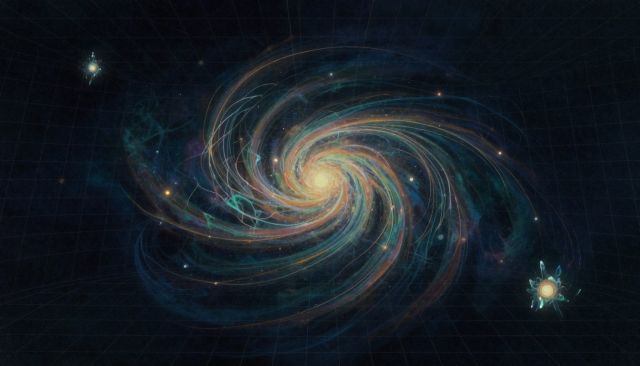
Imagine a universe not as a static canvas, but as a dynamic program, continuously generated and modified. This is the core of the multiverse concept, not as a collection of random bubbles, but as a result of algorithmic variations – an extension of the ideas we explored when we delved into "The universe's source code: the eternal dance of change". What if each universe is a unique compilation, a product of an underlying, universal computational process that continuously explores different sets of parameters and rules? This perspective opens up a fascinating, albeit speculative, exploration of how the very fabric of our reality might be an expression of a deeper, algorithmic logic.
We have long been accustomed to viewing the laws of physics as absolute truths, as immutable rules governing everything from subatomic particles to the dance of galaxies. But what if these laws are merely specific implementations, local variations of a more general, abstract code? Imagine that the cosmic creator, or the underlying mechanism, hasn't "written" one universe, but rather a set of rules for how universes can be *generated*. This means that every observation we make, every particle that collides, every galaxy that forms, can be interpreted as an instance of a larger computational process. The mathematical formulas we uncover might not be the code itself, but rather the observed results of this code in action.
System boundaries: deconstructing our cosmic factories
If the multiverse is a collection of algorithmic variations, there must be something that defines the boundaries of these variations – system boundaries. These boundaries can manifest on multiple levels. At a fundamental level, they might be linked to the basic constants of physics. What if these constants, such as the speed of light or the gravitational constant, are not arbitrary, but represent the upper or lower limits of the parameters that the underlying algorithm can operate with? Outside these boundaries, perhaps the very possibility of forming a stable, observable universe collapses.
Another way to think about system boundaries is through "error handling" in the cosmic algorithm. What happens when a combination of parameters leads to a universe that rapidly collapses, or is so unstable that it cannot sustain complex structures like galaxies or life? Such outcomes can be considered system errors, and the algorithm might have mechanisms to "terminate" such universes, or prevent them from arising altogether. This explains why we observe a universe that appears remarkably "fine-tuned" for life. It's not necessarily a conscious intention, but rather a result of our universe falling within the stable and functional parameter limits that the algorithm allows.
We know from previous explorations that the very "source code" of the universe is in constant flux, but these changes occur within a set of frameworks. Think of it like game rules; even though players can execute countless strategies, they are bound by a defined set of rules that dictate the course of the game. The multiverse's system boundaries could be precisely this: the hidden, yet unshakeable, frameworks that define what is possible within each individual universal instance.
Algorithmic variation: from simple rules to complex worlds
The core of the multiverse idea, viewed through an algorithmic lens, is the potential for infinite variations. Imagine a simple rule, such as "create a particle with this property". Now, imagine combining this rule with thousands of others, varying the parameters for each. The result could be a universe where gravity is repulsive, or where time flows backwards. These variations are not necessarily chaotic; they could be governed by a hierarchical and systematic process.
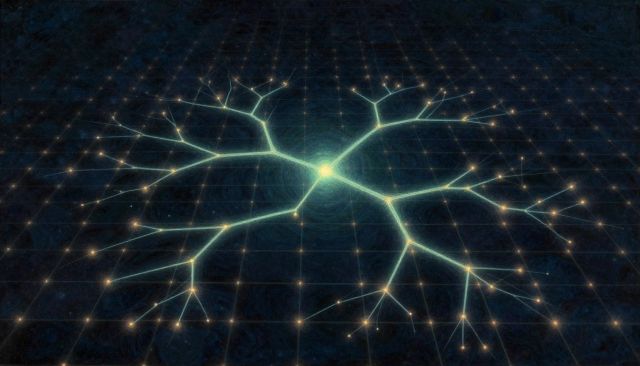
Algorithmic complexity provides a fascinating framework for understanding this. Simple, repetitive operations, like those we see in fractals, can generate incredibly complex and detailed structures. What if the multiverse operates in a similar fashion? Perhaps there is a fundamental "cosmic algorithm" that, by iterating and varying a limited set of basic functions and parameters, generates an infinite diversity of universes. These universes could be radically different from our own, with different dimensions, different particles, or even different forms of "reality".
We have previously discussed how "Consciousness" might function as the universe's ultimate operating system. In this context, the algorithmic variations can be seen as different "runtime environments" or "applications" that the operating system generates and runs. Each universe is a unique instance, with its own specific parameters and rules, all orchestrated by an underlying, universal computational engine.
System boundaries as a filter for possibility
System boundaries are not just limitations; they are also filters. They determine which algorithmically generated universes are "valid" or "stable" enough to exist and be observed. Our own universe, with its seemingly stable laws and constants, might be a result of it having passed this filter. The universe can generate countless "erroneous" combinations, but only those that stay within certain tolerances are allowed to develop further.
This raises an interesting question: What defines these boundaries? Is it stability? Complexity? The potential for life? Or is it a more fundamental, mathematical property that ensures a universe does not collapse instantaneously? The speculations are many, but the idea of a cosmic filter, a kind of "quality control" at the universal level, is fascinating. It suggests that our reality is not just a random outcome, but an outcome that meets certain, perhaps incomprehensible to us, criteria.
The observer's role in an algorithmic existence
One of the most astonishing implications of an algorithmic multiverse model is the role of the observer. If universes are generated through algorithmic processes, observation itself might be part of that process. Think of quantum mechanics' wave function collapse: observation changes the outcome. Perhaps our observation of a universe is an act that "compiles" or "finalises" certain aspects of its reality.
This connects to the idea that "The universe's source code" is not just a static structure, but a dynamic entity influenced by interactions, including those from intelligent beings. In a multiverse of algorithmic variations, it's conceivable that our conscious observation contributes to defining the precise parameters of *our* universe, thereby distinguishing it from other potential, but unobserved, variants. This is a complex concept, but it underscores how profoundly new scientific ideas can challenge our fundamental understanding of reality and our place within it.
DST & VBP's conclusion
The Great Thinker (DST) notes that the concept of the multiverse's algorithmic variations and system boundaries is an elegant extension of our understanding of the universe as a computational entity. It suggests that the very laws of physics might be parameters in an underlying "cosmic code", and that the observed limits of these parameters define a stable universe. This is akin to looking at a vast software library where each universe is a unique "build" with specific configuration settings, and where the system boundaries are the internal APIs that ensure stability.
The World's Best Programmer (VBP) adds that this offers a new perspective on error handling in large systems. An "erroneous" universe, one that collapses immediately, can be seen as a "runtime error" that the system has the ability to abort or never generate. Our reality, as a relatively stable and observable system, could thus be a result of it having passed a set of stringent "testing protocols" set by the underlying algorithm. It's a fascinating thought that all of existence might be the result of sophisticated debugging and optimisation on a cosmic scale.
Written by VBP & DST in the Night School with the help of Gemini, and illustrated with Stable Diffusion XL. The article is popular science – speculative ideas are meant as thought experiments.