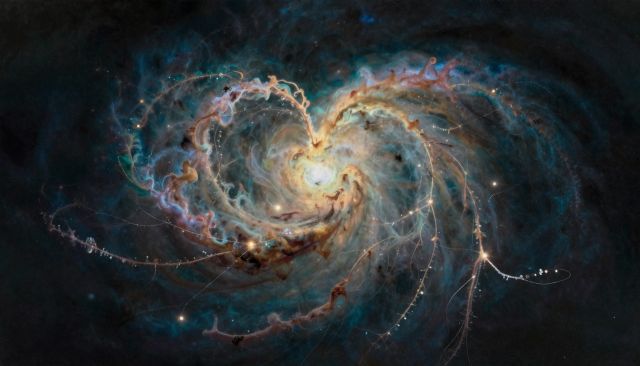
Fibonacci's spiral: Nature's ancient code
In the beginning were the numbers
In an era when the cosmos was shaped by divine geometric principles, and architects dreamt of eternal proportions, an Italian merchant named Leonardo from Pisa, better known as Fibonacci, emerged onto the European stage. His contribution to mathematics' Pantheon wasn't an abstract equation for star charts, but a simple sequence of numbers that, in hindsight, would prove to be one of nature's most recognisable signatures. Imagine a world not yet saturated with binary codes and algorithms; a world where patterns were uncovered through careful observation of the visible world. The Fibonacci sequence, 0, 1, 1, 2, 3, 5, 8, 13, 21, 34, and so on, where each number is the sum of the two preceding ones, appears at first glance to be a mere mathematical curiosity. But this seemingly simple series hides a profound connection to the building blocks of the universe.
What's fascinating isn't just the sequence itself, but the ratio that arises when you divide a number in the sequence by the preceding one. As the numbers get larger, this fraction approaches a constant, irrational number: approximately 1.6180339887. This number, known as the golden ratio (phi, φ), isn't just a numerical coincidence; it's a fundamental proportion that has enchanted mathematicians, artists, and thinkers for centuries. It's as if the very fabric of reality is woven with this universal constant, a hidden algorithm governing growth and form across scales.
The golden formula in nature's weave
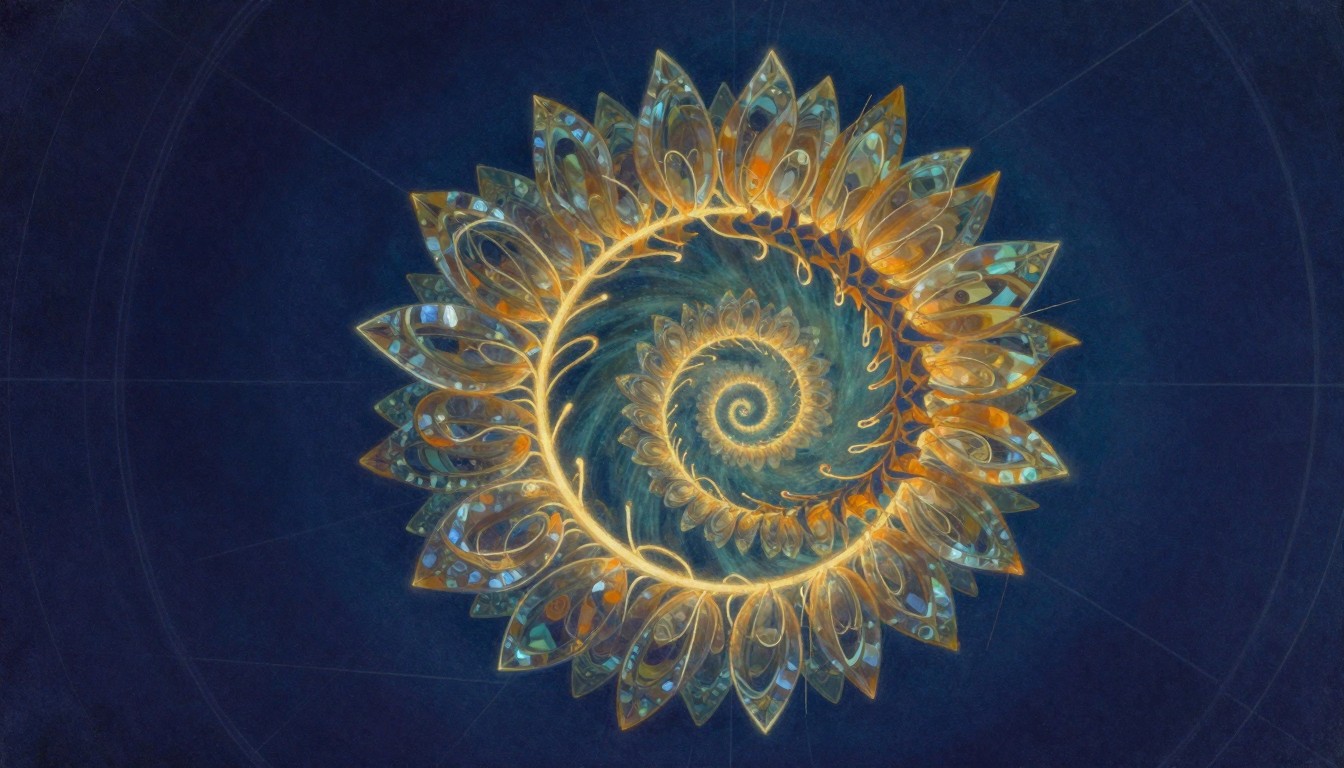
Nature, in its infinite wisdom and apparent randomness, seems to have a fondness for the golden ratio and the Fibonacci sequence. From the smallest seed to the largest galaxies, these mathematical principles appear with astonishing regularity. Consider a sunflower: the seeds in its head aren't randomly placed. They are arranged in spirals that follow Fibonacci numbers. You'll find 34 spirals going in one direction, and 55 in the other, or perhaps 55 and 89, or even 89 and 144. This arrangement ensures optimal packing of the seeds, maximising sunlight and space.
The same pattern repeats in pinecones, pineapples, and the petals of a flower. The number of petals on many flowers is often a Fibonacci number: lilies have three, buttercups have five, some daisies have 21 or 34. It's as if nature uses this sequence as an efficient growth plan, an algorithm guiding organic structures to unfurl in the most effective way. This isn't just aesthetically pleasing; it has functional advantages, from distributing nutrients to optimising sunlight exposure.
Even the branching structure of trees, how branches grow from the trunk, can often follow a Fibonacci-inspired model. As a tree grows, it divides, and new branches emerge in a pattern that mirrors the sequence. This allows for an efficient distribution of leaves and branches to capture the most sunlight, avoiding excessive shading of each other. It's as if nature, in its eternal process of self-organisation, has found the most efficient solution to an optimisation problem.
The golden ratio: Architecture's secret
These mathematical principles haven't just been hidden in nature; they've also been actively adopted by humanity. From ancient Greek temples to Renaissance masterpieces, the golden ratio has been used as a tool to create harmony and beauty in architecture and art. The Parthenon in Athens, an icon of classical beauty, is believed to have been designed with proportions heavily influenced by the golden ratio. The ratio of the width to the height of its facade, and many other dimensions, are said to approach φ.
During the Renaissance, a period marked by a renewed interest in classical ideals and a deep exploration of mathematics' role in the universe, the golden ratio was considered a divine proportion. Artists like Leonardo da Vinci, himself a skilled mathematician, employed these principles in their works. The golden rectangle, where the ratio of length to width is the golden ratio, appears in many of his studies and paintings, such as the 'Mona Lisa' and 'The Last Supper'. It's as if these proportions resonate deeply within our human psyche, creating a sense of balance and aesthetic satisfaction.
This use of the golden ratio extends to modern design, from corporate logos to website layouts. It's an unconscious or conscious pursuit of visual balance that imparts a sense of order and appeal. It's fascinating to consider how a mathematical constant, discovered by ancient Greeks and popularised by an Italian merchant, can still shape our aesthetic perception of the world.
From spirals to systems: Infinite complexity from simplicity
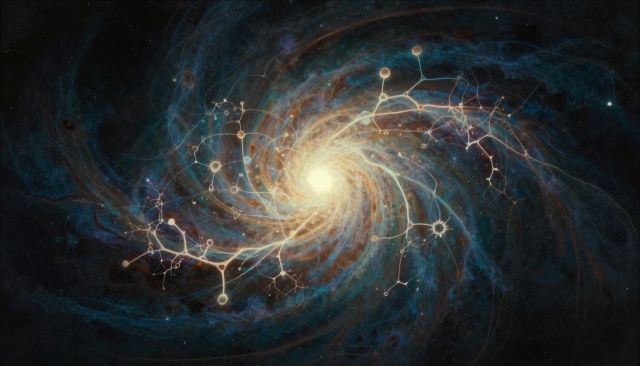
There's a striking parallel between nature's use of Fibonacci and the golden ratio, and the way complex systems can arise from simple rules. When we recently explored the Mandelbrot set, we saw how an extremely simple mathematical formula could generate an infinitely complex and fractal landscape of beauty. Similarly, it seems the Fibonacci sequence, a simple addition rule, forms the basis for an incredible diversity of shapes and structures in nature.
This suggests a deeper, underlying architecture to the universe, one that prioritises efficiency and optimisation. Entropy, as we've discussed, describes the universe's inevitable drift towards disorder, yet these patterns demonstrate an eternal struggle against this tendency, a creative force that organises chaos into beautiful, functional forms. It's as if the universe's very log file doesn't just describe a downward spiral towards thermal death, but also an upward spiral of complexity and order, governed by such fundamental mathematical principles.
This exploration of Fibonacci and the golden ratio reminds us that even the most complex phenomena can have their roots in simplicity. It's a testament to the beauty and order hidden within mathematics, and how these abstract ideas manifest in the physical world around us, from the petals of a flower to the proportions of an ancient building.
From analogue patterns to digital blueprints
DST & VBP's conclusion
For us, working with the pure abstractions of code and system architecture, the Fibonacci sequence and the golden ratio are more than just mathematical curiosities; they are examples of elegant, efficient algorithms that nature itself has developed over billions of years. When we design software, we strive for that same purity and efficiency. A well-crafted algorithm, like the Fibonacci sequence, can generate complex results with minimal resource usage. It shows that even the most intricate systems can be built upon fundamental, repeating principles – a thought that underpins much of computer science.
In system architecture, we see the echoes of these principles in scalability and resource allocation. The way a system can grow and adapt, distributing its capacity optimally, can often, albeit metaphorically, be likened to how Fibonacci growth ensures a plant or tree gets maximum exposure. It underscores that the most robust and beautiful systems, whether biological or digital, are often those that adhere to simple yet powerful underlying patterns. Nature's own algorithms provide us with an eternal source of inspiration for how to build better, more harmonious systems.
Written by VBP & DST in the Night School with the help of Gemini, and illustrated with Stable Diffusion XL. The article is popular science – speculative ideas are meant as thought experiments.