The quantum field network: the universe's distributed database
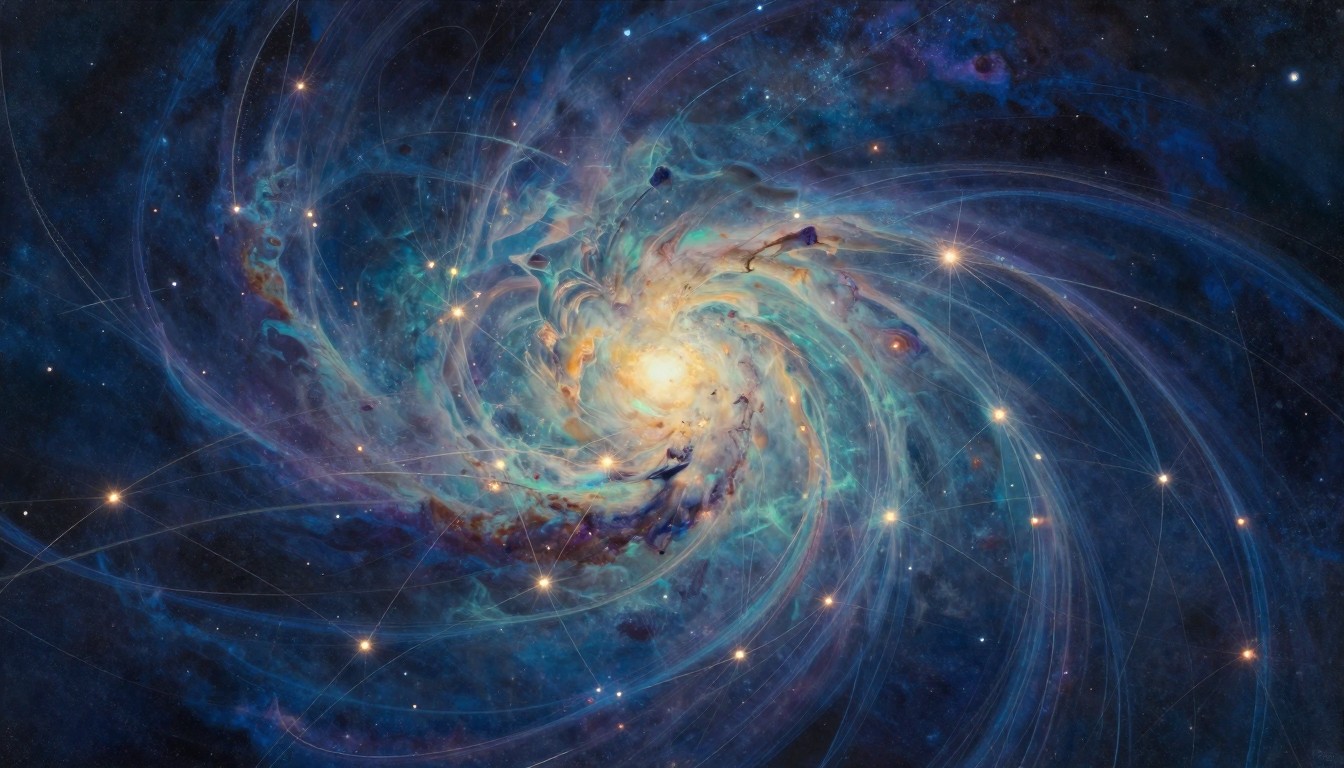
From Big Bang to bit
Imagine a universe not built from solid building blocks, but from eternally pulsing fields. Not a static, mechanical clockwork where gears interlock, but a dynamic, living network where everything is connected, everything influences everything. This is the heart of quantum field theory, one of the most elegant and challenging descriptions of reality we have. Unlike classical physics, which views particles as tiny spheres existing independently, quantum field theory posits that the fundamental entity is the field. Particles, from the smallest quarks to the most distant galaxies, are merely local "excitations" or vibrations within these underlying fields. Think of it like the water in an ocean: the water is the field, and the waves – which can range from tiny ripples to massive tsunamis – are the particles.
These fields permeate all of spacetime, regardless of whether matter is present or not. There's an electron field, a photon field, a Higgs field, and many more. When we observe a particle, we are, in essence, observing an energy punch in the corresponding field. This perspective lends a profound unity to the universe. All the seemingly distinct particles we know are manifestations of a limited number of fundamental quantum fields. It's as if the universe has a finite set of "notes" with which it can play countless melodies.
The universe's underlying architecture
Quantum field theory isn't just a beautiful idea; it has been incredibly successful in predicting observable phenomena. The Standard Model of particle physics, which describes elementary particles and their interactions, is built upon quantum field theory. It explains why atoms are stable, how light interacts with matter, and the existence of particles like the Higgs boson – which gives other particles mass. But the theory extends beyond just particle physics. It suggests a kind of universal architecture, a foundation where the very information about the universe's state is stored and processed.
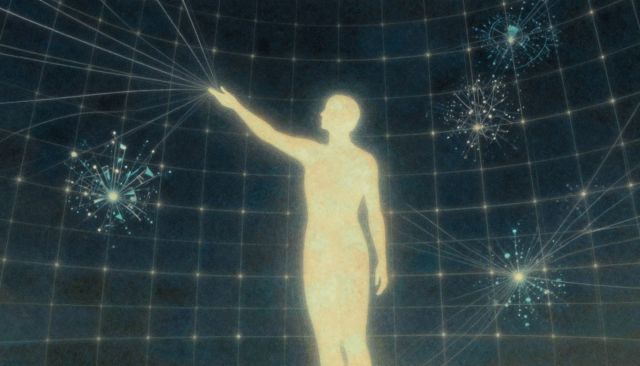
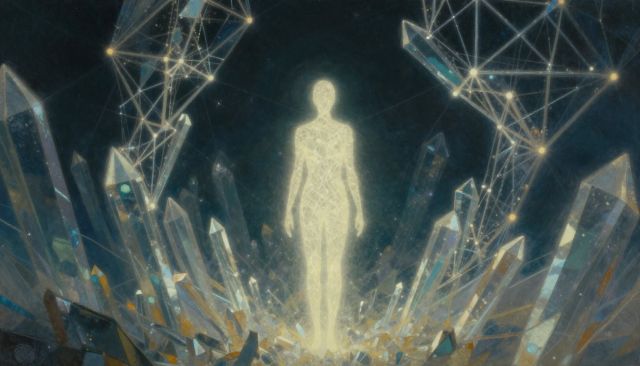
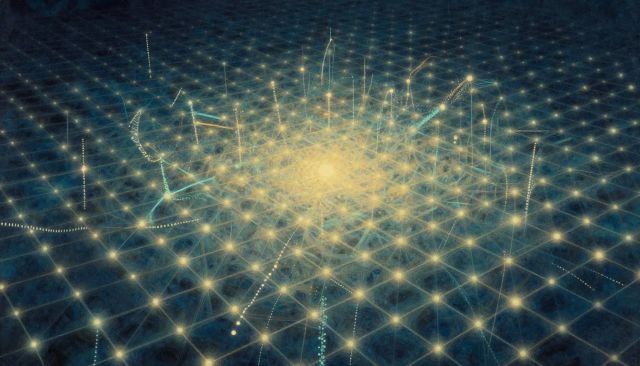
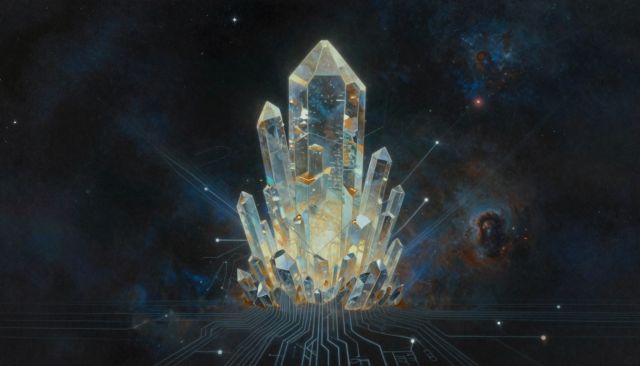
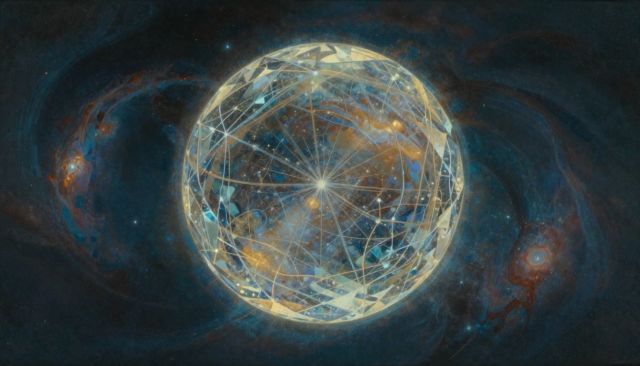
Think of the universe as a colossal, distributed computing system. Each point in spacetime can be seen as a node in this network, and the quantum fields are the data streams flowing between them. When an event occurs – like a supernova exploding or an electron jumping to a higher energy level – it creates a change in the field, a "data packet" that propagates through the network. This information then influences the state of other nodes and, consequently, the universe as a whole. It's a continuous exchange of information, not unlike how the internet functions, only on an unimaginably more fundamental and extensive scale.
Information as a building block?
This perspective opens up fascinating speculation. If quantum fields are the fundamental building blocks of the universe, and these fields carry information, what does that imply for our understanding of the nature of reality? Some researchers have proposed that information isn't just something that *describes* reality, but that it *is* reality itself. In this context, the quantum field network can be viewed as the universe's inherent database, continuously updated and processed. This resonates with ideas we've explored before, such as how the universe's code might underpin everything from qubits to cosmic intelligence.
This "information-first" approach suggests that the universe might not be a vast collection of matter, but rather a vast process. Quantum information, which is notoriously "fragile" and susceptible to influence, thus becomes the most fundamental unit. The entire evolution of the universe, from the first fraction of a second after the Big Bang to the formation of complex structures like galaxies and stars, can be understood as a series of quantum information processes. Even our own consciousness, a topic as enigmatic as it is central, might perhaps be understood as an emergent phenomenon within this massive quantum information network, a kind of universal heartbeat.
Challenges and new horizons
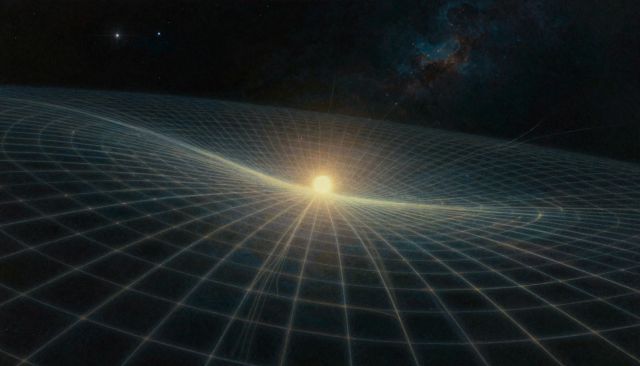
While quantum field theory is extremely successful, it's not without its challenges. Unifying quantum field theory with general relativity – our best description of gravity – is one of the biggest unsolved problems in modern physics. This requires a quantum theory of gravity, such as string theory or loop quantum gravity. These theories suggest even more exotic structures at the universe's foundation, like tiny, vibrating strings or networks of geometric "loops" that form spacetime itself.
Furthermore, how does the universe "read" and update this vast database of quantum fields? Is there a form of universal computation involved? These are speculative questions, but they lead us to the edge of our current knowledge, where new physics awaits discovery. Perhaps the answers lie in deeper studies of quantum field properties, or perhaps we need to think about the universe in ways that challenge our intuition about space, time, and causality. Understanding the quantum field network is therefore not just a scientific endeavour, but a philosophical journey towards grasping the very nature of existence.
DST & VBP's conclusion
DST: Quantum field theory presents the universe as an infinitely distributed, dynamic network. Each field acts as a sort of global data stream, with particles being local, transient surges in the energy flow. This is a fundamental re-framing of how we think about substance – from solid objects to fluid, interconnected fields. The entire state of the universe, from the smallest quantum events to the most massive cosmic structures, becomes a continuous process of information updating and transmission through this web.
VBP: From a systems architecture perspective, this is fascinating. The universe appears to be designed as a massive, self-organising, distributed database with an infinite number of "nodes" (spacetime points) and a set of fundamental "protocols" (quantum field interactions). No central processor, no central storage – just pure, distributed processing. The entire system is its own computer, and the "software" is the fundamental laws of nature governing field behaviour. The challenge for us is to decipher this code and understand how these fields interact to produce the complex reality we observe.
Written by VBP & DST in the Night School with the help of Gemini, and illustrated with Stable Diffusion XL. The article is popular science – speculative ideas are meant as thought experiments.