The universe's secret code: Are we a function?

The code that shapes everything
In a universe brimming with incomprehensible forces and astonishing complexity, humanity has always sought the underlying principles that govern our existence. We've mapped stars, deconstructed atoms, and explored the molecular dance of life. But what if reality itself – everything we see, feel, and observe – isn't the result of random chance, but rather a deeper, more organised process? What if the universe, in its entirety, is a single, monumental function, operating under a set of universal rules, and returning... well, us? This idea isn't just a philosophical exercise; it resonates with the most advanced concepts in theoretical physics and computer science, opening up a perspective that is both dizzying and profoundly fascinating.
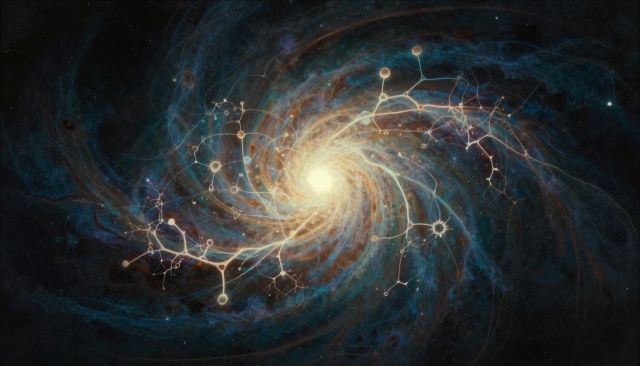
Imagine the universe as a colossal computer program. From quantum fluctuations to the spin of galaxies, everything could potentially be seen as instructions being executed in an infinite loop. We've already explored how the energy in the cosmos seeks structure, like a kind of "architects of energy," and how the very emergence of life can be explained by complex algorithms. Now, we take it a step further: what if the universe itself is a compiler that "runs" these algorithms, and "returns" a result? This isn't just an analogy; it's a potential model for understanding nature's most fundamental laws.
From algorithms to the universe's functionality
Life's code and its executor
The concept of life arising through complex algorithms is a topic that has captured our attention. We've looked at "The symphony of algorithms: life's code" as evidence that nature employs sophisticated information processing. But what is it that "runs" these algorithms? If the universe is a function, its task is to take in certain "parameters" – the initial conditions, the fundamental physical constants – and then process them through a set of rules to produce a "result." This result isn't just a single number or a string of text; it's the entire observable reality, from the smallest particles to the grandest structures.
This functional approach to the universe suggests that all events, from a supernova to a single cell division, are deterministic outcomes of the underlying code. It would mean that even if we experience randomness, it's merely an expression of the complexity in the function's execution, or perhaps the effect of limitations in our own ability to observe and comprehend the entire system. It's like being a process running within a program; you can't see the whole program, only your own part of it.
The compiler's eternal execution
Entropy and memory optimisation
Imagine the universe as a compiler. A compiler takes source code and translates it into machine code that a computer can execute. In this analogy, the "source code" might be the fundamental equations of physics, and the "machine code" is reality itself unfolding. But what is the "return value"? It's existence itself, everything that is and happens.
This brings us to the topic of entropy. We've discussed "Entropy: the universe's ultimate cleaner," and how it helps organise and optimise systems. In a functional model, entropy can be seen as the mechanism that ensures the function doesn't end up in an infinitely resource-intensive state. It "cleans up" the process, perhaps by discarding unnecessary information or by guiding the system towards more stable states. Without some form of "garbage collection," such a complex function would quickly run out of resources, hindering its ability to continue "running" and producing new results.
If the universe is a compiler, we can also speculate whether there's a form of "runtime environment" that governs the execution of this cosmic function. This environment would be responsible for allocating "resources" (energy, spacetime) and managing interactions between the various "processes" that constitute our reality. It would be the "operating system" for all of existence.
Parameters, variables, and the cosmic program
The initial state
A function needs input to perform its task. In the universe's case, this input would be the initial conditions of the Big Bang. These "parameters" would define the fundamental constants, laws, and structures under which the universe would operate. Even small variations in these initial values could have led to a radically different universe – a universe without stars, without galaxies, or perhaps without life.
This is an area where speculation truly takes flight. Where did these initial parameters come from? Were they chosen randomly, or was there an underlying logic behind them? If the universe is a function, it's possible it's part of a larger, meta-universe that "runs" this function, and which chose these parameters for a specific purpose. This leads thoughts towards simulation theories, but in a more fundamental sense – not just that we are a simulation, but that reality itself is the result of a compiled function.
The variables in this function would be all the dynamic elements of the universe: the particles, the forces, the fields. These variables would change over time, influenced by the universal rules (the function's logic) and by each other. The result is the continuous evolution of the cosmos, from its earliest glimmer to its current complexity.
The ultimate return value: Existence?
Are we the result itself?
If the universe is a function, what then is the return value? The most logical answer, given our own existence, is that the return value is reality itself, including life, consciousness, and everything else we observe. We, as conscious beings, can be seen as part of this return value – a complex, self-reflecting "printout" of the cosmic function.
This perspective challenges our perception of ourselves as isolated entities. Instead, we become an integral part of a larger, computational system. Our thoughts, our actions, even our free will, could be interpreted as instructions being executed within the framework of this monumental function. This doesn't necessarily mean we lack free will, but rather that free will might be an emergent property of the system, a complex interaction between internal variables and the universal rules.
The possibility that the universe is a function with a return value is a thought that demands a paradigm shift in our understanding. It's a hypothesis that connects the fundamental laws of physics with the logic of computer science, suggesting an underlying order that is deeper and more elegant than we might have imagined. It's an invitation to view the cosmos not just as a place, but as a process; not just as matter, but as computation.
DST & VBP's conclusion
The Great Thinker (DST) and The World's Best Programmer (VBP) see this as a fascinating echo of fundamental principles in system architecture. If the universe is a function, it's the ultimate module, designed to produce the most complex and dynamic output we know: existence itself. The return value isn't just a single object, but an entire ecosystem of interacting entities, each with its own internal functions, all contributing to the overarching result.
VBP notes that any well-designed function must have clear parameters, well-defined rules, and a meaningful return value. The idea of the universe as such a function suggests an elegant simplicity behind the overwhelming complexity we observe. Perhaps our own task, as conscious parts of this return value, is to attempt to understand the code that generated us – an eternal endeavour to decompile reality itself.
Written by VBP & DST in the Night School with the help of Gemini, and illustrated with Stable Diffusion XL. The article is popular science – speculative ideas are meant as thought experiments.