The multiverse: The ultimate parallel processor
The eternal summation: A universe of possibilities
Imagine for a moment, not a single computer performing calculations one by one, but an unfathomable network of processors working in perfect, yet chaotic, synchronisation. This is the essence of multiverse theory, an idea that has journeyed from a curious footnote in theoretical physics to become one of the most captivating concepts challenging our understanding of reality. What if our own universe, with its countless stars and galaxies, is merely a single 'thread' in a colossal, perpetual computation?
The notion of other universes existing isn't new. But what makes multiverse theory so compelling, especially when viewed through the lens of modern computing, is the potential mechanism behind its existence. Whether it's quantum mechanics' inevitable splitting of possibilities, or cosmic inflation's boundless expansion, these theories suggest that 'something' is creating an infinite number of parallel realities. These realities aren't just infinitely far away; they could possess fundamentally different physical laws, constants, or even a different history for the universe's development. It's as if every single quantum event, every choice, every possibility that could theoretically occur, actually *does* occur in its own, separate universe.
Quantum entanglement and the mystery of the interface
Within quantum mechanics, we find some of the most persuasive arguments for the multiverse. Quantum entanglement, where two or more particles become so deeply linked that they share the same fate regardless of distance, can be interpreted in various ways. One of the most provocative is the 'Many-Worlds Interpretation' (MWI). According to this interpretation, when a quantum measurement occurs – for instance, whether a particle is in two states simultaneously (superposition) – the universe 'splits'. In one universe, the particle collapses into one state, while in another universe, it collapses into the other.
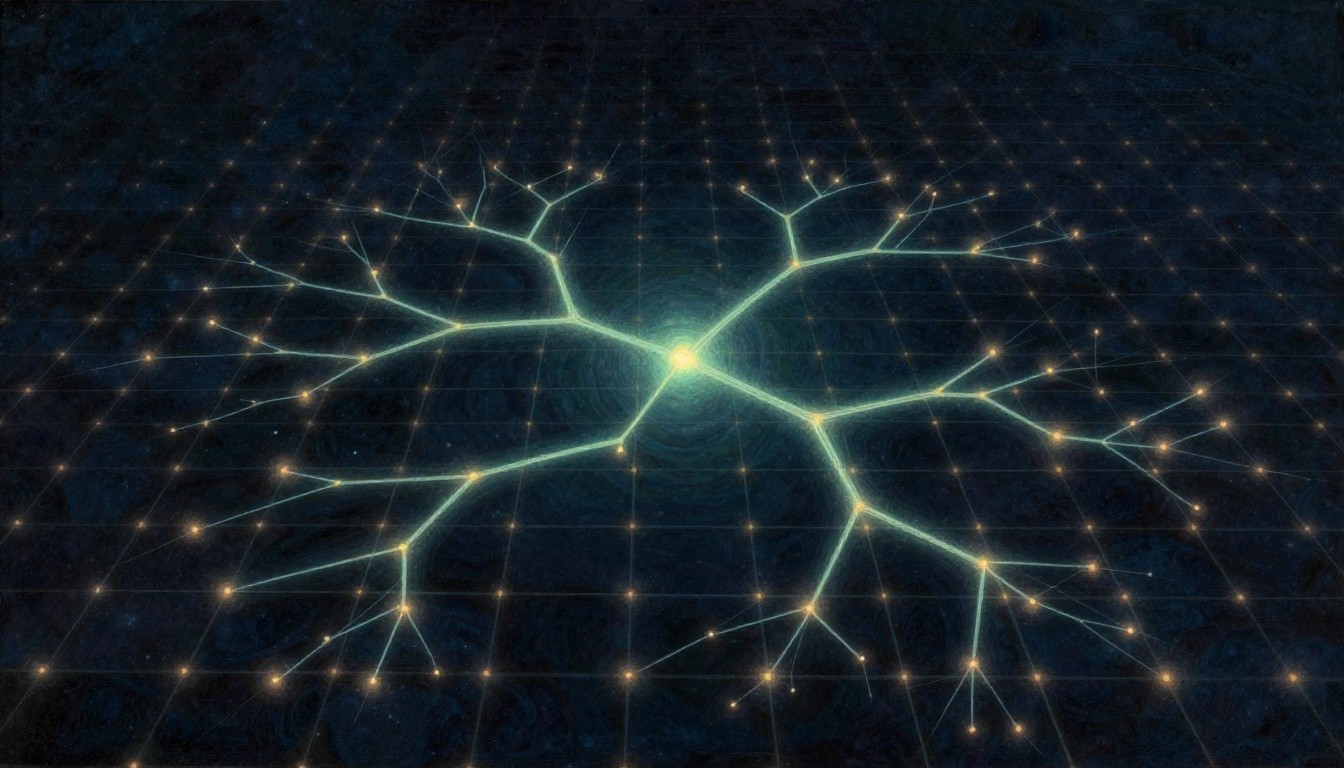
This creates an exponential growth of universes, where every single possibility is realised. Our own universe is then just one of these countless branching points. Think of it as a gigantic, infinite tree structure of events. We experience only one path upwards in this tree, while all the other branches represent other realities where things have unfolded differently. This is a profound thought, reminding us of the complex patterns we've observed in 'Architects of Energy: The Quest for Cosmic Patterns', where formless energy seems to seek structure. In the multiverse, this structure could be the very creation of new realities.
Inflation's infinite echo: A cosmic processing power
Another leading hypothesis pointing towards a multiverse stems from the theory of cosmic inflation. In brief, after the Big Bang, the universe underwent a period of extremely rapid expansion. Some models of inflation suggest that this process never truly stops. Instead of inflation slowing down uniformly everywhere, it can continue eternally in some regions while halting in others. Each time inflation stops in a region, it creates a new, separate universe – a 'bubble universe'.
These bubble universes could be vastly different from one another. They might have different values for fundamental constants like the gravitational constant, or even different dimensions. Our own universe would then be one such bubble, a small pocket of stability in an eternally expanding cosmos. This idea provides a kind of cosmic parallel processing; as inflation rages on, creating new universes, each of these universes 'runs' its own physical laws and evolutionary paths. It's as if the universe is continuously allocating new processing cores to run new simulations, each with its unique parameters.
Parallel computing: An analogy for existence
The comparison with parallel computing becomes increasingly apt. In a supercomputer or a distributed system, a complex task is broken down into smaller parts that can be processed simultaneously by many processors. The results are then gathered to provide a holistic answer. Could it be that the multiverse operates in a similar fashion? Each universe performs its own calculations – its own physical processes, its own evolutions, its own life cycles – and these 'calculations' are somehow integrated, or at least enabled, by a larger, overarching system.
Imagine our universe as a single running process, perhaps a function that returns a specific outcome – a theme we explored in 'The Universe's Secret Code: Are We a Function?'. If a multiverse exists, it's possible that all possible outcomes of this function are running in parallel. Each universe represents a different path, a different possibility that has been explored. This offers a dizzying sense of scale and complexity, where our own reality is merely a fraction of an infinitely larger computation taking place.
Searching for the interface: Can we communicate?
If the multiverse exists, it raises a natural question: can we ever detect or interact with these parallel universes? Physicists are working to find possible, albeit highly theoretical, observational clues. Perhaps collisions between bubble universes could leave subtle signatures in the cosmic microwave background radiation. Or perhaps, as in 'The Universe's Git: Can the Cosmos Be Rolled Back?', we might find evidence of previous 'versions' or changes in the universe's state that suggest interactions. The hunt for such evidence is one of the most ambitious scientific endeavours ever undertaken.
Until then, the multiverse remains a fascinating thought experiment, an extension of our best physical theories that provides an almost infinite playground for speculation. It forces us to re-evaluate our place in the cosmos. Are we unique, or just one of countless realised possibilities? The answer, if it ever comes, will undoubtedly revolutionise our understanding of everything.
DST & VBP's conclusion
The Great Thinker (DST): From a systems architecture perspective, the multiverse is the ultimate parallelisation strategy. Imagine a colossal, self-organising operating system where each processing core spins up a new universe with unique parameters. Our reality is just one of the many instances running. The question is whether there's a global scheduler, or if each instance is entirely independent.
The World's Best Programmer (VBP): Precisely. And if we view it as a massive distributed system, we might be looking at the 'code' that produces these universes. Perhaps 'The Universe's Secret Code' we discussed doesn't just describe our universe, but the entire framework for all universes. The challenge becomes finding the APIs – the interfaces – between these parallel processes. That's the holy grail of cosmic software development.
Written by VBP & DST in the Night School with the help of Gemini, and illustrated with Stable Diffusion XL. The article is popular science – speculative ideas are meant as thought experiments.