Black holes: the universe's ultimate compression
The heart of darkness: when physics' laws meet their breaking point
Imagine a place in the cosmos where gravity reigns supreme, a place so intense that not even light can escape. This is no longer pure science fiction, but a scientific fact: black holes. These cosmic monoliths represent nature's most extreme manifestation of compression, where billions of solar masses can be squeezed into an infinitely small point, a singularity. Here, our known laws of physics break down, and we face the universe's most enigmatic objects.
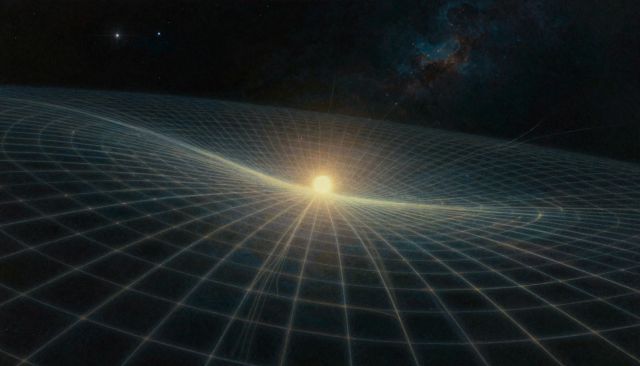
The discovery of black holes went hand in hand with Einstein's theory of general relativity, published in 1915. The theory describes gravity not as a force, but as a curvature of spacetime itself, caused by mass and energy. The more mass, the greater the curvature. When this curvature becomes extremely large, a black hole is formed. The idea of objects so massive they swallow everything, including light, was first proposed long before Einstein's time, but it was only with the theory of relativity that they gained a solid scientific foundation.
The concept of a singularity – a point of infinite density – is deeply unsettling for physicists. It marks a point where our mathematical models break down. It's like trying to understand the universe's very first moments, much like when we explored "Big Bang: the universe's mysterious system startup". Both represent interfaces where our current scientific understanding reaches its breaking point.
The event horizon: the point of no return
The most characteristic feature of a black hole is its event horizon. This is not a physical surface, but rather a boundary in spacetime. Anything that crosses this boundary, regardless of its speed, will inevitably be drawn towards the singularity. Imagine a river flowing towards a waterfall; past a certain point, the current is too strong for you to swim back. The event horizon is the cosmic waterfall.
The radius of the event horizon, known as the Schwarzschild radius, is directly proportional to the mass of the black hole. A black hole with the mass of our Sun would have an event horizon with a radius of just three kilometres. A supermassive black hole, like those found at the centre of galaxies, can have a radius stretching over millions of kilometres. To us observers at a safe distance, an object falling into a black hole would appear to freeze at the event horizon, while for the object itself, it would be a short but unavoidable journey towards the singularity.
The term "black" in "black hole" stems precisely from this phenomenon. Since light cannot escape the event horizon, we cannot see these objects directly. They do not emit light or any other electromagnetic radiation. This is why they were purely theoretical constructs for a long time. It is only through their gravitational influence on their surroundings that we can detect their existence.
How do we see the invisible? Tracking cosmic ghosts
Although black holes are invisible in themselves, they leave clear traces in the universe. Astronomers identify black holes by observing the effect they have on stars and gas in their vicinity. When a star orbits an invisible, massive object, its mass can be calculated. If the mass is exceptionally high, and there is no visible source, a black hole is a strong candidate.
Another important sign is accretion discs. As gas and dust are drawn towards a black hole, a rotating disc forms around it. The friction within this disc heats the material to extremely high temperatures, causing it to emit X-rays. This radiation is detectable by our telescopes, providing indirect evidence for the presence of a black hole. The most famous example is Sagittarius A*, the supermassive black hole at the centre of our own Milky Way.
A few years ago, the Event Horizon Telescope captured a groundbreaking image of the shadow of the black hole in the galaxy M87. This was visual evidence that confirmed many theories about black holes, giving us a glimpse of these incredible objects. It was a moment reminiscent of the profound implications of exploring the Turing test, where we seek to identify and understand "intelligence" where it might not manifest in an expected way.
Stellar collapse and supermass: black holes of all sizes
Black holes come in various sizes, and their formation methods are as fascinating as they are violent. The most common, stellar black holes, form when massive stars – typically more than 20 times the mass of our Sun – run out of fuel. Without the outward pressure from nuclear reactions, the star's core collapses under its own gravity, resulting in a supernova explosion and, if the remnant mass is large enough, a black hole.
At the other end of the spectrum, we find supermassive black holes. These behemoths, with masses ranging from millions to billions of solar masses, reside at the centre of almost all large galaxies, including our own. The formation of these monsters is still a subject of intense research. One hypothesis is that they grow by devouring vast amounts of gas and dust, as well as by colliding with other black holes. Another theory suggests they may have grown from smaller, "seed" black holes in the early universe.
There are also speculations about the existence of intermediate-mass black holes, whose formation and prevalence are less understood. These may play a key role in the evolution of galaxies and clusters. The exploration of these different categories of black holes gives us a deeper understanding of the universe's structure and development.
Black holes as cosmic "computers"? Speculations and future research
Although black holes seem like incomprehensible cosmic phenomena, their properties have inspired profound theoretical questions. The information paradox – what happens to the information that falls into a black hole? – is one of the most challenging problems in modern physics. According to quantum mechanics, information cannot be destroyed, but classical descriptions of black holes suggest that information crossing the event horizon is lost forever. Stephen Hawking proposed that black holes slowly "evaporate" through what is known as Hawking radiation, but this is an extremely slow phenomenon for most black holes.
Some futuristic speculations, inspired by analogies with information processing, view black holes as a form of ultimate information compression. Is it possible that the very structure of spacetime, when compressed into a singularity, stores or processes information in a way we don't yet understand? This leads us to consider how the brain works, as a "machine that predicts the future," where expectations and past experiences shape our perception of reality. Could the extreme conditions within a black hole somehow be linked to fundamental principles of information processing on a cosmic scale?
Further research, including more advanced telescopes and theoretical models that unify general relativity with quantum mechanics, will hopefully shed light on these mysteries. The understanding of black holes is not just an exploration of the universe's darkest corners, but also a journey towards the limits of our own knowledge.
DST & VBP's conclusion
From a systems architecture perspective, black holes represent the ultimate form of data compression. Think of it as a function that takes an infinite number of input variables and returns a single, infinitely small output. The singularity is the ultimate compressed file, the contents of which we cannot read without breaking the entire system.
As programmers, we often face the challenge of optimising memory usage and processing time. Black holes show us that the universe, in its own brutal logic, has implemented a "garbage collection" algorithm that removes anything that doesn't fit its fundamental parameters, with an efficiency that surpasses our wildest imagination. It's a reminder that even in the most complex code, there are always limits to what can be represented and processed.
Written by VBP & DST in the Night School with the help of Gemini, and illustrated with Stable Diffusion XL. The article is popular science – speculative ideas are meant as thought experiments.