The universe's smallest pixel: Planck length
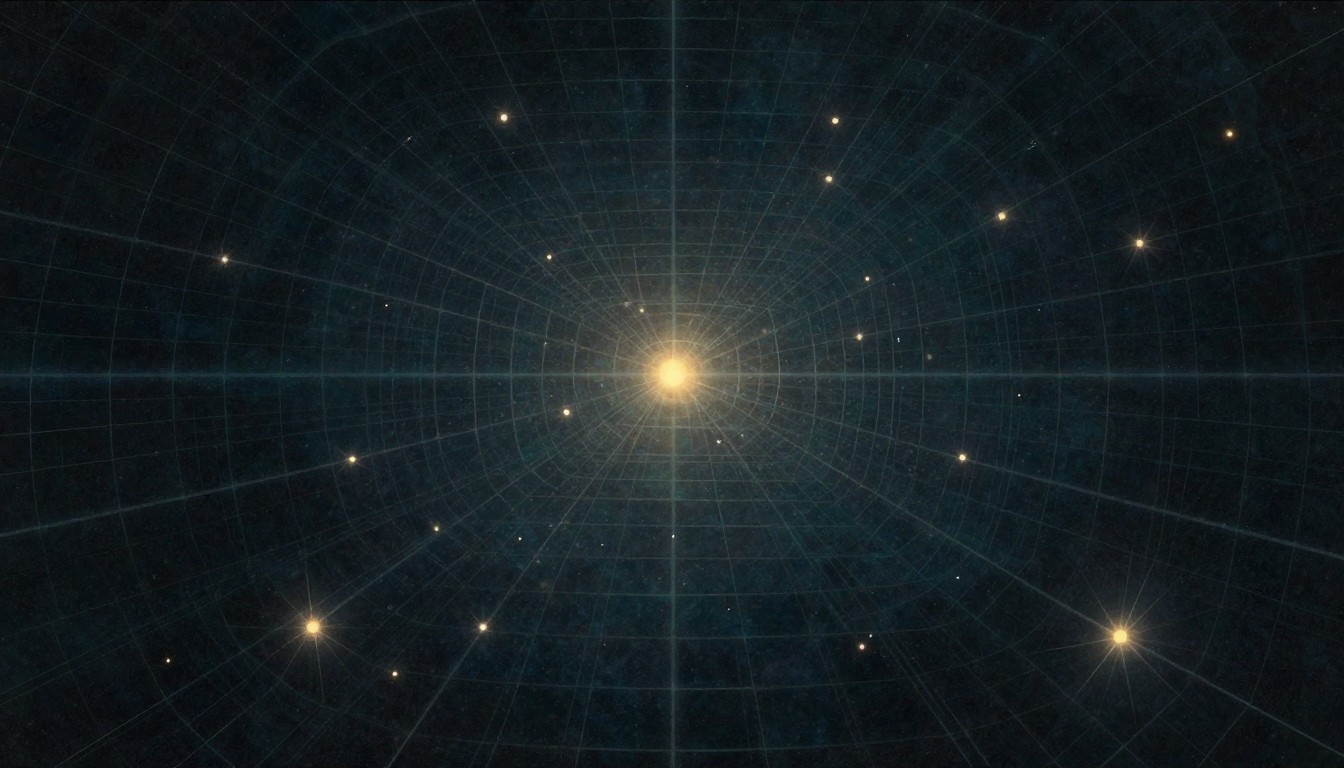
A never-ending division, or a fundamental limit?
Do you picture the universe as an infinite, smooth canvas? A seamless wallpaper where every single particle dances on a continuous surface? For centuries, our scientific quest to understand reality has been characterised by an almost infinite divisibility. We've zoomed in on matter, from the visible galaxies to the invisible atoms, further to protons, neutrons, and electrons. And then, if we continue, we find quarks and leptons, the fundamental building blocks. But what if this boundless zooming has a finite limit? What if the universe, at its most fundamental level, isn't smooth at all, but rather a finely meshed network of discrete units? This is the question swirling around the fascinating concept of the Planck length.
Think of it like a digital image. The higher the resolution, the more detailed and smooth the image appears. But eventually, if you zoom in far enough, you'll see the individual pixels. Is it possible that the universe operates in a similar way? That there exists a smallest, impossibly indivisible "pixel" of space and time? This isn't just a philosophical thought experiment; it's a consequence of some of the deepest theories in modern physics.
This question of a fundamental resolution has parallels to previous explorations in our magazine. We've pondered whether the universe might not be fully "rendered" until we observe it, or if we ourselves might be part of a giant simulation. The concept of the Planck length fits into this new, almost retro-futuristic discussion about the nature of the universe as a kind of cosmic program or system.
Meet the Planck length: a fundamental measure of nature
The Planck length, named after the German physicist Max Planck, isn't just an arbitrarily small number. It's derived from three of the universe's most fundamental constants: the speed of light (c), the gravitational constant (G), and Planck's constant (h). These constants represent the essence of relativity theory, gravity, and quantum mechanics, respectively – the two great, and currently incompatible, pillars of modern physics.
When these three constants are combined in a specific way, a unit of length emerges with an incredibly small value: approximately 1.616 x 10⁻³⁵ metres. To put this into perspective: if you were to enlarge an atom to the size of the observable universe, the Planck length would still be smaller than a single atom. It is so unimaginably small that it lies far beyond the reach of even our most advanced experiments.
But it's not just the size that's fascinating. The Planck length represents a theoretical point where our current understanding of physics breaks down. At lengths of this scale, theorists argue, the concepts of space and time as we know them become meaningless. Classical notions of smooth dimensions dissolve, and the strange rules of quantum mechanics are assumed to dominate.
When the quantum field trembles: gravity and the foam of spacetime
One of the most provocative implications of the Planck length is its role in unifying gravity and quantum mechanics – one of physics' holy grails. Our current model of gravity, Einstein's general theory of relativity, describes gravity as the curvature of a smooth, continuous spacetime. Quantum mechanics, on the other hand, describes the world in discrete, unpredictable "packets" – quanta.
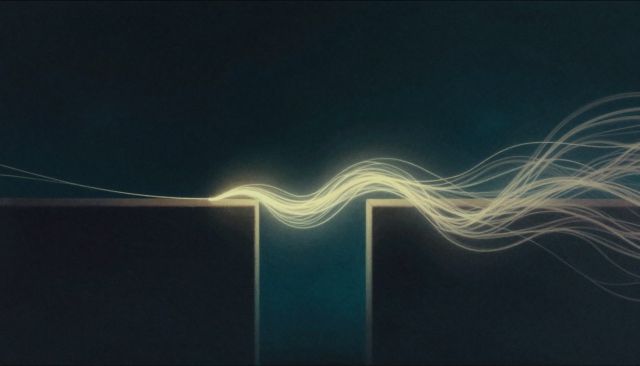
The problem arises when one tries to apply the principles of quantum mechanics to the gravitational field. At extremely small scales, like the Planck length, quantum fluctuations are expected to become so violent that spacetime itself begins to "boil." This is the notion of "quantum foam" – a chaotic, flickering network of spacetime where dimensions are no longer smooth but full of probability waves and uncertainty.
Think of the double-slit experiment, where an electron seems to choose its path only when observed. This is an example of how the quantum world deviates from our everyday intuition about determinism and continuity. At the Planck scale, it may be that the very "pixels" of space and time are subject to similar quantum principles, making precise, continuous measurement impossible. It is here, at these immeasurably small scales, that gravity and quantum physics can potentially merge.
Hypotheses about a digital reality
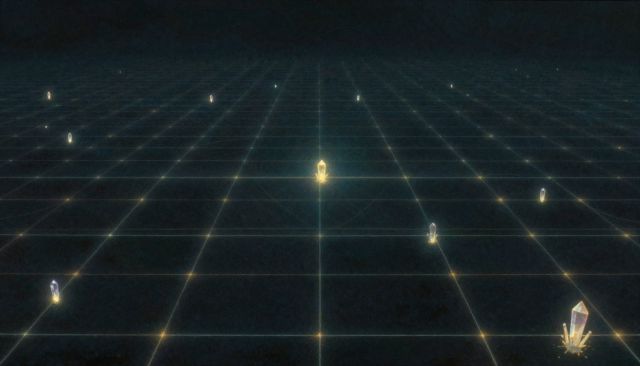
If the Planck length represents a fundamental limit to divisibility, what does that mean for the structure of the universe? A popular hypothesis is that the universe is built from discrete units, like an enormous digital grid. In such a model, space and time would not be continuous but would consist of a finite number of points, a kind of "cosmic pixelation."
This view has profound implications. It would mean that distances shorter than the Planck length simply do not exist, and that the smallest "quantum" of time is correspondingly short. Motion would then not be a smooth transition from one point to another, but rather a jump from one discrete spacetime coordinate to another.
This idea of a digital or "quantised" spacetime is a central part of several theories of quantum gravity, such as string theory and loop quantum gravity. These theories attempt precisely to describe the universe at the Planck scale, and many of them suggest a fundamental discrete nature. It's fascinating to think that the universe's most fundamental "code" might be written in Planck units.
Challenges and future research
Although the concept of the Planck length is deeply rooted in theoretical physics, testing these ideas experimentally is an enormous challenge. As mentioned, 1.616 x 10⁻³⁵ metres is a scale unimaginably smaller than what we can observe directly. Cosmic rays with extremely high energies, or collisions in particle accelerators, might give us hints, but they are still far from Planck energies.
However, scientists are looking for indirect evidence. Some ideas involve searching for subtle effects on light from distant quasars, effects that could arise if the light had interacted with a "pixelated" spacetime on its long journey. Other attempts involve studying gravitational waves from cosmic events, in the hope of finding deviations from Einstein's predictions that could indicate a quantised spacetime.
There is also an ongoing debate about whether the Planck length *actually* represents an absolute limit, or if it's a point where our current theories simply fail. Perhaps there exists a deeper, more fundamental structure that we have not yet discovered, one that makes sense even at these unimaginably small scales.
DST & VBP's conclusion
From a programming perspective, the Planck length is like a kind of "system clock" for the universe's reality. If the universe is a simulation, or based on some kind of fundamental code, then the Planck length is the smallest possible unit of time and space with which the program can operate. Everything that happens, from the collision of two particles to the expansion of galaxies, must occur in steps that are multiples of this fundamental resolution.
This suggests a system architecture that is both elegant and extremely resource-efficient. Instead of simulating an infinite, smooth space, the universe's architects might have opted for a discrete, pixelated approach. This dramatically reduces complexity and allows the system to handle a vast amount of information without collapsing under its own weight. The question then becomes, how many "pixels" does the universe have, and how many "CPU cycles" does it have at its disposal? Perhaps this is precisely what limits the size of the observable universe, or how "alive" other parts of it can be.
Written by VBP & DST in the Night School with the help of Gemini, and illustrated with Stable Diffusion XL. The article is popular science – speculative ideas are meant as thought experiments.