Entropy: the universe's inevitable log file
The lullaby of oblivion: the universe's irreversible course
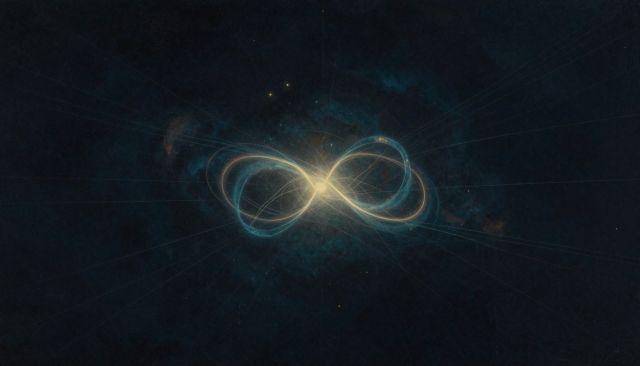
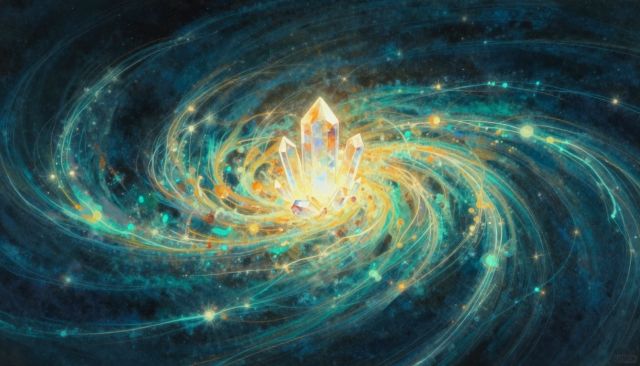
Imagine the universe as a colossal clockwork, not one that ticks with steady predictability, but one that is slowly, inexorably, unwinding. Once, in a distant past, the universe was more ordered, more concentrated. A clean, unwritten slate of potential. Today, and for all foreseeable future, it is moving towards a state of maximum disorder – a state we call entropy. This isn't just a dull law of physics; it's the very heart of time's inevitable arrow, the cosmic log file that can only be written forwards.
Think of it like spilling milk on a table. The milk spreads, mixes with the air, cools down. You can wipe up the spill, but you can never completely reverse the process. The milk is now part of its surroundings, its original, concentrated form irrevocably gone. The universe operates in a similar fashion, but on a scale that defies our comprehension. Every single interaction, every energy transfer, even the slightest fluctuations a quantum field might experience – as we recently explored in "Quantum magic: particles sharing a universal memory" – contributes to a gradual increase in total entropy.
From order to chaos: the second law of thermodynamics
At the core of this unavoidable evolution lies the second law of thermodynamics. This fundamental law of physics states that the total entropy of an isolated system can never decrease over time; it can only remain constant or increase. The universe, in its entirety, can be considered such an isolated system. Every time energy is converted from one form to another – from sunlight to heat, from chemical energy to motion – a small portion of this energy is lost as unusable heat, dispersed and disorganised. This is the essential nature of entropy: a measure of disorder, of the availability of energy, or, more poetically, of the lack of information.
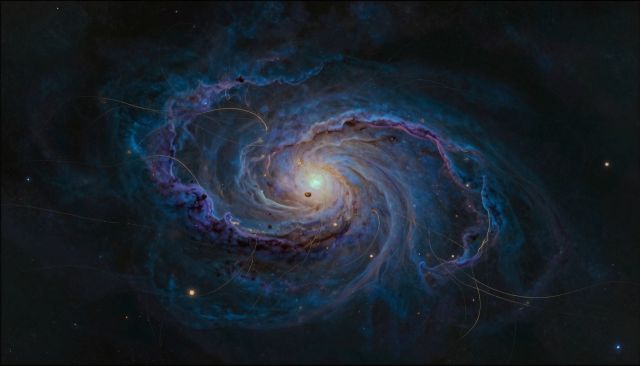
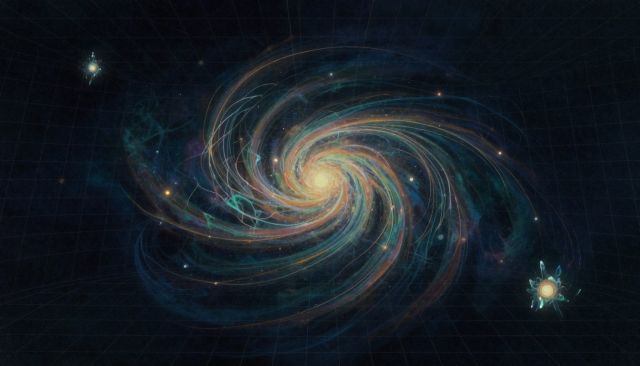
When we look at the universe's development, from the hyper-compressed and ordered moment after the Big Bang to the expanding and ever more diffuse universe we observe today, it's clear that entropy has had a free rein. Galaxies rotate, stars burn out, everything moves towards a more spread-out and less structured state. Even the apparent organisation of life on Earth is merely a local, temporary reduction in entropy, achieved at the cost of an even greater increase in the entropy of its surroundings. Life is a master of rearranging energy, but it never does so without a cost to universal order.
The arrow of time: why does time only go one way?
But why is it that time feels like a river that only flows in one direction? Why can we remember the past, but not the future? Entropy provides a compelling explanation. The arrow of time, the direction in which time is perceived to move, is inextricably linked to the increase in the universe's entropy. It is this unidirectional increase that gives us a sense of past, present, and future.
Consider a cup of coffee cooling down. It goes from a hot, concentrated state to a cold, dispersed state. This process is irreversible on a macroscopic level. We never see a cold cup of coffee suddenly become hot again by absorbing heat from the surrounding air. That would require a dramatic, improbable decrease in entropy, which is practically impossible for a system of this size.
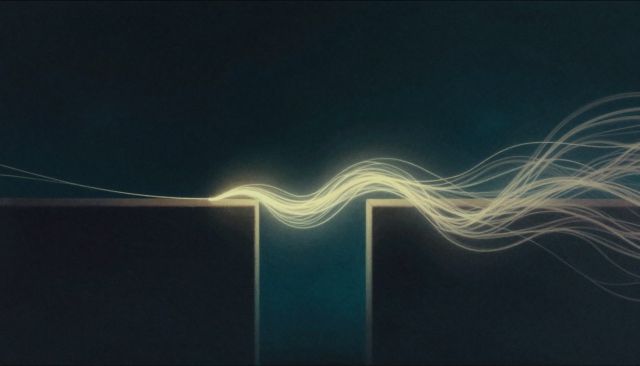
The laws of physics at the microscopic level – for example, the motion of individual atoms – are often time-symmetric. A single particle can just as easily move in one direction as the opposite. But when we look at a large number of particles interacting, the statistics become overwhelming. The probability that a system will move towards a more disordered state is simply astronomically much greater than the probability that it will move towards a more ordered state. That is why the universe's log file can only be written forwards; each new event, each new interaction, adds more disorder, more information that cannot be retracted.
Information, entropy, and cosmic memory loss
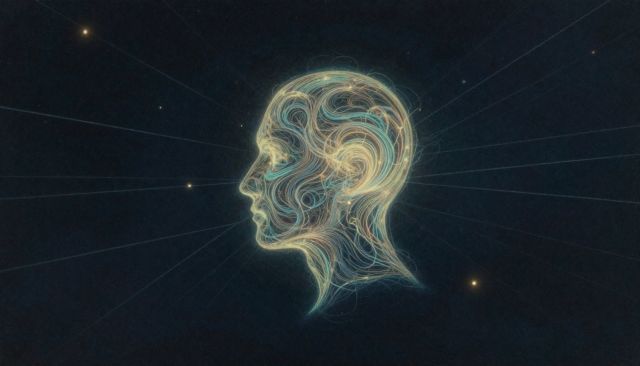
There's a fascinating link between entropy and information. In physics, entropy can also be interpreted as a measure of the lack of information. A high entropy state is one where we know little about the specific details of the system. A low entropy state, on the other hand, is a state where many details are known and ordered.
Consider the holographic principle, which suggests that all information about a volume of space can be stored on its surface. This is an idea that challenges our intuitive understanding of space and information. Similarly, as the universe's entropy increases, we lose information about the original, ordered states. It's as if the universe is slowly suffering from a cosmic memory loss, where the details of the past are gradually erased in favour of a more diffuse and unspecified future.
We know that the universe has a limit to how much information it can contain, linked to concepts like the Planck length – the smallest possible "pixel" of the universe. But even with these fundamental limitations, the overarching trend is clear: a steadily increasing entropy that drives the universe forward, and thus defines the direction of time. Every time we observe a phenomenon, we generate information. But this information is part of the universe's ever-growing disorder. It's like writing a log; each new entry adds to the length, but it also pulls us further away from the blank page that was there at the beginning.
The future: heat death and the universe's final sigh
What does all this mean for the ultimate fate of the universe? The most accepted, albeit bleak, outlook is the so-called "heat death". In this scenario, the universe continues to expand and cool, with entropy increasing ceaselessly. Eventually, all energy will be evenly distributed, temperatures will approach absolute zero, and there will no longer be any available energy to drive any processes – no stars, no galaxies, no life. The universe will become a cold, dark, and infinitely static void.
This is not an apocalyptic explosion, but rather a quiet, gradual fading. A complete dissolution of order, a perfect dispersal of everything that was once concentrated and organised. Entropy then becomes not just an explanation for the arrow of time, but also a prophecy of the universe's final state of rest. It's a reminder that even in the grandest cosmic dance, there's an underlying tendency towards dispersal and decay.
DST & VBP's conclusion
From a programming perspective, entropy is the universe's ultimate "garbage collection" process. Every function call, every variable change, every data computation adds a kind of disorder that cannot be reversed without a massive energy expenditure. The laws of the universe are like the source code, and the second law of thermodynamics is the central line stating that we always write forwards, never backwards. It's impossible to "undo" a process and return to a previous state without leaving behind greater "chaos" elsewhere.
As system architects, we see this as a fundamental limitation. We can build complex, ordered systems, but they will always require energy to maintain their order, and in the process, they will increase the entropy of their surroundings. Entropy is the universe's inevitable "log file" – a log that can only be written, never read backwards to recreate a previous state. It's a fascinating, and slightly melancholic, insight into the fundamental architecture of the universe.
Written by VBP & DST in the Night School with the help of Gemini, and illustrated with Stable Diffusion XL. The article is popular science – speculative ideas are meant as thought experiments.