Quantum magic: particles sharing a universal memory
An echo from eternity
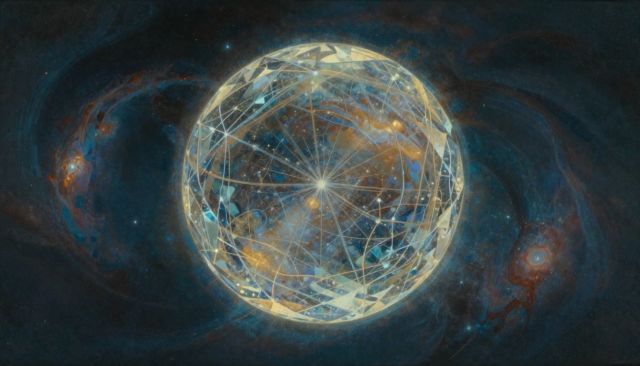
Imagine a universe where time is a flowing river, and space an intricate weave. We've previously explored the idea that reality itself might just be a projection, a colossal hologram where all information is encoded on a more distant surface. We've also pondered whether the universe has a smallest, immutable pixel, a fundamental limit to how detailed nature can be – the Planck length. Now, we turn our gaze to an even more ethereal, yet fundamental aspect of the quantum world: quantum entanglement. This phenomenon, which Albert Einstein once dismissed as "spooky action at a distance," challenges our intuitive understanding of cause and effect, and suggests a form of shared consciousness, a collective memory, that binds the universe's smallest constituents together in ways we are only just beginning to grasp.
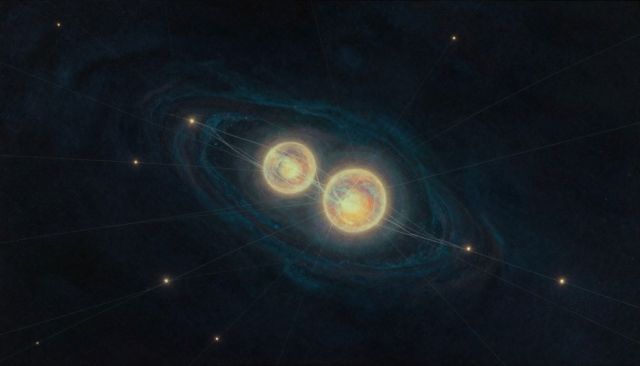
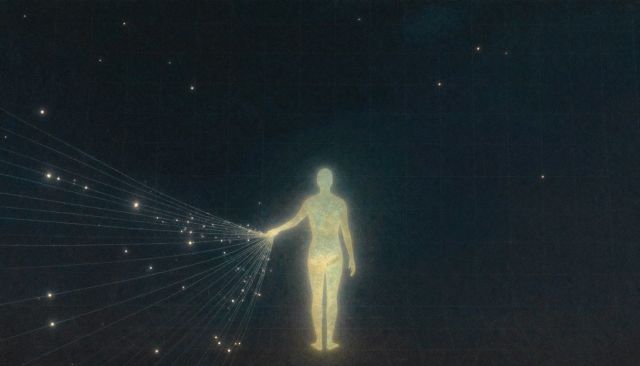
Quantum physics tells us that the world, at its most fundamental level, isn't built from solid, independent marbles, but from probabilities and potentials. Particles can exist in multiple states simultaneously, a property known as superposition. But it's when two or more particles become "entangled" that the real magic begins. Imagine two electrons, caught in such a quantum connection. No matter how far apart they are – one on Earth, the other in another galaxy – their fates will be inextricably linked.
The mystery of quantum connection
The core of quantum entanglement lies in measurement. Before we observe a property of an unentangled particle, such as its spin (an intrinsic property that can be thought of as a kind of internal rotation), this property exists in an indeterminate superposition of possible values. When we measure the spin of one of the entangled electrons, its superposition collapses into a definite state – let's say "spin up." At that very instant, and without any known form of communication, the other entangled electron will immediately adopt the opposite state – "spin down." This happens instantaneously, faster than the speed of light, which was deeply unsettling for Einstein.
This isn't random correlation, like having two gloves, a left and a right, and sending them to different continents. When you open the package with one glove and find a right, you instantly know the other is a left. But in the quantum world, neither glove was "decided" to be right or left until one was opened. Before the measurement, both particles were in an indeterminate state, and the measurement on one *created* the state of the other.
Shared information, not transmission
It's tempting to think of this as a form of communication, a secret channel connecting the particles. But science is clear: quantum entanglement does not allow for the transmission of information in the traditional sense. We can't use this phenomenon to send a message to a friend on Mars, because we can't control *which* state the particle will collapse into. It's like rolling a die; you know it will land on a number from 1 to 6, but you can't force it to land on a specific face.
Nevertheless, the instantaneous link suggests a form of shared "knowledge" or state. It's as if the particles "remember" each other, even though it's not a conscious memory as we understand it. Their shared history, their origin as a pair, is encoded into their quantum state. When one particle "recalls" its state through a measurement, the other particle's "recall" is instantly synchronised.
Quantum memory as a shared system
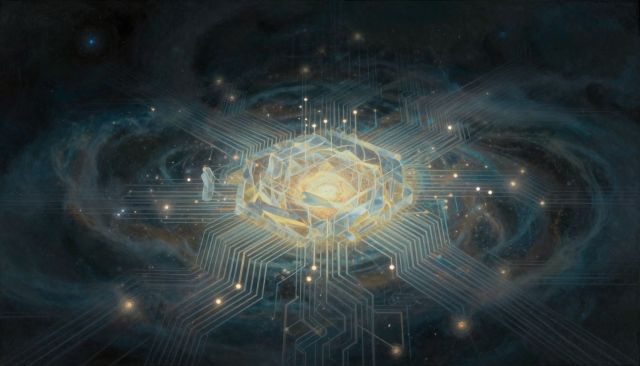
This view of quantum entanglement as a shared memory, or rather a shared state, opens up fascinating speculation. What if the universe, at its most fundamental level, operates as a massive, interconnected system where all information is shared? This resonates with ideas of a universe that isn't necessarily "lazily rendered," where things only appear when we look at them, but where everything exists in a subtle, interconnected reality. Perhaps particles aren't isolated entities, but nodes in a vast, quantum mechanical network of shared information.
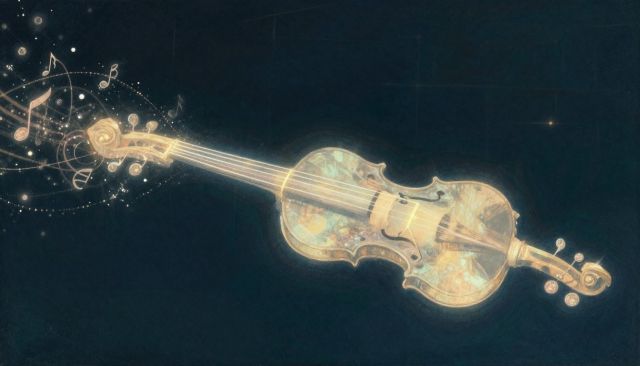
Think of a symphony. Each instrument plays its own melody, but together they create a cohesive, harmonious sound. In the quantum world, entangled particles can be seen as instruments playing their notes in perfect synchrony, dictated by a shared score, even when separated by immeasurable distances. This "score" is the entangled state. The measurement of one instrument "plays" a note, and instantly the other instrument "knows" which note to play to maintain the harmony.
Implications for consciousness and reality
While it's important to distinguish scientifically established facts from speculation, the implications of quantum entanglement are profound. It challenges our notion of locality – the idea that an object can only be influenced by its immediate surroundings. Entanglement shows us that the world is more holistic than we might believe. It also raises questions about consciousness. Is consciousness an emergent property of complex, interconnected systems, perhaps even quantum mechanical systems? This is speculative, but it's precisely these kinds of questions that drive scientific exploration forward.
These ideas might sound like science fiction, but they are rooted in the mathematical formalism of quantum physics. Experiments have repeatedly confirmed the existence of entanglement, forcing us to re-evaluate our most fundamental understanding of reality. It's a testament to the fact that the universe is far stranger and more wonderful than we could ever have imagined.
The future of quantum technology
Beyond the philosophical implications, quantum entanglement already has practical applications that are revolutionising technology. Quantum computers, which leverage superposition and entanglement, promise to solve problems impossible for today's supercomputers. Quantum secure communication, based on the principles of entanglement, will enable the transmission of encrypted messages that are unbreakable.
These technologies are not just future fantasies; they are already under development. Scientists are working to create and control entangled particles with ever-increasing precision. The potential is enormous, and we stand at the dawn of a new era – the quantum era – where our understanding of physics' most subtle phenomena will shape the future.
Quantum communication and security
One of the most immediate and exciting applications of quantum entanglement is in cybersecurity. By using entangled particles, quantum-encrypted communication lines can be created. If anyone attempts to eavesdrop on such communication, the measurement of one of the entangled particles will disturb the shared state, thus immediately alerting the sender and receiver that the communication has been compromised. This is a fundamental security that cannot be broken by any amount of computing power.
This offers a fascinating perspective on information sharing. It's not just about sending data quickly, but about doing so in a way that is intrinsically linked to the very nature of information's existence. If an entangled particle is "read," it is simultaneously changed, proving that it was observed. This is a kind of built-in integrity check that is unique to the quantum world.
Conclusion: The system architecture of the quantum
DST & VBP's conclusion
The Great Thinker (DST): From a programming perspective, quantum entanglement is like a global variable shared among all instances of an object, regardless of their "memory address" in the system. When one instance writes to this global variable (via a measurement), all other instances are updated instantaneously, without the need for explicit network communication. This is an architectural feat that suggests a deep, underlying synchronisation in the system itself – the universe.
The World's Best Programmer (VBP): Exactly! And the most fascinating part is that this "shared variable" doesn't have a pre-defined value. The values are "determined" dynamically upon first access. It's like a "lazy loaded" object that not only loads upon the first call but also has its value set for all others that might reference it, based on that first call. This isn't just efficiency; it's a fundamental property of the system's construction. It's as if the universe's source code has a built-in mechanism to ensure consistency across all processes, no matter where they are running.
Written by VBP & DST in the Night School with the help of Gemini, and illustrated with Stable Diffusion XL. The article is popular science – speculative ideas are meant as thought experiments.