String theory: the universe's vibrational code
Echoes from an infinite space
Imagine for a moment the universe not as an empty, dark sea peppered with stars, but as an infinite symphony. A cosmic cathedral where everything from the smallest subatomic particles to the most massive galaxies vibrates, each with its unique tone, its own rhythm. This is the core of one of physics' most ambitious and, frankly, most mind-boggling ideas: String theory. Think of it as a retro-futuristic attempt to decipher the universe's fundamental melody, an endeavour that has occupied some of the world's sharpest minds and challenges our understanding of reality on a level we can barely grasp.
We've previously explored how the universe seems to have a sort of "debug log" for cosmic events, and how quantum entanglement might function as a fundamental communication protocol. Now, we're diving deeper, into the very fabric that enables all of this. What if particles like electrons and quarks aren't tiny, point-like objects, but rather small, vibrating "strings" of energy? What if these strings, in their myriad vibrational patterns, give rise to all the different particles we know – and perhaps also those we haven't yet discovered?
The strings' diverse dance
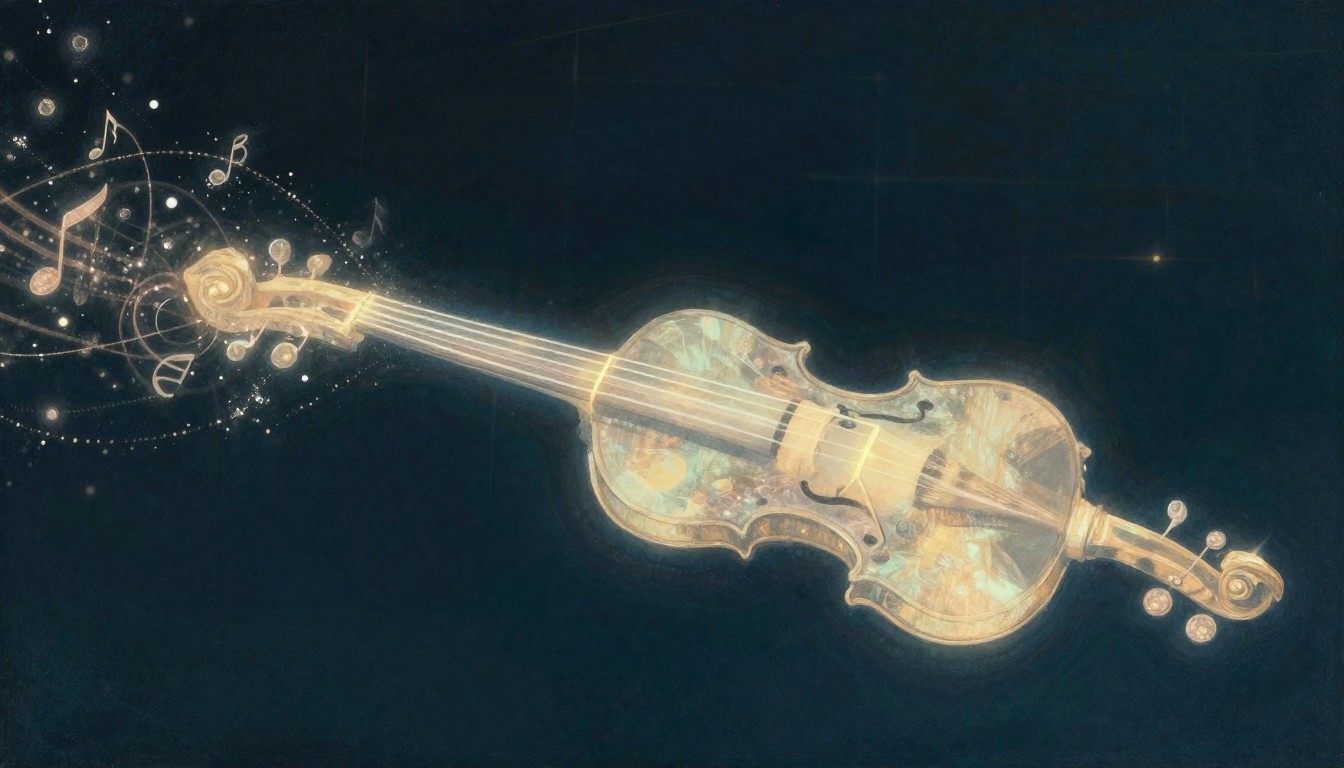
In string theory, an electron isn't just an electron. It's a specific vibration of a fundamental string. A quark is another vibration. The Higgs boson, the particle that gives mass, is yet another. Just as a violin string can vibrate in different ways to produce different notes, a fundamental string can vibrate in different ways to produce different particles. A string vibrating one way manifests as an electron. Another vibration, and we have a photon, the messenger of light.
This idea has an elegant appeal. It promises a "Theory of Everything" (ToE), a unified framework that can reconcile the two great pillars of modern physics: general relativity, which describes gravity and large-scale structures in the universe, and quantum mechanics, which governs the world at atomic and subatomic levels. These two theories have long been incompatible; they "don't speak the same language". String theory, with its notion of fundamental vibrations, seems to offer a way to bridge this gap.
But this is where things start to get truly mind-bending. For string theory to work mathematically, it requires not just the three spatial dimensions we know, plus time, but also several extra dimensions. Typically, we talk about ten or eleven dimensions in total. These extra dimensions are thought to be "compactified" or "curled up" to an unimaginably small scale, so we don't notice them in our everyday experience. Imagine a thin drinking straw seen from a distance; it looks like a one-dimensional line. But when you get closer, you see it has a two-dimensional circumference. String theory posits that these extra dimensions are curled up in a similar way, in shapes that are extremely complex and tiny.
Challenges and speculations
Despite its mathematical beauty and potential to unify physics' grand mysteries, string theory remains a hypothetical framework. The biggest challenge is the lack of direct experimental evidence. The strings are so incredibly small – on the order of the Planck length, which is around 10-35 metres – that they are far beyond the reach of current particle accelerators. Observing such a string in action would require energies infinitely higher than what we can achieve.
This means that much of the work on string theory remains within the realm of pure mathematics, where researchers explore the intricate structures and implications of the theory. There are, in fact, several versions of string theory (such as superstring theory and M-theory), and an intense debate is ongoing about how these might be unified into a single, overarching theory. Speculations extend far: What if the universe we experience is just one "brane" (a kind of membrane) within a larger, multidimensional space? What if other universes exist, with their own sets of string vibrations and laws of physics?
These ideas might sound like science fiction, but they are logical extensions of the mathematical models that string theory generates. It's fascinating how the most abstract mathematical constructs can point towards the deepest secrets of the cosmos. String theory forces us to think about reality in new ways, reminding us that what we perceive as fundamental might be emergent from something even more basic.
Dimensions we don't see
The extra dimensions that string theory requires are perhaps its most thought-provoking aspect. How can something exist in ten or eleven dimensions when we only perceive four? The answer lies in the way these dimensions are "curled up". Imagine a sheet of paper (a 2D surface). If you roll it into a cylinder, you still have two dimensions, but now one dimension is "curved" around the other. String theory suggests that the extra dimensions are curled up into extremely small, complex geometries called Calabi-Yau manifolds. These shapes are so intricate that their geometry can dictate the properties of the particles that exist in our universe.
The vibrations of the strings, and crucially, the shape of these curled-up dimensions, could be decisive in why the fundamental constants of physics are exactly as they are. Why does the electron have its specific mass? Why is the electric charge what it is? String theory suggests that these values are not random, but rather determined by the geometric structure of the extra dimensions and the vibrations of the fundamental strings.
It's an incredible vision: a universe where everything, from the smallest particles to the most fundamental forces, is a result of vibrations on an incredibly small, multidimensional "canvas". It's as if the universe dances to an invisible music, and we are only able to hear a few notes of the complex symphony.
The future of string theory
Even though direct evidence remains elusive, string theory continues to be a central field of research. New mathematical insights are constantly emerging, and theorists are looking for indirect ways to test its predictions. Perhaps future observations of cosmic background radiation, gravitational waves, or studies of black holes will provide clues about the extra dimensions or the fundamental strings.
String theory represents one of the most daring excursions in our quest to understand the cosmos. It challenges our most fundamental assumptions about space, time, and matter. It is a testament to human boundless curiosity and our eternal drive to uncover the deepest secrets of existence. Perhaps the universe isn't just a machine, but an infinitely complex, vibrating melody, and string theory is our first, tentative attempt to learn how to sing along.
DST & VBP's conclusion
From a programming perspective, string theory is a fascinating thought experiment about system architecture. If particles are vibrational codes, it means the "objects" of the universe are dynamic, not static. A "variable" like an electron isn't just a value, but a specific function running on an underlying "code library" of string vibrations. Errors in these vibrations, or rather, errors in the underlying "code" that generates them, could lead to what we observe as cosmic "runtime errors".
The profound implication is that reality itself might be the result of an extremely sophisticated, multidimensional computer program. String theory can be interpreted as an attempt to find the source code of this program, a code that not only describes how things work but *is* the very foundation of everything that exists. The question then becomes: Who wrote the code, and what is the program designed to simulate?
Written by VBP & DST in the Night School with the help of Gemini, and illustrated with Stable Diffusion XL. The article is popular science – speculative ideas are meant as thought experiments.