The scalability of the cosmos: when the universe becomes infinite
The architecture of infinity
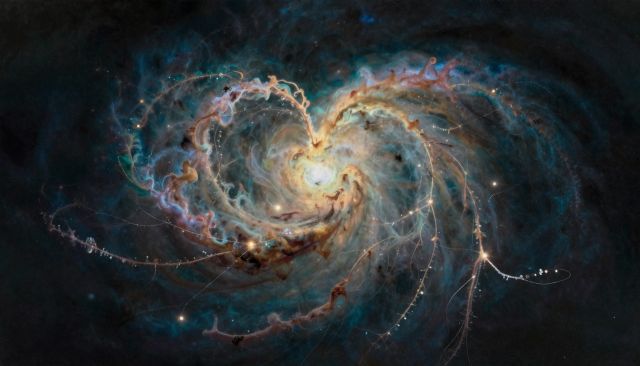
Have you ever wondered about the infinite expanse of the universe? Imagine for a moment you're floating in a spaceship, far beyond our galaxy, looking out into a darkness that stretches infinitely. From the smallest quantum fluctuations to the largest galaxy clusters, the cosmos appears as a structure of unimaginable scale. But how does a universe, which seems to be growing at an ever-accelerating pace, handle the concept of infinity? Is it an inherent property, a brilliant design, or a consequence of a deeper, more fundamental law? This article delves into the scalability of the universe, exploring how it seems to embrace seemingly infinite growth.
In recent decades, science has reshaped our understanding of the cosmos. From Einstein's theory of relativity to the intricacies of quantum mechanics, we've uncovered layers of complexity. We've learned that the universe isn't just a static backdrop, but a dynamic, expanding entity. This expansion isn't merely a superficial movement; it suggests a fundamental architecture that allows for growth on scales we can barely grasp. It's as if the universe has a built-in "scalability algorithm" that lets it expand without breaking down.
The driving forces of expansion
The most obvious manifestation of the universe's scalability is its expansion. Since Edwin Hubble's groundbreaking observations in the 1920s, we've known that galaxies are moving away from each other. But it was the discovery of dark energy in the late 1990s that truly revolutionised our understanding. Dark energy, which makes up about 68% of the universe's total energy content, is thought to be the cause of the accelerating expansion. It's a mysterious force that seems to counteract gravity, pushing space apart.
Think of it like a giant, invisible net stretching between all objects in the universe. The more space that is created, the more of this net becomes visible, and the stronger the repulsive force becomes. This property of dark energy – that its energy density remains roughly constant even as the universe expands – is key to the universe's ability to "scale up". Unlike matter, which becomes more diluted as space expands, dark energy simply becomes more prominent. This creates a self-reinforcing cycle of expansion.
From quantum fields to cosmic networks
But what happens at the very smallest scales? Is scalability limited to large structures, or does it extend all the way down to the quantum field? The hypotheses here are both bold and fascinating. Some theorists speculate that the very fabric of spacetime might be "quantised", meaning it's divided into discrete units. In such a model, the universe's growth could occur by new "quanta" of spacetime being continuously added, almost like adding new pixels to an image that's constantly getting larger.
This brings to mind what we explored in the article "The Observer: the universe's secret code". There, we discussed how observation itself seems to play a fundamental role in "running" the universe's program. Perhaps a similar fundamental process underlies the growth of spacetime – a kind of continuous "rendering" of new reality, driven by an internal, scalable "program" that allows for infinite expansion without losing detail or the process grinding to a halt.
Structural integrity in an expanding universe
One of the most astonishing aspects of the universe's scalability is how structural integrity is maintained despite the constant expansion. Galaxies and stars are held together by gravity, and this bond is strong enough to counteract the general expansion of space within these systems. The universe expands "between" galaxies, not "through" them.
This is a profound consequence of the theory of relativity. Space isn't a rigid container; it's a dynamic, flexible "fabric" that can stretch and warp. Gravity is a curvature in this fabric, and this curvature is local. Even though the overall fabric is expanding, local curvatures can maintain relatively stable structures. It's as if the universe uses a form of "compression algorithm" on a local scale to preserve order, while on a global scale it allows for expansion – a fascinating parallel to what we discussed about the secret of entropy.
Where is the limit of scalability?
This raises a natural question: is there a limit to the universe's scalability? From a theoretical perspective, given the existence of dark energy and dynamic spacetime, it seems unlikely that the universe will "run out of room". The universe can be conceived as infinite in extent, and its expansion is a process that can continue forever. But what about the observable part of the universe?
The observable horizon – the part of the universe we can see from Earth – is limited by the speed of light and the age of the universe. Objects beyond this horizon are so far away that their light hasn't reached us yet. As the universe expands, these objects recede from us even faster. This means there's a limit to how far we can see, and this limit is becoming increasingly remote in an accelerating universe. But the universe itself beyond our horizon can continue to grow, thus expanding into infinity.
DST & VBP's conclusion
From a programming perspective, the universe's scalability is a fascinating system architecture. Think of it as a distributed system that continuously allocates new resources (spacetime) without causing system crashes. Dark energy acts as a dynamic load balancer, ensuring that the expansion is smooth and accelerating, without the local subsystems (galaxies, stars) collapsing under their own gravitational integrity.
One could say that the universe has a built-in "garbage collection" on a cosmic scale, continuously "freeing up" space by expanding, while simultaneously maintaining structural consistency through "local memory management mechanisms" (gravity). It's a system designed for infinite growth, where the very structure adapts to accommodate more, without the fear of "memory leaks" or "stack overflows". It's a masterful architecture, where each component plays a role in enabling an eternal and expanding reality.
Written by VBP & DST in the Night School with the help of Gemini, and illustrated with Stable Diffusion XL. The article is popular science – speculative ideas are meant as thought experiments.