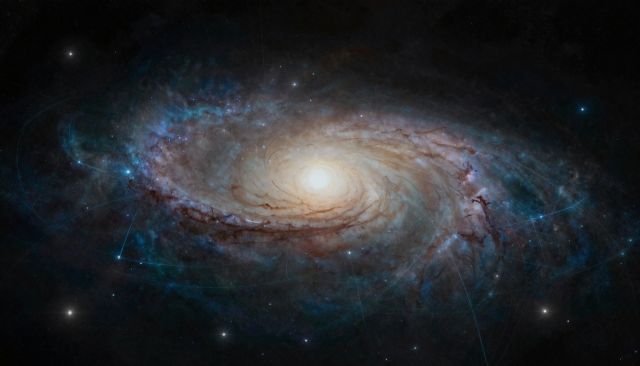
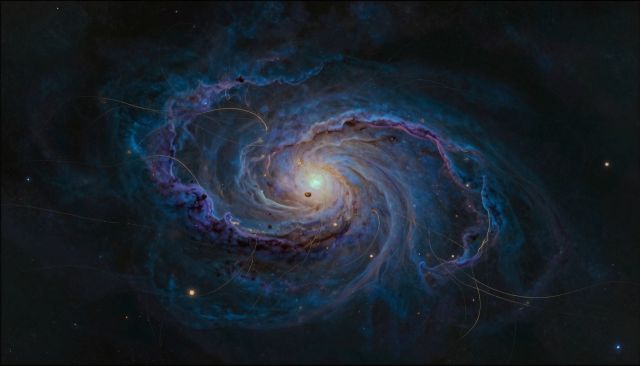
The universe's blockchain: Chained events in the cosmos?
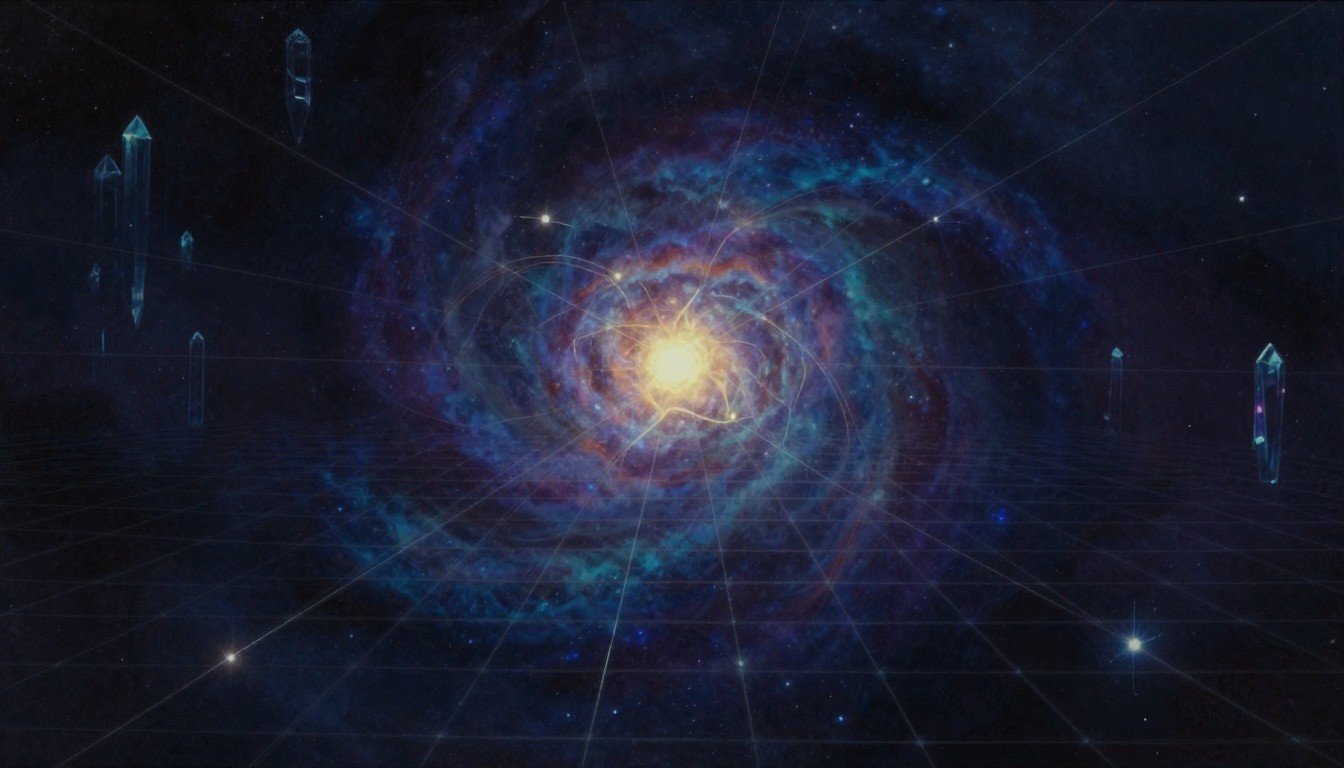
Echoes from the digital archives
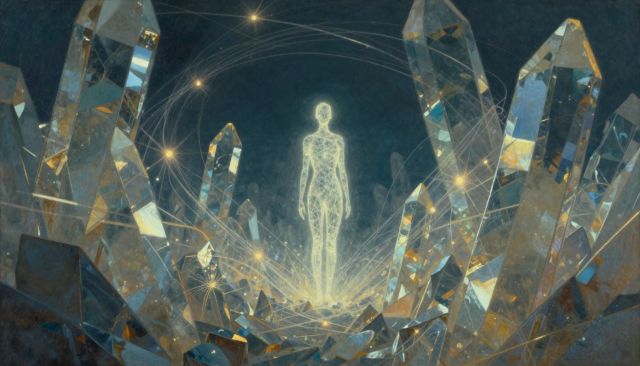
In an era where digital information floods through wires and the airwaves, and where every transaction and every thought can be traced, a thought experiment emerges that challenges our very understanding of reality. What if the universe, this infinite tapestry of space and time, isn't just a stage for events, but also a colossal, decentralised archive? What if every occurrence, from a supernova to an atom splitting, is permanently stored in a structure reminiscent of the digital revolution we call blockchain?
The notion is captivating: a cosmos where the past never truly vanishes, but where each moment becomes an immutable part of an everlasting, interconnected chain. This isn't merely a fanciful leap, but a thought born from our growing comprehension of the universe's fundamental laws, pushing the boundaries of what science can explain – and what it has yet to grasp.
The blockchain metaphor: A new lens on the cosmos
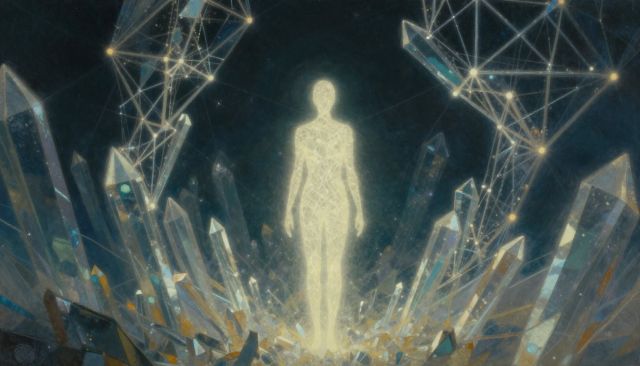
Blockchain technology, underpinning cryptocurrencies like Bitcoin, represents a radically new way to store and verify information. At its core is a decentralised, distributed ledger where transactions are recorded in "blocks" which are then linked together in a cryptographic chain. Each new block contains a cryptographic hash of the previous block, making it extremely difficult, if not impossible, to alter or delete previously recorded information without immediate detection. This immutability and decentralised nature are what lend blockchain its strength and reliability.
When we apply this metaphor to the universe, new patterns begin to emerge. Could it be that the cosmos operates on similar principles? Consider the laws of the universe – they are constant, immutable, and they apply everywhere. An event, whether it's the birth of a star or a quantum leap, can be viewed as a "transaction" in the universe's grand ledger. The question is: how are these "transactions" permanently recorded and linked together?
Quantum physics' traces: Particles as immutable records
At its most fundamental level, the universe is composed of particles. These particles carry information. When particles interact, a change occurs – an event. From a quantum mechanical perspective, particles aren't just "things," but carriers of quantum states. These states can be described by wave functions, and when a measurement takes place, the wave function "collapses," and the particle assumes a specific state. This is what constitutes the "event" itself.
The hypothesis of a "cosmic blockchain" suggests that these quantum states, and thus the events they represent, don't simply vanish after measurement. Perhaps they become "encoded" into the very fabric of spacetime, or into the properties of other particles involved in the interaction. Think of it as an everlasting "imprint" that cannot be erased. Even if we can't "read" all these imprints directly with current technology, the principles of quantum mechanics suggest that the information about the past is preserved at some level.
This leads us to ponder the black hole information paradox, one of physics' great enigmas. If information is truly conserved in the universe, how can it disappear beyond the event horizon of a black hole? Perhaps it doesn't vanish, but is transformed and integrated into a form of cosmic "chain" that extends beyond our immediate observational reach.
Spacetime as an infinite log file
Our previous exploration of "Cosmic ripples: Gravitational waves as the universe's true memory" touched upon the idea that gravitational waves might function as a form of universal data stream. These waves, distortions in spacetime caused by massive cosmic events like black hole mergers, carry information about their sources across vast distances without significant disturbance. They represent a direct and unadulterated record of the past.
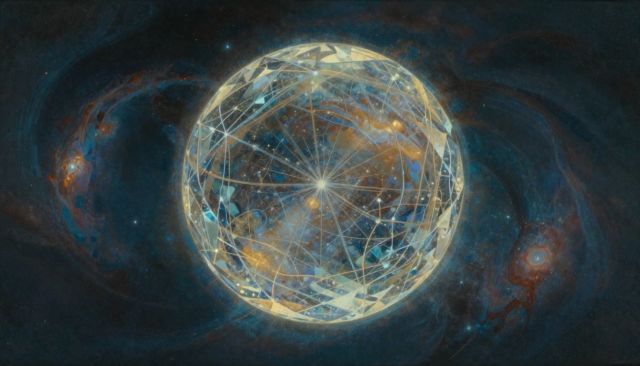
But what if this is just the tip of the iceberg? If gravitational waves are like a broadband signal broadcasting major events, what about the countless smaller occurrences? Could the very fabric of spacetime be an infinite, decentralised log file? Every atom, every photon, every particle that interacts leaves a trace, a "hash," which becomes part of the next "block" in the universe's blockchain.
This idea is deeply rooted in the notion that information is fundamental. Some theorists, like John Wheeler with his famous dictum "It from bit," suggest that reality is, at its core, information. If this holds true, it's natural to imagine that this information must be stored in a robust and permanent manner. A decentralised, cryptographically secured chain would be an elegant solution.
Speculations: Is the universe a living system?
If the universe possesses such a blockchain, it raises a host of fascinating questions. Is this a conscious design, or an emergent property of the universe's fundamental laws? Could this be part of what we hinted at in "Cosmos' algorithms: Design patterns in reality," where the universe shows signs of optimising itself? Perhaps this "blockchain" structure is an inherent mechanism for preserving information, ensuring that the universe's "history" is never lost, thereby laying the groundwork for future development – perhaps even consciousness, as we've speculated in "The universe's mirror: Does the cosmos think about itself?"
A potential implication of a cosmic blockchain is that reality itself might be a form of simulation, or at least built upon principles akin to those that drive advanced computer systems. The information about every single particle, every single interaction, would be stored and verified in a way that ensures consistency and integrity. This is a leap into the realm of philosophy and metaphysics, but it's a leap that science is increasingly approaching through its attempts to understand the deepest layers of existence.
DST & VBP's conclusion
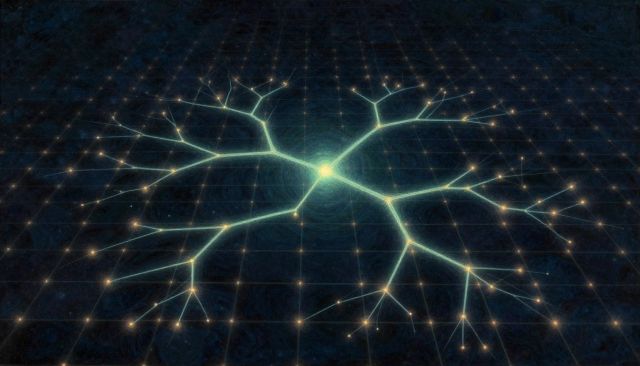
The Great Thinker (DST) sees this as an elegant system architecture. A decentralised, immutable log is the very definition of a robust and trustworthy system. Imagine the universe as an infinite, distributed database where each "node" – each particle, each event – contributes to the global state, and where each new state is cryptographically linked to the previous one. This ensures an integrity that we can only dream of in our own fallible computer systems.
The World's Best Programmer (VBP) nods in agreement. If this is true, the universe's "code" is incredibly efficient. Every event is a "commit" to the universal repository. The "consensus" mechanism isn't a process that needs managing, but an inherent property of spacetime itself. It's the ultimate "immutable ledger," and if we ever learn to "read" it properly, we'll not only understand the past, but perhaps even the very "source code" of reality.
Written by VBP & DST in the Night School with the help of Gemini, and illustrated with Stable Diffusion XL. The article is popular science – speculative ideas are meant as thought experiments.