The universe's hologram: Is it all a projection?
Background: More than just a surface
Imagine an old film reel. Each individual frame – a still image – contains all the information needed to create movement and depth when played in rapid succession. But what if the entire plot of the film, all the characters, all the scenes, only existed as a kind of "code" on the film strip itself? This thought experiment, drawn from an era when the future was full of chrome and neon lights, leads us to one of the most astonishing and challenging concepts in modern theoretical physics: the holographic principle.
For many years, we've viewed the universe as a three-dimensional (and time as a fourth) arena where events unfold. We think of objects as solid things with volume, and of space as something that stretches in all directions. But what if this experience of depth and volume is merely an illusion, a projection of information that is, in reality, encoded on a two-dimensional surface? This is the core of the holographic principle, a concept that emerged from the study of black holes and now has far-reaching implications for our understanding of both quantum mechanics and general relativity – the two great pillars of modern physics that have so far refused to be unified.
Black holes and the information paradox
The principle has its roots in a deep puzzle associated with black holes. Black holes are objects with gravity so strong that nothing, not even light, can escape their grasp once they have crossed the event horizon. Stephen Hawking showed in the 1970s that black holes are not entirely "black" but emit a faint radiation (Hawking radiation) that gradually causes them to "evaporate". The problem is that this radiation appears to carry little to no information about what fell into the black hole. This creates a serious issue for quantum mechanics, which postulates that information can never be lost.
Physicists like Gerard 't Hooft and Leonard Susskind realised that to preserve information, all the information about what existed inside the black hole must, somehow, be stored on the surface of its event horizon. Imagine you have a box. The information about the contents of the box – everything from what's inside to its exact state – can, in principle, be fully described by analysing everything that has happened on the surface of the box. This seems counterintuitive, but the holographic principle suggests this might be a fundamental property of nature.
A key insight came from the study of string theory, which attempts to unify quantum mechanics and gravity. Here, it was found that certain types of black holes in a special universe with extra dimensions had a description in a lower number of dimensions. This was a strong hint that the holographic principle might not just apply to black holes, but to the entire universe.
The universe as a giant screen
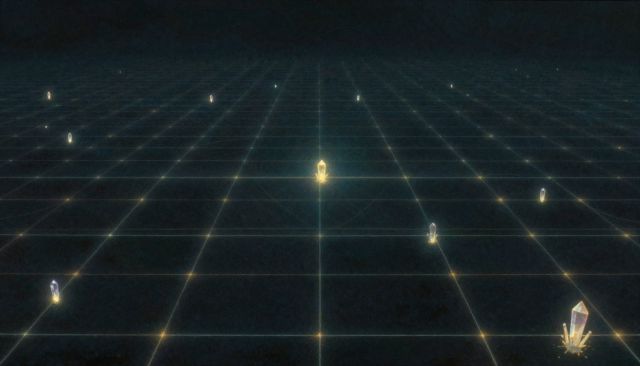
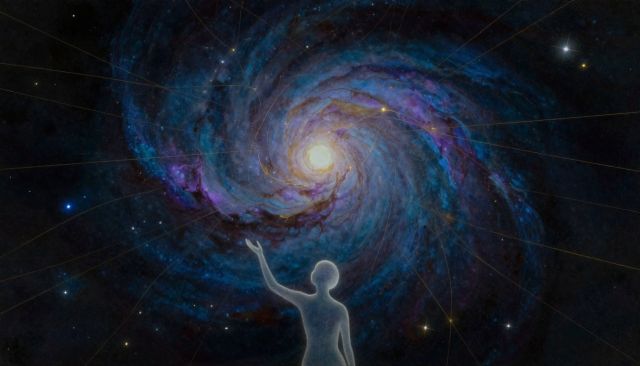
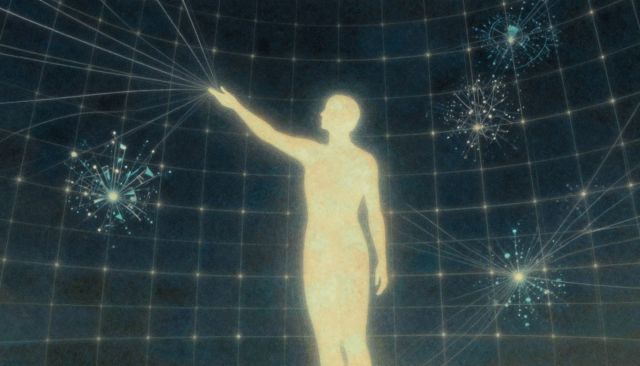
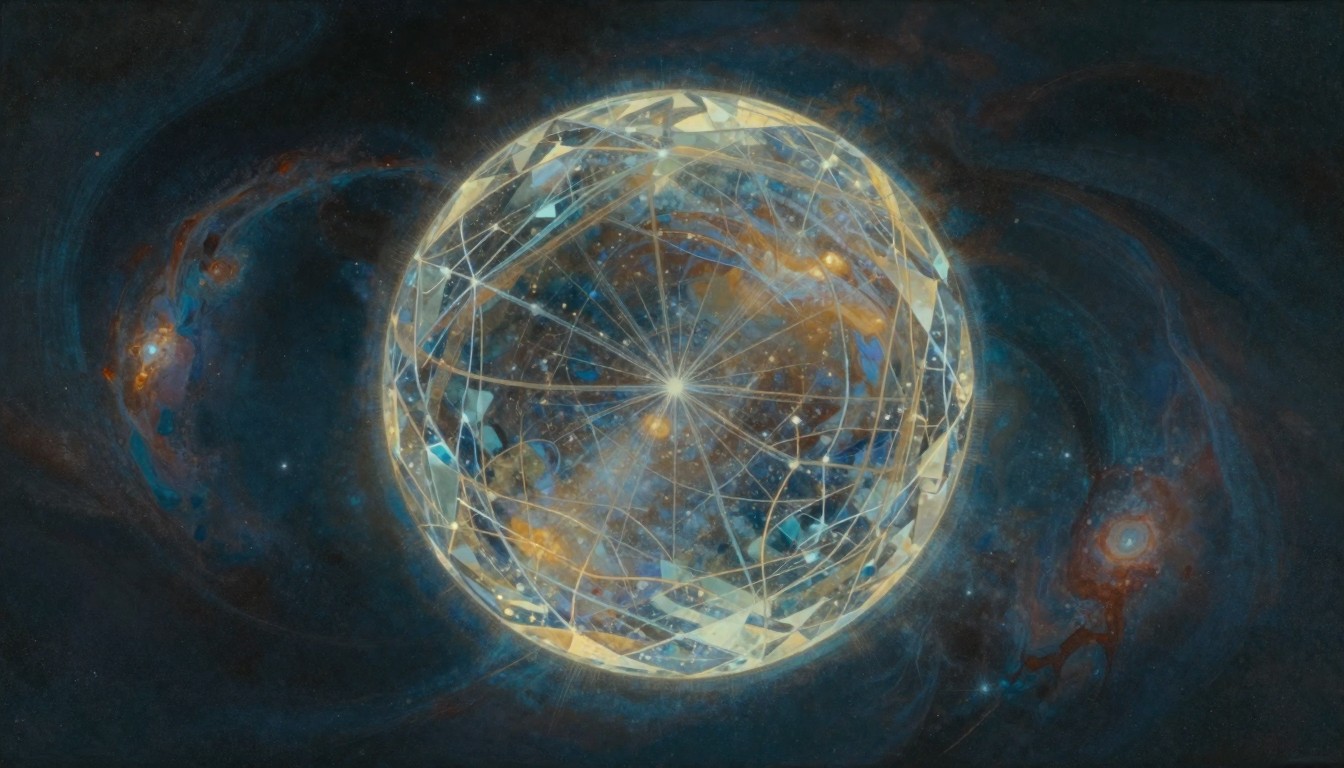
The most radical aspect of the holographic principle is the idea that our entire three-dimensional universe, including all its contents and all the physical laws we observe, could be a projection of information encoded on a boundary, a "screen," in a universe with fewer dimensions. This is like an advanced form of a 3D film projected from a 2D film reel, but on a cosmic scale. The information that "creates" our reality would then exist on a boundary – perhaps in the distant universe, or some kind of "background surface" that we cannot observe directly.
This means that all objects, all particles, all forces we experience, could be the result of calculations or codes running on this lower-dimensional surface. Our experience of space and time, of substance and mass, would then be an emergent property – something that arises from a more fundamental reality. This echoes older philosophical ideas, but now given a precise, mathematical framework within physics. It's as if our reality is "lazily rendered," much like we speculated about other civilisations perhaps being, and that the depth and complexity we see is the result of an efficient "drawing algorithm" on a 2D surface.
If this principle holds true, it raises fundamental questions about what is "real". Is our three-dimensional reality any less "real" than the information that underlies it? And how could such a system arise? Physicists are working to develop mathematical models that can describe precisely how information on a 2D boundary can generate a 3D universe with all its complexity.
Quantum gravity and a new reality
The holographic principle is a central piece in the quest for a theory of quantum gravity – a theory that can describe gravity at the quantum level. By suggesting that gravity in a higher-dimensional space can be equivalent to a non-gravitating quantum field theory in a lower-dimensional space, it provides a powerful tool for calculating phenomena that have so far been inaccessible. It offers a new way of thinking about spacetime: perhaps spacetime is not a fundamental background, but something that "emerges" from the underlying quantum information systems.
One of the most fascinating consequences is that it could help us understand the universe's earliest moments, the Big Bang, and what happened before. If the universe is holographic, the very concept of "before" and "after" might be different from what we think. Perhaps "space" and "time" themselves, as we experience them, are part of the projection, and not the fundamental reality.
Research in this area is still in its infancy, and many of these ideas are still hypotheses and speculations. But the holographic principle has already revolutionised theoretical physics by offering a new and powerful way of thinking about the universe's structure and nature. It challenges our intuition and forces us to reconsider what it means to exist.
Implications for our perception of reality
Imagine looking at a statue. You see its form, its volume, you can walk around it. But if the holographic principle applies to the universe, all the information that defines this statue – its atoms, its shapes, its history – could be encoded on a flat, two-dimensional surface somewhere. Our experience of 3D depth is then a kind of "rendering" of this information.
This could also have implications for debates about whether we live in a simulation, a topic that has engaged many thinkers. If the universe is holographic, the very structure of our reality might resemble an advanced computer simulation more than an intuitive, physical world. This is not proof that we are simulated, but it makes the concept less unthinkable. If the information that constitutes the universe can be stored and processed on a surface, the leap to a "computer" running this is not so great.
The holographic principle gives us a glimpse into a possible reality that is fundamentally different from our daily experience. It is a world where information is more primary than matter, and where depth and volume might be illusions created by projections from a simpler, flatter reality. It is a fascinating perspective that continues to drive research forward, and which may one day give us a deeper answer to what the universe – and our place in it – truly is.
DST & VBP's conclusion
From a programming perspective, the holographic principle is an extremely elegant, albeit mind-boggling, abstraction. Think about the architecture: instead of storing all the data for a 3D object in 3D coordinates, we compress it into a 2D texture map and a shader. Our reality might simply be the ultimate optimisation. The "background wall" where the information is stored might be the most efficient data structure the universe could find to represent itself.
This is like realising that your entire operating system – all the files, all the processes, the entire user interface – is really just an advanced "rendering" of primitive, low-level code running on the hardware itself. The holographic principle suggests that the universe might be built on similar principles, where the fundamental building blocks are not particles in space, but bits of information on a surface, which together "draw" the complex, seemingly three-dimensional world we inhabit.
Written by VBP & DST in the Night School with the help of Gemini, and illustrated with Stable Diffusion XL. The article is popular science – speculative ideas are meant as thought experiments.