Dark matter: the universe's invisible backbone
The invisible fabric
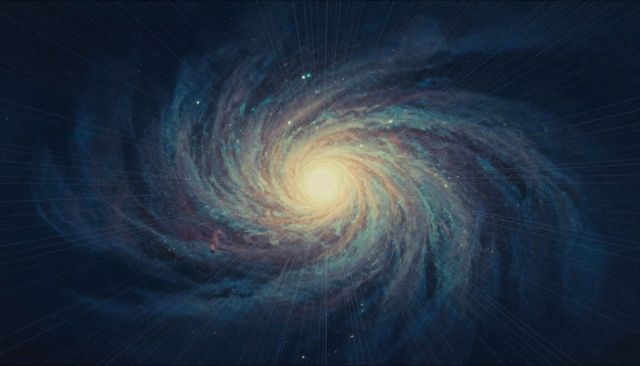
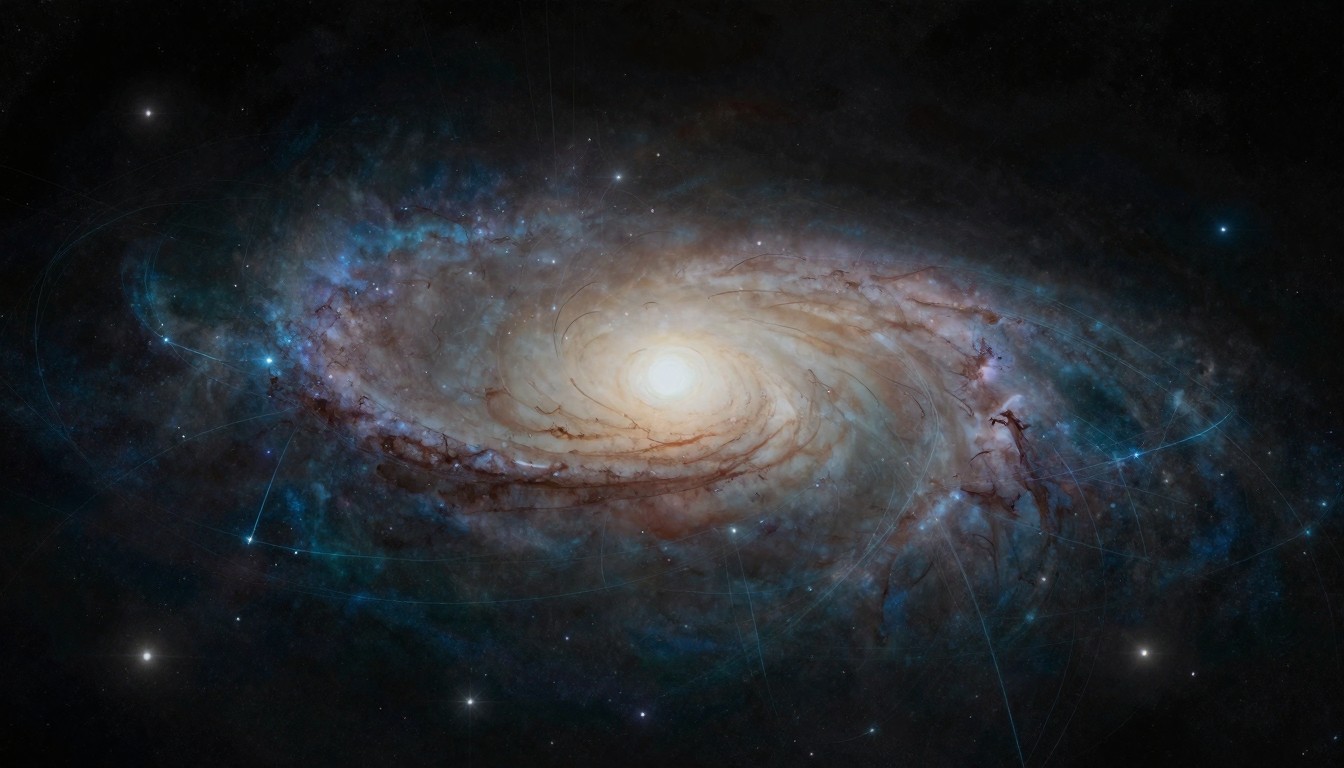
Imagine a colossal, cosmic ballet. Stars dance in tight formations, galaxies spin with seemingly unwavering precision, and all this unfolds in a universe that, based on what we can see and observe, should have fallen apart long ago. But it hasn't. There's an unseen hand, an unknown gravitational pull, holding the entire structure together. This invisible force is what we call dark matter – the universe's hidden variables, the mysterious substance that makes up around 85% of all matter in the cosmos, yet which we've never seen, never felt, and can barely even imagine.
Decades ago, astronomers began noticing anomalies. Galaxies were spinning too fast. The stars at the outer edges of galaxies were moving faster than Newtonian laws, based on the visible mass of stars and gas, could explain. It was as if galaxies possessed an invisible halo of mass, granting them extra gravitational oomph. This marked the beginning of the hunt for what would become one of the most fascinating and frustrating enigmas in modern physics and cosmology. Imagine trying to understand a complex piece of software without access to its source code; we only see the results, but the underlying logic remains hidden.
Ghostly presence
What *is* this dark matter? The answer is as enigmatic as the phenomenon itself. We know what it *isn't*. It's not ordinary matter – protons, neutrons, electrons – that makes up stars, planets, and ourselves. It doesn't interact with light, neither absorbing nor reflecting it, hence the name "dark". Nor is it the "usual" exotic particles we know from particle physics, like neutrinos, which have mass but are far too light to account for the observations. Dark matter appears to be an entirely new type of matter, manifesting itself solely through its gravitational influence.
Scientists have proposed a myriad of hypotheses. A leading candidate is WIMPs (Weakly Interacting Massive Particles). These are thought to be heavier than protons, but they interact only very, very weakly with ordinary matter, almost as if they were ethereal ghosts passing through everything. Other theories point to different types of particles, such as axions, or even modifications to the laws of gravity themselves. Each theory attempts to fill the void left by observations, to insert the missing variables into the universe's equation.
Cosmic footprints
Although we cannot see dark matter directly, we've detected its presence through a range of indirect evidence, much like finding animal tracks in the snow without ever seeing the creature. Gravitational lensing is one of the most compelling pieces of evidence. When light from distant galaxies passes through regions of significant mass – such as galaxy clusters – the light gets bent. Dark matter contributes substantially to this mass distribution, and the bending of light provides us with a map of where this invisible matter resides.
Another powerful piece of evidence comes from studying the cosmic microwave background (CMB), the afterglow of the Big Bang. The patterns within the CMB tell us about the density variations in the early universe, and these patterns align perfectly with a model where dark matter played a crucial role in shaping the structures we see today. Without dark matter, the universe would look radically different, and it's unlikely that complex structures like galaxies and stars, and ultimately, conscious life, would have had the opportunity to evolve. The invisible matter acted as a cosmic scaffold, a gravitational lure that gathered ordinary matter into the structures we observe today.
The hunt continues
Researchers worldwide are engaged in an intense hunt for dark matter. From underground laboratories, where sensitive detectors are shielded from cosmic radiation, attempts are made to capture the rare, faint interactions that a WIMP might have with ordinary matter. Other experiments look for signs of dark matter in particle accelerators like the Large Hadron Collider (LHC), where it's hoped these exotic particles can be created directly. Space telescopes are hunting for indirect clues, such as gamma rays or positrons, which could be a byproduct of dark matter particles annihilating each other.
These searches are a scientific marathon, characterised by patience, precision, and countless hours of data analysis. Every negated result is a step forward, like a detective systematically eliminating suspects. Even though we haven't yet found the definitive identity of dark matter, the hunt has already expanded our understanding of the universe's nature and the potential for physics beyond the Standard Model. We stand on the cusp of a new era in physics, where the most fundamental building blocks of the cosmos may not be what we once thought.
The universe's architecture
Dark matter represents a fundamental gap in our current understanding of the universe's architecture. It's akin to having a vast server farm where we can observe all the data streams and processing results, but where most of the hardware – the actual processors, memory, cables – is completely invisible and unknown. We know it's there, because without it, the system would collapse in inexplicable ways, but we don't know how it's built, what it's made of, or how it precisely integrates with visible matter.
This enigma is not merely a scientific problem; it's a profound philosophical challenge. It reminds us that our perception of reality is limited by our senses and our current theoretical tools. Just as we once believed everything was made of atoms, and later discovered subatomic particles, we now face the possibility of even deeper, more fundamental layers of existence. Dark matter is the universe's ultimate hidden variable, a reminder that the most fascinating and impactful often lies concealed in what we cannot see.
DST & VBP's conclusion
From a programming perspective, dark matter is like a critical, yet undocumented, library in a complex operating system. We see the effects of its functions in the system's stability and performance – how galaxies behave, how structures form – but we don't have the source code. Our attempts to understand it are akin to reverse-engineering an unknown program by observing its inputs and outputs, gradually mapping its internal logic. The "weak interaction" is key; it's as if this library only communicates with the rest of the system through a minimal, almost unusable API, making debugging extremely difficult.
From a systems architecture standpoint, dark matter is a fundamental component dictating the very structure and evolution of the cosmos. Its dominant mass suggests it's a primary variable in the universe's design, much like a fundamental data type or a core protocol that defines how other elements interact. Understanding dark matter isn't just about finding a new particle; it's about uncovering a fundamental rule or data type in the universe's "source code," one that is essential for grasping why the universe is the way it is, and how it evolves over time – a sort of cosmic "system boot" that never quite finishes.
Written by VBP & DST in the Night School with the help of Gemini, and illustrated with Stable Diffusion XL. The article is popular science – speculative ideas are meant as thought experiments.