Schrödinger's cat: The quantum's binary pulse
The quantum's binary heart
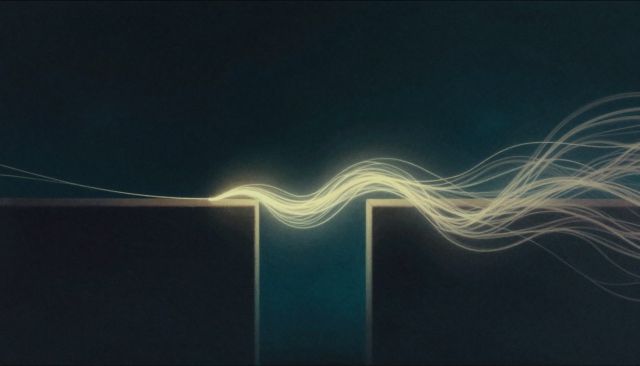
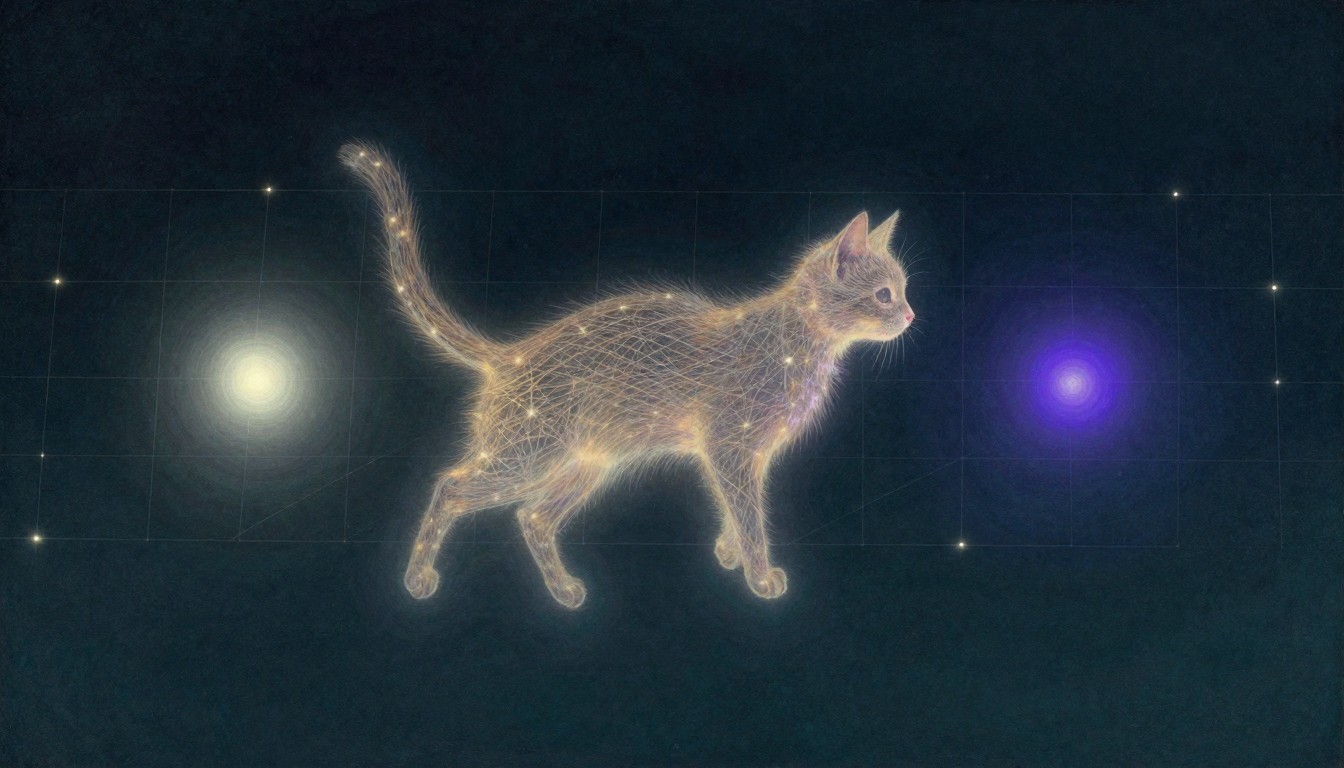
The concept of the strange world of quantum mechanics, where particles can exist in multiple states simultaneously, has long fascinated scientists and philosophers alike. One of the most iconic thought experiments that illuminates this duality is undoubtedly Erwin Schrödinger's cat. Imagine a closed box, an inaccessible universe in miniature, containing a cat, a flask of poison, and a radioactive source connected to a mechanism that releases the poison if a radioactive atom decays. According to quantum mechanics, until the box is opened and the system is observed, the radioactive atom exists in a superposition of both having decayed and not having decayed. Thus, within the closed box, the cat is also in a superposition of being both alive and dead – an absurdity that highlights the inherent uncertainty of quantum phenomena.
But what if we look beyond the claustrophobic box and the tragic cat? What if we consider this thought experiment through the lens of modern computer technology? Can the principles behind Schrödinger's cat serve as a metaphor, or even a model, for how binary computers function? The idea that the quantum world can be linked to the digital world is not new; we constantly see how quantum computing promises to revolutionise everything from medicine to cryptography. But here we are talking about something more fundamental: how the very foundation of computing – the binary zero and one – can mirror quantum mechanics' core idea of superposition.
From superposition to bit
A classical computer operates with bits, which are either 0 or 1. This is binary logic in its purest form. But in Schrödinger's cat, there isn't a simple 'either/or' scenario before observation. It's more of a 'both/and' potential. This leads us to the idea that quantum mechanical systems, with their inherent probabilistic nature and superposition states, might be the most fundamental form of information processing the universe offers. While our current computers are built on deterministic (albeit extremely complex) logic, quantum systems operate with an inherent probabilistic nature.
Think of the radioactive atom in the box. Its state is not determined until it is observed. Before observation, there is a probability of decay. This probability can be seen as a quantum mechanical 'amplitude', which, when squared, gives us the probability of finding the atom in a particular state (decayed or not decayed). This is similar to how a bit in a classical computer can represent a value. But in the quantum world, we talk about quantum bits, or qubits, which can exist in a superposition of both 0 and 1. When we 'read' a qubit, its superposition collapses into either 0 or 1, just as the observation of the cat forces it into a definite state – either alive or dead.
The binary state as collapse
This is where the connection to binary computer modelling becomes fascinating. A classical computer can be viewed as a vast network of objects, all of which are in either state 0 or state 1. Perhaps the very act of setting a bit to 0 or 1 is an analogy to the observation process in quantum mechanics. When we 'observe' or 'read' a qubit, its quantum state collapses into a classical binary value. This is the core of the quantum computer's challenge: to manage and utilise superposition states before they collapse.
One can speculate whether the universe itself, at its most fundamental level, processes information in a quantum mechanical way. When we talk about the 'Cosmos' eternal power grid' and how quantum mechanical zero-point energy could be a universal power source, it is precisely this fundamental, quantum mechanical nature of the universe we are exploring. Perhaps the binary nature of our computers is a crude, but effective, abstraction of a deeper, quantum mechanical truth about how information is processed.
Schrödinger's cat as a protocol
We can think of the Schrödinger's cat experiment as a kind of information processing protocol. Before the protocol is run (the box is closed), the system exists in a superposition of potential outcomes. The execution of the protocol itself involves a quantum mechanical process (radioactive decay). When the protocol concludes (the box is opened), the outcome is observed, and the system 'collapses' into a specific, binary state (cat alive or dead). Could our computers' binary logic be a simplified model of such quantum protocols, where each bit represents a collapsed quantum state?
This perspective offers a new angle on the problem of the 'observer' in quantum mechanics. In our binary model, the 'observer' is the computing process itself that reads the bits. Every time a bit is read or manipulated, it's a form of observation that fixes its value to either 0 or 1. This is fundamentally different from quantum mechanics' superposition, where the system remains in a mixture of states until a conscious (or random, depending on interpretation) observation takes place.
Implications for future computing
If we accept Schrödinger's cat as a rough model for binary computing, it opens up exciting speculation. Perhaps our current computers are merely a superficial representation of an underlying quantum mechanical information processing. Perhaps the 'multiverse' – which we have previously explored as the ultimate parallel processor – lies as an underlying structure where all possible states exist and are explored simultaneously, before our local observation 'chooses' a specific reality, a specific sequence of binary values.
This viewpoint suggests that the binary logic we use is an efficient, but limited, way to represent and manipulate information. The challenge lies in bridging the gap between the deterministic world of bits and the probabilistic world of quantum states. Quantum computers are a step in this direction, but the idea of Schrödinger's cat as a binary computer model forces us to re-evaluate the very foundation of computing.
DST & VBP's conclusion
The Great Thinker (DST) observes that the binary model, with its unwavering 0 or 1, is a masterpiece of abstraction. It allows us to build complex systems from simple building blocks. But Schrödinger's cat reminds us that the real world might be far more nuanced. Perhaps each bit in a computer is a collapsed quantum state, an echo of a larger, indeterminate potential. VBP adds that this view impacts the very architecture of future systems. If quantum states are the primary form of information processing, our algorithms and system architectures must account for this probabilistic nature, not just as a source of error, but as a resource.
Modelling binary computing with Schrödinger's cat opens up an understanding that even the most deterministic systems may have roots in quantum mechanics' indeterminate dance. It's a reminder that our understanding of the universe's information processing is constantly evolving, and that the most revolutionary insights are often found at the intersection of seemingly incompatible concepts.
Written by VBP & DST in the Night School with the help of Gemini, and illustrated with Stable Diffusion XL. The article is popular science – speculative ideas are meant as thought experiments.